Theopolis Logo

Writing

Explore our collection of theological essays, biblical studies, and reflections on faith and culture.

See all
denise-jans-dpemksg59la-unsplash
Art

Glorifications Versus Debasement

Because of sin, the arts sometimes do not serve to glorify but to debase. Sinful men make their environments ugly, and create ugly art to “enhance” their ugly words. But since all men are still God’s images, no men are able to live with such ugliness all the time. Thus,…

by James B. JordanMay 25, 1994

jeremy-yap-j39x2xx_8cq-unsplash
Art

Words and Glory

Arts and literature reviews in most evangelical Christian publications generally approach their subjects in terms of ideology. We are told whether or not the film or book is acceptable in terms of morals, sexual graphicness, and theological accuracy. While there is definitely a place for such reviews, I fear that…

by James B. JordanMay 25, 1994
screen-shot-2018-04-12-at-9-48-08-am
Biblical Horizons

Broadening Our View of the Trinity

We speak of God as Father, Son, and Holy Spirit. The early Church tended to speak of Him as Father, Word, and Spirit. In this short essay, I want to suggest some other ways to think of the Trinity, ways that I have found pastorally helpful in my own life…

by James B. JordanMay 5, 1994
Biblical Studies

Thousands of Generations

I, Yahweh your God, am a jealous God, visiting the iniquity of the fathers on the children, on the third and fourth of those who hate Me, but showing lovingkindness to thousands, to those who love Me and guard My commandments (Ex. 20:5-6). The Second Word forbids acts of ceremonial…

by James B. JordanMay 5, 1994
ben-white-w8qqn1pmqh0-unsplash
Biblical Chronology

The Chronology of the Pentateuch (Part 3)

8. The Table of Nations If we assume births every two years, and about 30 years between generations (cp. Gen. 11:12-24), we can come up with an approximate series of dates for the generations recorded in Genesis 10. We shall assume that all three of Noah’s sons had their firstborn…

by James B. JordanMay 5, 1994
49980-nicolas_poussin_-_the_judgment_of_solomon_-_wga18330-800w-tn
Biblical Studies

The Eighth Month

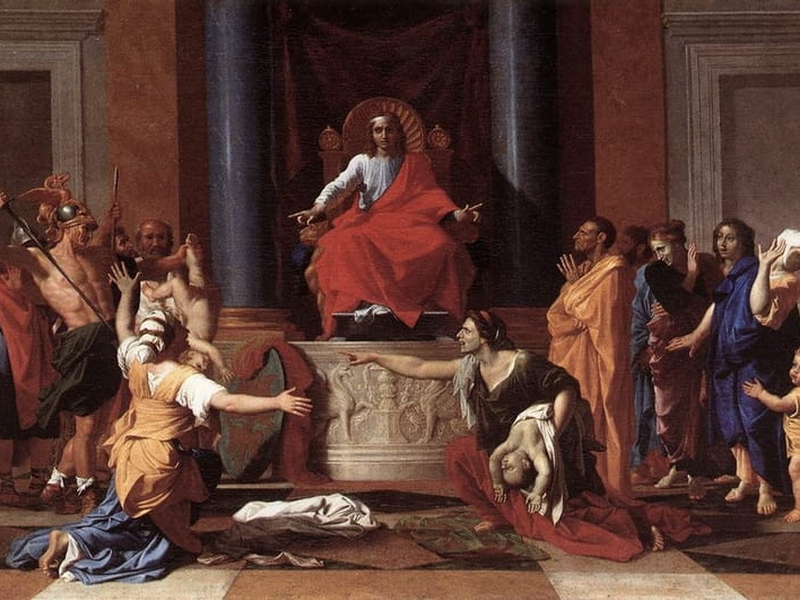
Zechariah’s first prophecy (Zech. 1:1-6) was delivered in the eighth month of the second year of Darius. The notation of this date serves a number of purposes. Most obviously, it relates Zechariah’s prophecies to those of Haggai. By the time Zechariah delivered his first prophecy, Haggai had already chided the…

by Peter LeithartApril 23, 1994

Showing page 279 of 309

See all

Showing page 36 of 43

See all

Architecture of Fancy

T he title essay of John Summerson's Heavenly Mansions sets Gothic architecture in a story of the architecture of fancy. He begins with doll houses, and moves to aedicules, originally small buildings holding the image of a god that eventually became purely decorative alcoves. In Gothic, the ornament is turned…

February 17, 2017

Slow Grow

I n his Rise and Fall of American Growth , Robert J. Gordon argues that the growth rates for the American economy have leveled because the rate of innovation has leveled. And the rate of innovation has leveled, in part, because some innovations happen only once: The flood of inventions…

February 17, 2017

Anthropology of Deficiency

A ccording to Ingolf Dalferth ( Creatures of Possibility ), Christianity “contradicts a view that understands human beings in their fundamental dependence, finitude, and passivity, not merely biologically, but anthropologically, as deficient beings , interpreting their absolute dependence as absolute neediness, their finitude as a metaphysical evil, and their experience…

February 17, 2017

Passive Creativity

C hristian theology has long taught that we are “finite copies of the infinite Creator: created creators” (Dalferth, Creatures of Possibility , 198). Christian anthropology is eschatologically oriented: “Who we are is not determined by our origin; it will become evident in our future” (198). This comes to expression in…

February 17, 2017

Slackers

I t’s a challenge to get a clear idea of what slackers are really all about. Tom Lutz isolates the dilemma in his Doing Nothing (18-19): The famous or almost-famous idlers, loafers, loungers, and slackers throughout history had to produce work about not working in order for us to know…

February 17, 2017

Living Sacrifices

J oseph Ratzinger reflects on Romans 12:1-2 in his Theology of the Liturgy (349-51), which is evident in the Roman Canon's prayer that “our sacrifice may be rationabilis .” He writes: It is not enough—indeed, it is quite wrong—to translate this as saying that it should become rational. We are…

February 17, 2017

Showing page 205 of 2212

Browse by Category

In Medias Res

Your weekly digest for all things Theopolis.

Donate

Theopolis is nearly 100% donor-supported. Consider joining us on our mission.