Theopolis Logo

Writing

Explore our collection of theological essays, biblical studies, and reflections on faith and culture.

See all
denise-jans-dpemksg59la-unsplash
Art

Glorifications Versus Debasement

Because of sin, the arts sometimes do not serve to glorify but to debase. Sinful men make their environments ugly, and create ugly art to “enhance” their ugly words. But since all men are still God’s images, no men are able to live with such ugliness all the time. Thus,…

by James B. JordanMay 25, 1994

jeremy-yap-j39x2xx_8cq-unsplash
Art

Words and Glory

Arts and literature reviews in most evangelical Christian publications generally approach their subjects in terms of ideology. We are told whether or not the film or book is acceptable in terms of morals, sexual graphicness, and theological accuracy. While there is definitely a place for such reviews, I fear that…

by James B. JordanMay 25, 1994
screen-shot-2018-04-12-at-9-48-08-am
Biblical Horizons

Broadening Our View of the Trinity

We speak of God as Father, Son, and Holy Spirit. The early Church tended to speak of Him as Father, Word, and Spirit. In this short essay, I want to suggest some other ways to think of the Trinity, ways that I have found pastorally helpful in my own life…

by James B. JordanMay 5, 1994
Biblical Studies

Thousands of Generations

I, Yahweh your God, am a jealous God, visiting the iniquity of the fathers on the children, on the third and fourth of those who hate Me, but showing lovingkindness to thousands, to those who love Me and guard My commandments (Ex. 20:5-6). The Second Word forbids acts of ceremonial…

by James B. JordanMay 5, 1994
ben-white-w8qqn1pmqh0-unsplash
Biblical Chronology

The Chronology of the Pentateuch (Part 3)

8. The Table of Nations If we assume births every two years, and about 30 years between generations (cp. Gen. 11:12-24), we can come up with an approximate series of dates for the generations recorded in Genesis 10. We shall assume that all three of Noah’s sons had their firstborn…

by James B. JordanMay 5, 1994
49980-nicolas_poussin_-_the_judgment_of_solomon_-_wga18330-800w-tn
Biblical Studies

The Eighth Month

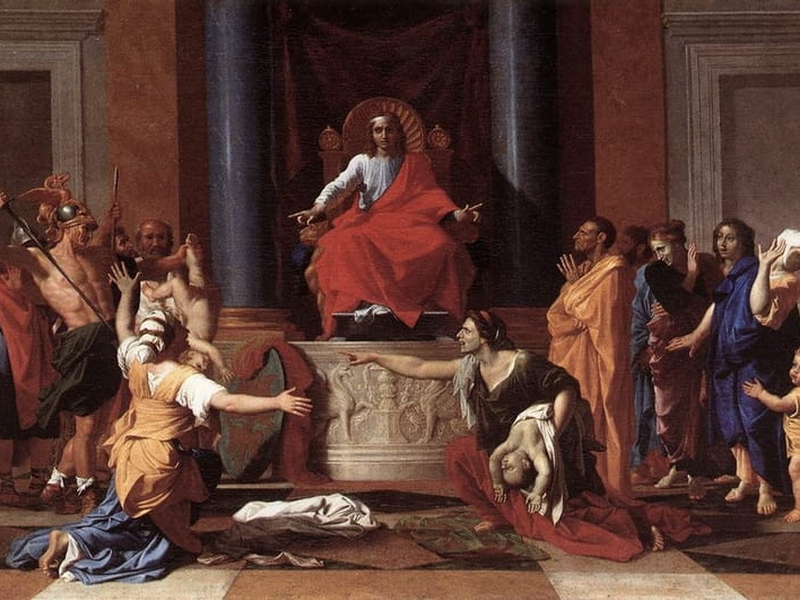
Zechariah’s first prophecy (Zech. 1:1-6) was delivered in the eighth month of the second year of Darius. The notation of this date serves a number of purposes. Most obviously, it relates Zechariah’s prophecies to those of Haggai. By the time Zechariah delivered his first prophecy, Haggai had already chided the…

by Peter LeithartApril 23, 1994

Showing page 279 of 309

See all

Showing page 36 of 43

See all

Classifying God

The “do Muslims and Christians worship the same God?” controversy surges on, reported most recently in the Economist . It's worth revisiting. In an earlier post, I charged that the claim that Muslims and Christians worship the same God (what I will call the “identity theory”) implicitly denies a central…

January 15, 2016

Empire with the Soul of a Church

In an article on Revelation, J. Daryl Charles observes that the Roman Empire “had brought about the ‘solution' - ‘salvation' for the human race - and was thus worthy of popular adoration. Empire-adoration necessitated a personal symbol which the ancient city-state could not generate. In the Imperial cult resided the…

January 15, 2016

Spaces of Apocalyptic

In his packed little book, Theology and the Spaces of Apocalyptic , Cyril O'Regan observes that “there seems to be a binary opposition in the modern world between apocalyptic and the discipline of theology” (15). Heterodox apocalyptic is everywhere, in Milton and Blake and Romanticism, among Hegelians, especially those on…

January 15, 2016

The Great City

G. Biguzzi asks whether the city “Babylon” (Revelation 17-18) represents Rome or Jerusalem. The first option was presented early, by Victorinus. He “(i) gives the circumlocution, ‘city of Rome,' as toe equivalent of Babylon: . . . ruina Babylonis, id est civitatis Romanae, (ii) identifies the seven mountains of Rev…

January 14, 2016

Anagogy in Modernity

Medieval biblical scholars read Scripture through the lens of the quadriga, fourfold sense of Scripture. Texts had a literal sense, an allegorical or Christological sense, a tropological or moral sense, and an anagogical sense. In his recent study of de Lubac, Between Apocalypse and Eschaton , Joseph Flipper focuses on…

January 14, 2016

How To Write An Introduction

Here's some seasoned advice to young scholars on how to write an introduction. 1. Write the book first. You don't know what the book is about until you finish it, and you can't introduce what you don't know. This may seem backwards, but it is inevitable, because a thing is…

January 14, 2016

Showing page 332 of 2212

Browse by Category

In Medias Res

Your weekly digest for all things Theopolis.

Donate

Theopolis is nearly 100% donor-supported. Consider joining us on our mission.