Theopolis Logo

Writing

Explore our collection of theological essays, biblical studies, and reflections on faith and culture.

See all
preston-goff-xncifslw0jw-unsplash
Biblical Theology

The Old Testament Precursor to the Pastor

WHAT IS THE OT PRECURSOR OF THE NT OFFICE OF PASTOR? HOW DOES THE FORMER ILLUMINATE THE LATTER? The first problem to address is: how do we know that there is an office of pastor in the New Testament? 1 Perhaps the way the question is put may permit me…

by Mark HorneJune 5, 1999

nasa-vhsz50aafas-unsplash
Biblical Horizons

The Geocentricity Question

[This essay was originally published in December, 1981, in The Biblical Educator , a publication of the Institute for Christian Economics, and again with slight revisions in Contra Mundum 7 (Spring, 1993). It is reprinted here as a supplement to my book Creation in Six Days .] In 1979, Dr.…

by James B. JordanJune 4, 1999
screen-shot-2022-05-12-at-12-07-23-pm
Biblical Horizons

Call Me Ishmael, Part 2

Anyone seeking to reverse the meaning of this promise needs to come to grips not only with the phrase "God was with the lad" later on, but also with Hagar’s response in 16:13. She worships Yahweh, putting her trust in Him and obeying Him. In fact, Hagar is at the…

by James B. JordanJune 4, 1999
aaron-burden-h8s0pf2rcqs-unsplash
Biblical Horizons

Call Me Ishmael, Part 1

Ishmael is the narrator of Melville’s fantasy-romance Moby Dick. Melville takes up the traditional view of Ishmael as a wayward son of Abraham, driven out solely because of the Divine "caprice" of election, an angry man with his hand raised against all other men. He is a fitting "anti-hero," or…

by James B. JordanMay 4, 1999
aaron-burden-1ebsmyrau-s-unsplash
Isaiah

Five Cities and Isaiah 19

There were five cities at the center of the Canaanite culture in the circle of the Jordan, a place like the Garden of Eden, like the land of Egypt, before it became the Dead Sea at the destruction of the cities (Genesis 13:10). Genesis 14:2 tells us their names: Sodom,…

by James B. JordanApril 4, 1999
phillip-medhurst-abraham-and-lot
Biblical Horizons

Lot

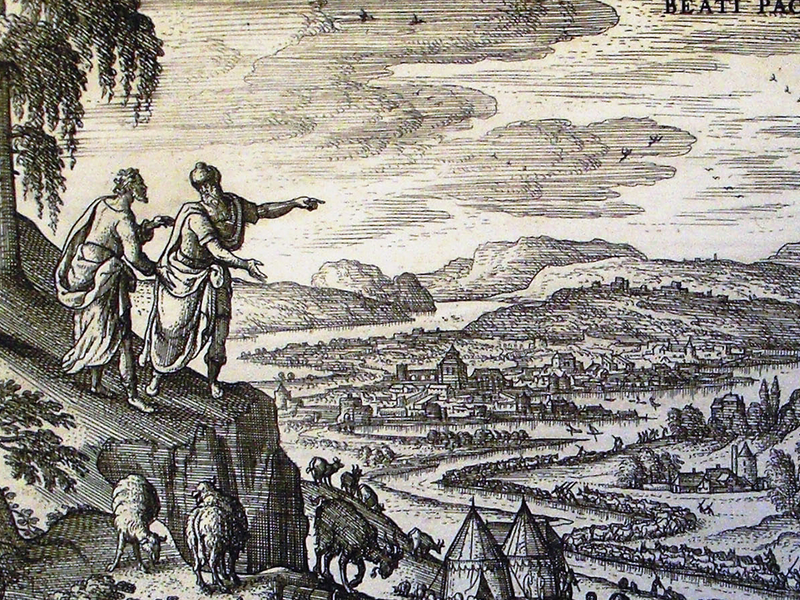
Meditations by James B. Jordan Genesis 19, the destruction of Sodom and the rescue of Lot, is part two of a story that begins in Genesis 18. These two chapters happen in one 24-hour period: noon and evening in Mamre, and midnight and daybreak in Sodom. God and two angels…

by James B. JordanApril 4, 1999

Showing page 244 of 309

See all

Showing page 36 of 43

See all

Circular Evolution

In his Natural History of Religion, David Hume proposes an evolutionary progress from natural polytheism to more developed monotheism. This, he thinks, is the natural and virtually inevitable progress: “As far as writing or history reaches, mankind, in ancient times, appears universally to have been polytheists” and idolaters. It makes…

March 11, 2014

Persistent Protest

Protestant problematics about sacraments still run in the background of early modern debates about religion. In response to evidence of similarities between Jewish and “savage” Indian religion, some early modern thinkers argued that the ritual similarities were marginal to Judaism. Some thought of Jewish ceremonies as a kind of prophylactic…

March 11, 2014

Jubilee: Real or Ideal?

Many scholars have concluded that the Jubilee legislation of Leviticus 25 is an idealized portrait of an institution that Israel never practiced. In a 2003 essay in Vetus Testamentum , Lee Casperson takes issue with this viewpoint: “There are extensive parallels in the ancient Near East, long predating the entry…

March 11, 2014

Reenacted Exodus

Leigh Trevaskis tries to suss out the rationale for sticking Leviticus 24 (menorah, showbread, blasphemy) between Leviticus 23 (Israel’s festival calendar) and Leviticus 25 (Jubilee). He proposes a symbolic solution to the puzzle. He observes that chapter 24 begins with a reverence to “light” (v. 2), alluding back to the…

March 11, 2014

Epistemological Dualism

Esther Lightcap Meek presents the most devastating little critiques of epistemological dualism I’ve ever read near the beginning of A Little Manual for Knowing . Epistemological dualism describes the way we “distinguish knowledge from beliefs, facts from values, reason from faith, theory from application, thought from emotion, mind from body,…

March 11, 2014

Righteous aggressors

Halbertal ( On Sacrifice , 72-3) offers this fine analysis of the self-justificating moves of aggressors: “The mind can play complicated games, and among them is the accusation that an aggressor directs toward his victim for causing him to become violent, which all too easily turns into a justification for…

March 10, 2014

Showing page 663 of 2212

Browse by Category

In Medias Res

Your weekly digest for all things Theopolis.

Donate

Theopolis is nearly 100% donor-supported. Consider joining us on our mission.