Theopolis Logo

Writing

Explore our collection of theological essays, biblical studies, and reflections on faith and culture.

See all
aaron-burden-h8s0pf2rcqs-unsplash
Galatians

The Restoration of the Galatians

While controversies over the writings of Paul continue in various corners of the intellectual globe, the word of God given through Paul and his scribe and all of the church’s interpreters and translators over the last two millennia is still readily available to the lofty and the lowly. Paul, as…

by Grace LangnessMarch 25, 2013

kiwihug-l4gw27xzn1i-unsplash
Deuteronomy

Law and History: How to Read the Law of Moses (Part 2)

The second in a series of studies in Deuteronomy. Deuteronomy 22:30: A man shall not take his father’s wife, and shall not uncover his father’s wing (Hebrew: kanaf ). There are a number of unusual features in this law that mark it out from the previous context, indicating that it…

by Ralph Allan SmithMarch 20, 2013
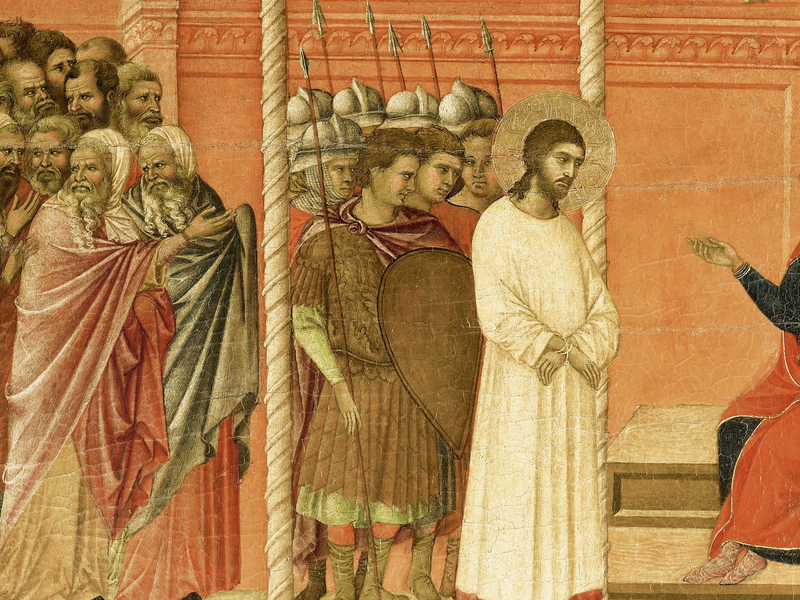
200403-moss-pilate-tease_pncfq5
History

Victimhood and the Gospel

The texts of Christianity have been slowly at work, under the power of the Holy Spirit for 2000 years now. If we could be magically transported back into the world of two millennia ago, modern Americans would be shocked at the cruelty of that world. There was no concern for…

by Richard BledsoeMarch 18, 2013
aaron-burden-1ebsmyrau-s-unsplash
Luke

The Dysfunctional Family of the Gadarene Madman

The Story of the Gadarene Madman is told in all three synoptic Gospels (Matthew 8:28-34, Mark 5:1-20, Luke 8:26-37). Jesus ventures into a Gentile area when He passes over the Sea of Galilee. Upon disembarking from his boat, he is immediately met by a demon-possessed madman. Upon meeting Jesus, he…

by Richard BledsoeMarch 13, 2013
aaron-burden-1ebsmyrau-s-unsplash
Deuteronomy

Law and History: How to Read the Law of Moses

Part 1 of a multi-part series of studies on Deuteronomy 22:30-23:8. Eric Auerbach, in his classic work on Western literature, devotes his first chapter to contrasting Homer with the Bible. Of Homer, he writes of the “need of Homeric style to leave nothing which it mentions half in darkness and…

by Ralph Allan SmithMarch 12, 2013
markus-winkler-aid-xyrtlec-unsplash
Theopolis News

James Jordan in Korea, Japan

Trinity House Fellow James B. Jordan will be a speaker at an International Conference on Biblical Symbolism that will be held in Seoul on Monday, May 27 in 2013. He will address "The Importance of Biblical Symbolism and Symbolic Interpretation of the Bible." The conference will have three other speakers…

by Peter LeithartMarch 9, 2013

Showing page 197 of 309

See all

Showing page 37 of 43

See all

Form and Type

It sure seems that the story of Joseph is a typological foreshadowing of the life of Jesus. Joseph is hated by his brothers; turned over to Gentiles; falsely accused; thrown into pit and prison; raised up, finally set on a throne, from which he gathers and distributes bread. Of course,…

March 5, 2015

Othering and Order

Jock Young ( Vertigo of Late Modernity ) discerns two sorts of “othering” in contemporary life: “the first is a conservative demonisation which projects negative attributes on the other and thereby grants positive attributes to oneself The second, very common yet rarely recognised, is a liberal othering where the other…

March 5, 2015

Fragmentation and Aestheticism

In several dense paragraphs in The Fragmented World of the Social , Axel Honneth describes the Gyorgy Lukacs's analysis of the fragmentation caused by capitalist society and the romantic reaction. There is, for starters, the fragmentation of the human being himself, induced by the capitalist separation of the worker from…

March 4, 2015

A World Beyond Morality

In his little book, Alone Again , Zygmunt Bauman summarizes his characteristic themes: We live in a liquid world, nothing permanent, nothing solid, nothing predictable. Typically pungent, Bauman points to “the overall tendency to dismantle, deregulate and dissipate the once solid and relatively lasting frames in which the concerns and…

March 4, 2015

Heifers, Serpents, Trees, Locusts

Jeremiah 46 is an oracle against Egypt, which, like Judah, is threatened by the advancing forces of Babylon. In the space of four verses (20-23), Jeremiah runs through a dizzying series of metaphors. Egypt is a pretty heifer (v. 20), and Nebuchadnezzar's army is a “horsefly” that is going to…

March 4, 2015

Making Selves Without Straw

The late Jock Young observes in his Vertigo of Late Modernity that our period is characterized by “a combination of factors, some long existing yet unique in their combination, others pre-existent yet transformed in the present period. The impact revolves around three axes, the disembeddedness of everyday life, the awareness…

March 4, 2015

Showing page 456 of 2212

Browse by Category

In Medias Res

Your weekly digest for all things Theopolis.

Donate

Theopolis is nearly 100% donor-supported. Consider joining us on our mission.