
Theopolis Logo

Writing

Explore our collection of theological essays, biblical studies, and reflections on faith and culture.

See all
jez-timms-8muutamcwu4-unsplash
Leviticus

Savage Judaism

​Should anthropological categories and tools be applied to Judaism? Seems a narrow and academic question, of interest to maybe ten people on the planet. It's one of the many virtues of Howard Eilberg-Schwartz's 1990 ​The Savage In Judaism to show that the question is a central one in the origins…

by Peter LeithartMarch 10, 2014
Leviticus

Obsessed with Sex?

Christians are often accused of being obsessed with sexual sin. Why can't two people, of whatever sex, do whatever they please in the enclosure of their own room? Who is hurt if a guy wants to get off looking at tantalizing pictures and videos on his computer? What's the big…

by Peter LeithartMarch 5, 2014
francesco_hayez_017
Mark

Binding and Loosing

“No one can enter a strong man’s house and plunder his goods, unless he first binds the strong man. And then he will plunder his house” (Mark 3:27 NKJV). Much commentary on the Revelation seems oblivious to its allusions to the Pentateuch (although there are many that do enlighten us…

by Mike BullMarch 3, 2014
Leviticus

Holiness, Ethics, Ritual

Leigh M. Trevaskis's 2011 monograph, Holiness, Ethics and Ritual in Leviticus , is an outstanding contribution to the study of Leviticus. His main thesis is directed at the world of Old Testament scholarship, in which there is a consensus that the ritual laws of Leviticus 1-16 come from a school…

by Peter LeithartMarch 1, 2014
6273e95e0f5ac766258d8cf3_joshuasconquestoftheland-2
Hermeneutics

Joshua Typology

Richard Ounsworth begins his Joshua Typology in the New Testament with an excellent discussion of what he calls "ontological" typology, which he handily summarizes in four points. Typology involves "correspondences between real historical events, personalities, institutions, etc. described in scripture," a correspondence that is discerned (not created) by the reader…

by Peter LeithartFebruary 26, 2014
alfons-morales-ylswjsy7stw-unsplash-1
Theopolis News

Book Release

Baylor University Press is sponsoring a reception to celebrate the official release of Peter Leithart's Gratitude: An Intellectual History . The reception will be held at the First Things offices in Manhattan on Thursday, March 6, at 6 PM. For more details, click here .

by Peter LeithartFebruary 26, 2014

Showing page 178 of 309

See all

Showing page 37 of 43

See all

History of Disgust

Norbert Elias’s The Civilizing Process traces modern standards of disgust and cleanliness to the development of court society during the Renaissance. Drawing on Elias, William Miller ( Anatomy of Disgust ) suggests sensitivity to disgust and being civilized are directly proportional. Martha Nussbaum ( Hiding from Humanity , 115-6) disagrees…

December 15, 2014

Islamic Revolutionaries

In his brilliant Earthly Powers (3), Michael Burleigh cites a passage from Tocqueville’s book on the French Revolution. Taking a note from Schiller about “how early modern religious wars spilled across political boundaries, which reminded Tocqueville of the ideological struggle between Jacobins and counter-revolutionaries in late-eighteenth-century Europe,” Tocqueville drew a…

December 12, 2014

Sacrificial Politics

Semyon Frank was a Russian emigre to London. Michael Burleigh ( Sacred Causes , 39) sums up his life: “Born in 1877 into a Russian-Jewish family, he had quickly outgrown a juvenile Marxism, converting to Orthodox Christianity in 1912, on the ground that the Jewish God was as remote from…

December 12, 2014
Modernity

Un-Secular Age

Our secular age can be sustained only if the secular has been carefully distinguished from the sacred, and only if the boundary between the two is vigorously, not to say violently, guarded. But boundary-drawing between the sacred and profane is the work of a priest. It is the sacred act…

December 12, 2014

Pure Aesthetics

Hugh Grady opens his Shakespeare and Impure Aesthetics (6-10) with a brief and illuminating discussion of Kant’s aesthetics of purity. By “pure” here is meant the freedom of aesthetic experience from cognitive reason and teleological judgments, from practical or moral interests. This disinterested experience of art is an encounter with…

December 12, 2014

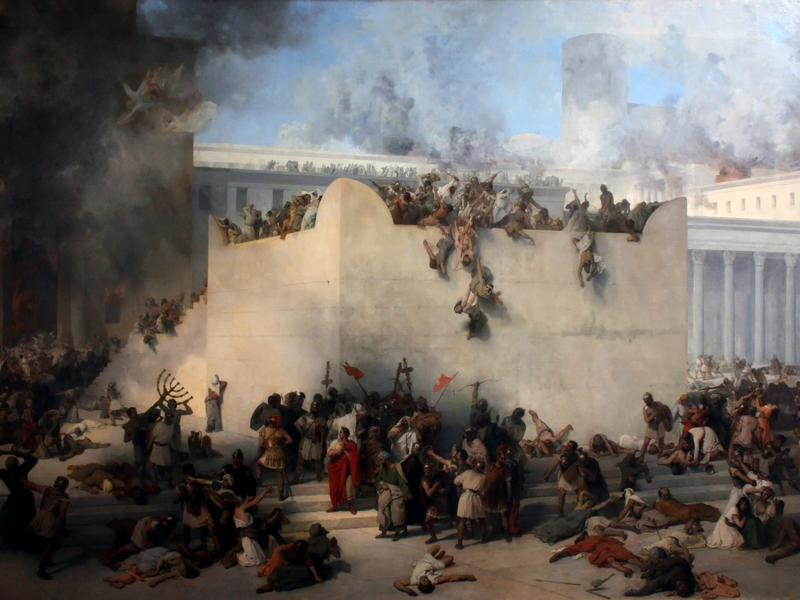
After the Temple

Jonathan Klawans is a great one for cutting through nonsense. In his Purity, Sacrifice, and the Temple , he points to the oddity that “documents composed three, four, or even five centuries after the destruction are labeled as delayed responses to the destruction. . . the suggestion that it took…

December 11, 2014

Showing page 487 of 2212

Browse by Category

In Medias Res

Your weekly digest for all things Theopolis.

Donate

Theopolis is nearly 100% donor-supported. Consider joining us on our mission.



