Theopolis Logo

Writing

Explore our collection of theological essays, biblical studies, and reflections on faith and culture.

See all
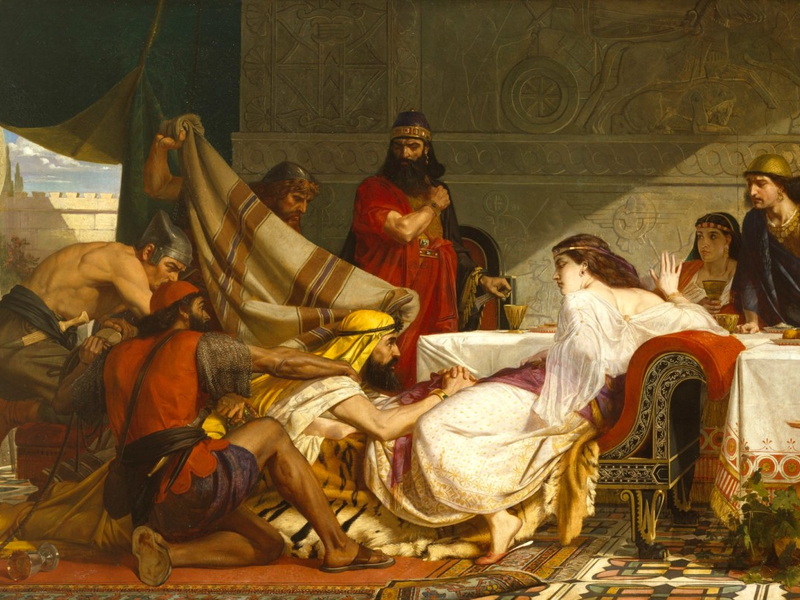
armitage-edward-the-festival-of-esther
Biblical Studies

Esther and Ruth, Grain and Fruit

1 Introduction ESTHER and RUTH are similar stories. Each details the changing fortunes of a young woman. Each begins with the protagonist in a destitute situation. The fortunes of each reverses by story’s end. Intriguing parallels exist: Scenes : The stories transition through a similar set of scenes, see Table…

by Scott FairbanksApril 29, 2021

dariusz-sankowski-abamxzlot8e-unsplash
Biblical Studies

A Hermeneutic of Riddles

Maybe this is not the best venue to reveal that I sometimes wonder about all that deep exegesis: the chiasms, the numerology, vowel modifications, the typological labyrinthes, the innumerable exodus patterns that are so often limned by Peter Leithart or James Jordan or Alastair Roberts. Maybe it’s because I am…

by John AhernApril 27, 2021
fabian-keller-kqjpiatm-om-unsplash
Culture

Building New Watchtowers

In 1923, J. Gresham Machen wrote the book he is perhaps most remembered for, “Christianity and Liberalism”. Machen wrote it to help map out the cultural currents that were impacting the church with the hope that the church could be vigilant against the dangers theological liberalism posed to historic Christianity.…

by Steve GreggApril 22, 2021
download
Matthew

THE ANNUNCIATION TO JOSEPH | (Matthew 1:18-25)

March 25, nine months before Christmas, is the date that is often associated with the Annunciation to Mary, Gabriel’s announcement to Mary that, by the coming of the Spirit upon her, she would conceive and bear the heir to David’s throne, whose kingdom would have no end. The story is…

by John BarachApril 20, 2021
screen-shot-2021-04-14-at-8-50-22-am
Book Review

Book Review: Race and Covenant: Recovering the Religious Roots for American Reconciliation

Race and Covenant: Recovering the Religious Roots for American Reconciliation , edited by Gerald R. McDermott (Grand Rapids, MI: Acton Institute), 278 pp. A group of notable thinkers gathered to discuss biblical resources for addressing racial conflict in America in February 2019 at Samford University in Birmingham. Race and Covenant…

by Ben PetersonApril 15, 2021
beyond-creation-science-illustration
Matthew

Full Preterism’s Fatal Fractal Fracture

“Covenant Creationism,” which might be the most consistent brand of full preterism, is merely dispensationalism turned inside-out. The main cause of disputes over the interpretation of the Scriptures is the practice of interpreting texts in isolation. This applies not only to interpreting a passage without reference to other passages, but…

by Mike BullApril 13, 2021

Showing page 56 of 309

See all

Showing page 38 of 43

See all
History

Converted Jerusalem

In his fascinating Rise of Christianity , Rodney Stark cites estimates that there were between 10,000 and 20,000 inhabitants of Jerusalem in the first century. Stark uses this to falsify Luke’s claims that there were 5000 Christians in Jerusalem (Acts 4:4) and “many thousands” of Jews (Acts 21:20): “Had there…

March 30, 2007

Hebraic hermeneutics

One Rhonda Wauhkonen discusses Nicholas of Lyra’s “Hebraic” semiotics and hermeneutics in a 1992 article on Chaucer. She begins by contrasting Augustine’s signum/res distinction to Lyra’s Hebraic viewpoint: “In the Hebrew system as evidenced in Scripture and as adapted by Nicholas, such stratification of signification did not exist, for the…

March 29, 2007

Last and first

Nicholas of Lyra is known for his notion of a “double literal” sense to Scripture. For him, interpretation ad litteram includes both the historical and the doctrinal/christological senses, and he suggests that the ancient Hebrews could well have seen the Messianic sense as the literal sense. He also suggests that…

March 29, 2007

Nicholas of Lyra’s afterlife

In Book 3 of Gargantua and Pantagruel, Rabelais attributes an odd opinion to the 14th-century exegete, Nicholas of Lyra: “Pantagruel, having wholly subdued the land of Dipsody, transported thereunto a colony of Utopians, to the number of 9,876,543,210 men, besides the women and little children, artificers of all trades, and…

March 29, 2007

Nicholas of Lyra’s afterlife

In Book 3 of Gargantua and Pantagruel, Rabelais attributes an odd opinion to the 14th-century exegete, Nicholas of Lyra: “Pantagruel, having wholly subdued the land of Dipsody, transported thereunto a colony of Utopians, to the number of 9,876,543,210 men, besides the women and little children, artificers of all trades, and…

March 29, 2007

Thomas on the Parable of the Workers

Steinmetz summarizes Thomas’s remarkably “NTWrightian” commentary on Matthew 20:1-16. While acknowledging an Origenist tradition that sees the hours as moments of an individual life, Thomas is more interested in the Irenaean tradition that interprets the parable in terms of redemptive history: “The hours mentioned in the parable are not stages…

March 29, 2007

Showing page 1699 of 2212

Browse by Category

In Medias Res

Your weekly digest for all things Theopolis.

Donate

Theopolis is nearly 100% donor-supported. Consider joining us on our mission.