Theopolis Logo

Writing

Explore our collection of theological essays, biblical studies, and reflections on faith and culture.

See all
blocks-t3mkjxfdims-unsplash-2
Advent

Advent and Christmas Music Recommendations

Inspired by our recent podcast on Christmas and Advent music recommendations, we offer here a list of excellent recordings that are sure to enrich your Advent and Christmas season. Praetorius: Mass for Christmas Morning Paul McCreesh with the Gabrieli Consort and Players Amazon | Spotify | Apple Music 2. Christmas…

by John Ahern and Paul BuckleyDecember 23, 2020

sasha-stories-c6g-26myd34-unsplash
Advent

Between the Altar and the City: Isaiah 65:17-25

In the year 1483 in the city of Nuremberg, the leaders of the renowned Saint Lawrence Church were seeking to redesign their altar, and above the table where the priests presided over the eucharist, they wanted new art installed above the prestigious Krell altar. What they decided on took everyone…

by Casey BedellDecember 22, 2020
adam-and-eve-in-the-garden-of-eden-wenzel-peter
Advent

Why We're the Real Seventh Day Adventists

The consequences of disobedience start with exile from the garden of God and the Tree of Yahweh, but they do not end there. They cascade down through the structure of the dynastic order. Everything which had previously been given in the Kingdom of Elohim is either taken back or curtailed…

by Jerry BowyerDecember 18, 2020
herrmann-stamm-19il-6uc5c4-unsplash
Biblical Studies

Psalm 23: A Lesson in Reading Biblical Poetry

Parallelism: A Course Correction If you have ever studied Hebrew poetry, you have probably heard its basic poetic feature described as “parallelism.” Hebrew poetry is not metered, it does not rhyme, it does not employ many of the common poetical tropes, but its distinctive (and almost universal) feature is commonly…

by Ryan HandermannDecember 15, 2020
screen-shot-2020-12-11-at-10-04-32-am
Deuteronomy

Deuteronomy 17 and the Separation of Powers

In The Crown and the Courts , David C. Flatto traces the development of the idea of judicial independence in Jewish commentaries on the Scriptures – particularly Deuteronomy 17 – from the Second Temple and early rabbinic periods. These periods roughly span 400 BC to 300 AD. Flatto does not…

by James R. RogersDecember 11, 2020
67201-zechariah-verses-1200w-tn
Advent

Zechariah and John: A Story in Names

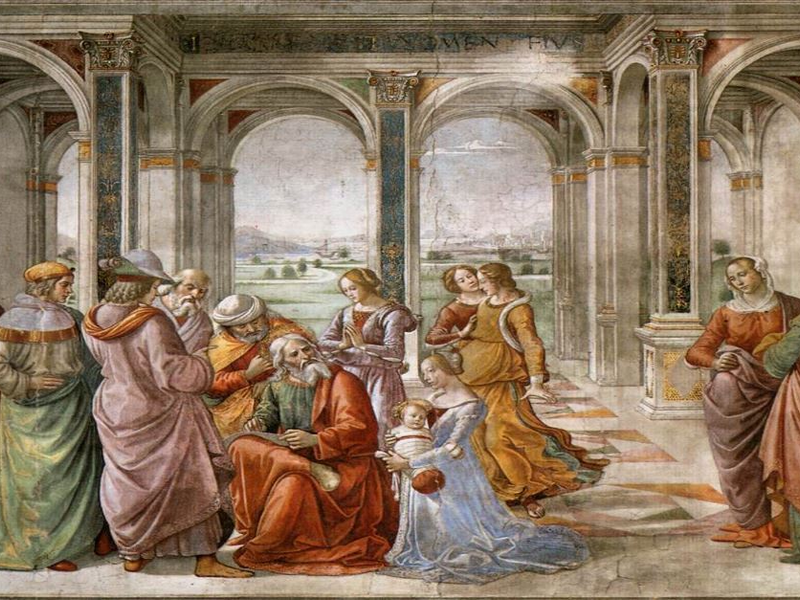
A curious feature of the Infancy Narratives in the Gospel of Luke is the naming of John the Baptist. When the angel appears to Zechariah, he is instructed to give his promised son the name John (Luke 1:13). On the day of John’s circumcision, Luke tells us that “they [presumably…

by Rhys LavertyDecember 8, 2020

Showing page 60 of 309

See all

Showing page 38 of 43

See all
History

Converted Jerusalem

In his fascinating Rise of Christianity , Rodney Stark cites estimates that there were between 10,000 and 20,000 inhabitants of Jerusalem in the first century. Stark uses this to falsify Luke’s claims that there were 5000 Christians in Jerusalem (Acts 4:4) and “many thousands” of Jews (Acts 21:20): “Had there…

March 30, 2007

Hebraic hermeneutics

One Rhonda Wauhkonen discusses Nicholas of Lyra’s “Hebraic” semiotics and hermeneutics in a 1992 article on Chaucer. She begins by contrasting Augustine’s signum/res distinction to Lyra’s Hebraic viewpoint: “In the Hebrew system as evidenced in Scripture and as adapted by Nicholas, such stratification of signification did not exist, for the…

March 29, 2007

Last and first

Nicholas of Lyra is known for his notion of a “double literal” sense to Scripture. For him, interpretation ad litteram includes both the historical and the doctrinal/christological senses, and he suggests that the ancient Hebrews could well have seen the Messianic sense as the literal sense. He also suggests that…

March 29, 2007

Nicholas of Lyra’s afterlife

In Book 3 of Gargantua and Pantagruel, Rabelais attributes an odd opinion to the 14th-century exegete, Nicholas of Lyra: “Pantagruel, having wholly subdued the land of Dipsody, transported thereunto a colony of Utopians, to the number of 9,876,543,210 men, besides the women and little children, artificers of all trades, and…

March 29, 2007

Nicholas of Lyra’s afterlife

In Book 3 of Gargantua and Pantagruel, Rabelais attributes an odd opinion to the 14th-century exegete, Nicholas of Lyra: “Pantagruel, having wholly subdued the land of Dipsody, transported thereunto a colony of Utopians, to the number of 9,876,543,210 men, besides the women and little children, artificers of all trades, and…

March 29, 2007

Thomas on the Parable of the Workers

Steinmetz summarizes Thomas’s remarkably “NTWrightian” commentary on Matthew 20:1-16. While acknowledging an Origenist tradition that sees the hours as moments of an individual life, Thomas is more interested in the Irenaean tradition that interprets the parable in terms of redemptive history: “The hours mentioned in the parable are not stages…

March 29, 2007

Showing page 1699 of 2212

Browse by Category

In Medias Res

Your weekly digest for all things Theopolis.

Donate

Theopolis is nearly 100% donor-supported. Consider joining us on our mission.