Theopolis Logo

Writing

Explore our collection of theological essays, biblical studies, and reflections on faith and culture.

See all
denise-jans-dpemksg59la-unsplash
Art

Glorifications Versus Debasement

Because of sin, the arts sometimes do not serve to glorify but to debase. Sinful men make their environments ugly, and create ugly art to “enhance” their ugly words. But since all men are still God’s images, no men are able to live with such ugliness all the time. Thus,…

by James B. JordanMay 25, 1994

jeremy-yap-j39x2xx_8cq-unsplash
Art

Words and Glory

Arts and literature reviews in most evangelical Christian publications generally approach their subjects in terms of ideology. We are told whether or not the film or book is acceptable in terms of morals, sexual graphicness, and theological accuracy. While there is definitely a place for such reviews, I fear that…

by James B. JordanMay 25, 1994
screen-shot-2018-04-12-at-9-48-08-am
Biblical Horizons

Broadening Our View of the Trinity

We speak of God as Father, Son, and Holy Spirit. The early Church tended to speak of Him as Father, Word, and Spirit. In this short essay, I want to suggest some other ways to think of the Trinity, ways that I have found pastorally helpful in my own life…

by James B. JordanMay 5, 1994
Biblical Studies

Thousands of Generations

I, Yahweh your God, am a jealous God, visiting the iniquity of the fathers on the children, on the third and fourth of those who hate Me, but showing lovingkindness to thousands, to those who love Me and guard My commandments (Ex. 20:5-6). The Second Word forbids acts of ceremonial…

by James B. JordanMay 5, 1994
ben-white-w8qqn1pmqh0-unsplash
Biblical Chronology

The Chronology of the Pentateuch (Part 3)

8. The Table of Nations If we assume births every two years, and about 30 years between generations (cp. Gen. 11:12-24), we can come up with an approximate series of dates for the generations recorded in Genesis 10. We shall assume that all three of Noah’s sons had their firstborn…

by James B. JordanMay 5, 1994
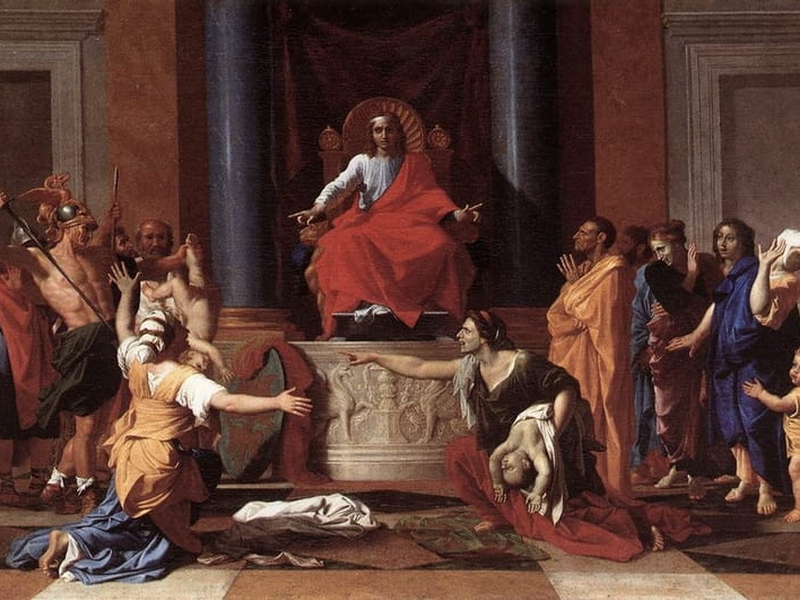
49980-nicolas_poussin_-_the_judgment_of_solomon_-_wga18330-800w-tn
Biblical Studies

The Eighth Month

Zechariah’s first prophecy (Zech. 1:1-6) was delivered in the eighth month of the second year of Darius. The notation of this date serves a number of purposes. Most obviously, it relates Zechariah’s prophecies to those of Haggai. By the time Zechariah delivered his first prophecy, Haggai had already chided the…

by Peter LeithartApril 23, 1994

Showing page 279 of 309

See all

Showing page 38 of 43

See all

Sexual Laws of Leviticus 18

The sexual laws of Leviticus 18 have long been puzzling on a couple of levels. The logic of the arrangement of the laws is difficult to discern; the gaps in the laws seems inexplicable (no prohibition, for instance, of father-daughter incest); and the question of how obedience to these laws…

November 2, 2004

Righteousness in Romans 1

The phrase “righteousness of God” in Romans 1:17 has been the subject of considerable dispute in recent years, with many abandoning a standard Protestant interpretation of the passage (i.e., that the righteousness of God refers to the righteousness that God gives) in favor of a more redemptive-historical understanding (righteousness as…

November 2, 2004

Matthew 8 and Sodomy

Theodore Jennings and Tat-Siong Benny Liew have a curious article in the Fall 2004 issue of JBL . They offer an alternative interpretation of the story of the centurion of Matthew 8, an interpretation that hangs on taking “PAIS” not as “slave” or “son” but as “boy-lover.” They find plenty…

November 2, 2004
Literature

Romanticism and Spain

In a review of Joseph von Eichendorff’s collected works ( TLS , October 1, 2004), Carol Tully points out the fascination of German Romantics for Spain: “For the poets and theoreticians of the Romantic age in German, Spain was somewhere very special indeed. The nation and its culture were eulogized…

November 2, 2004

Two Kinds of Righteousness

Some intriguing quotations from Luther’s treatise on Two Kinds of Righteousness . 1) The first sort is “alien righteousness”: “The first is alien righteousness, that is the righteousness of another, instilled from without. This is the righteousness of Christ by which he justifies though faith, as it is written in…

October 27, 2004

Eucharist Lecture #3

INTRODUCTION Because of the imperfections of the reformation of the Eucharist in the sixteenth century, and because of the alien influences that have affected the practice of the Eucharist in the centuries since, there is much left to do in order to renew the Table. The Reformation must at this…

October 27, 2004

Showing page 2042 of 2212

Browse by Category

In Medias Res

Your weekly digest for all things Theopolis.

Donate

Theopolis is nearly 100% donor-supported. Consider joining us on our mission.