Theopolis Logo

Writing

Explore our collection of theological essays, biblical studies, and reflections on faith and culture.

See all
trump-2
American Politics

Kingdom First

Whatever else the 2016 Presidential cycle has accomplished, it has brought the chasm between nationalism and globalism into sharp relief. Many see this divide as the issue of the campaign (Robert Merry) or of the century (Pat Buchanan). It seems to be a choice we have to make. Christians must…

by Peter LeithartJanuary 24, 2017

screen-shot-2016-03-31-at-9-32-11-am
Romans

God, Gift, Sacrament

Salvation is a gift. The righteousness of justification (Romans 5:17) and eternal life (Romans 6:23) are gifts freely offered. According to Risto Saarinen ( God and the Gift ), “God is directly called the giver 104 times [in Scripture], of which 42 are in John’s Gospel and John’s Letters. In…

by Peter LeithartJanuary 19, 2017
hebrew-manuscript
Biblical Studies

Hear, O Israel!

In the last 40 odd years of studying the Bible, I have read more essays and commentaries on Deuteronomy 6:4 than I can recall. I have also more than twice changed my view on what should be the correct translation of Israel’s central confession. What is so complicated? After the…

by Ralph Allan SmithJanuary 17, 2017
paul_alexander_leroy_-_haman_and_mordecai_1884
Biblical Theology

Brexit and the Binding of Satan (Part 5)

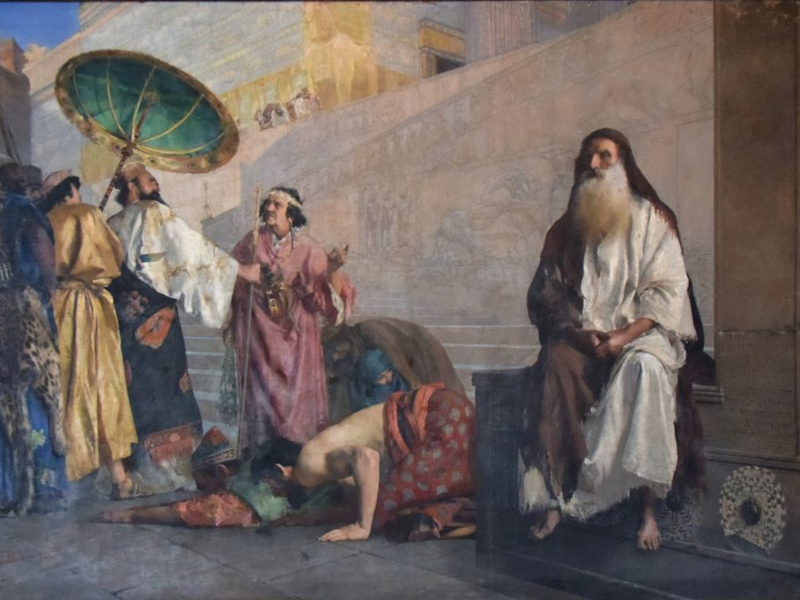
Satan is currently bound from gathering the nations in kingly rebellion so that Jesus might gather them in priestly unity. Everything which Scripture records for us, no matter how mundane or mysterious, exists as part of a process of growth to maturity. This transformation is achieved through relationships established by…

by Mike BullJanuary 13, 2017
nativity
Church Calendar

Epiphany and Mission

God’s people are a missionary people, and this is not true only of the New Testament church. God called Abraham to bless the Gentiles through him, and one of Israel’s recurring sins was her failure to carry out this mission. Israel was supposed evoke praise from the Gentiles, but instead…

by Peter LeithartJanuary 5, 2017
cross-grunwald
Discipleship

Readiness Is All

Are you ready for the New Year? Are you ready to follow Jesus wherever He takes you this year? Are you read to follow Him into the garden? Are you ready to stay at His side to be arrested, interrogated, tortured, crucified, buried? Are you ready to follow Jesus wherever…

by Peter LeithartJanuary 3, 2017

Showing page 118 of 309

See all

Showing page 39 of 43

See all
Philosophy

Heidegger in his woods

Latour is tired of being accused of having forgotten Being, and offers this clever brush-off of Heidegger: “If, scorning empiricism, you opt out of the exact sciences, then the human sciences,, then traditional philosophy, then the sciences of language, and you hunker down in your forest - then you will…

November 15, 2006
History

Semi-modernism

Postmoderns, Latour suggests, think they are still modern, but in fact they have greatly oversimplified the modern Constitution. Postmoderns might emphasize the separation of subject and world, and stretch that opposition to a breaking point (Latour vividly describes them as doing the splits to keep subject and world apart); but…

November 15, 2006
History

Modern temporality

In his very good section on modern temporality, Latour argues that modernity assumes that everything in the present, modern moment, is purely modern, novel. Anything that appears that is not up-to-date is a “archaism,” and moderns worry constantly that this or that event or trend might “turn back the clock.”…

November 15, 2006
History

Representation

One of the key moves made since the 17th century, Latour argues, is a distinction between modes of “representation.” In the laboratory Boyle is representing things before selected witnesses through scientific experiments, giving mute nature a voice through the scientist, while in politics Hobbes suggests that the Sovereign speaks for…

November 15, 2006
History

We Have Never Been Modern

Bruno Latour’s We Have Never Been Modern (Harvard 1993) is a rich study. He describes modernity in terms of a dual process of “purification” and “hybridization.” Purification involves the clean construction of a nature (and science) separated off from society and the self, while hybridization involves mixtures of nature and…

November 15, 2006

Tears of things

And/Or: Virgil is aware that the furor of civil war can be curbed only by an opposing, and more intense, furor. That, as Milbank says, is the way of paganism - peace established only by superior violence against violence. But in those tears Virgil expresses the the painful recognition -…

November 13, 2006

Showing page 1763 of 2212

Browse by Category

In Medias Res

Your weekly digest for all things Theopolis.

Donate

Theopolis is nearly 100% donor-supported. Consider joining us on our mission.