Theopolis Logo

Writing

Explore our collection of theological essays, biblical studies, and reflections on faith and culture.

See all
800124htsdl
Authority

The Restrainer

When Samuel saw Saul, Yahweh answered him, "Behold, the man of whom I spoke to you! This one will restrain My people" (1 Samuel 9:17) Many English versions of 1 Samuel 9:17 read, "This one will rule over My people," but that is a mistranslation. The Hebrew verb is `atsar…

by James B. JordanDecember 4, 1992

screen-shot-2022-05-12-at-12-07-23-pm
Acts

Chronology of the Gospels

We have arrived at the tentative date of A.M. 3474 for the decree of Cyrus, and we have determined to operate as if the 70 weeks of Daniel 9 are literal years. We also decided that Messiah the Prince arrives at the beginning of the 70th week, after the 69…

by James B. JordanDecember 4, 1992
alex-shute-oz2yqcaszw-unsplash
Biblical Studies

The Dramatic Structure of Proverbs

The book of Proverbs appears as a largely random collection of aphorisms drawn from experience saturated in law. Despite its random arrangement, however, the book does have an over-arching structure that reinforces its main themes. One way to gather clues regarding the structure of a biblical book (or any book)…

by Peter LeithartNovember 17, 1992
sincerely-media-bhaswrjttzw-unsplash-2
Leviticus

Leviticus 27

I recently had the privilege and pleasure of reading the first draught of Gary North’s Economic Commentary on Leviticus , which will be out some time next year. Gary’s comments on Leviticus 27 were stimulating, and caused me to take another look at the passage. The results, which I sent…

by James B. JordanNovember 4, 1992
venice-la-distruzione-del-tempio-di-gerusalemme-francesco-hayez-gallerie-accademia-venice
Daniel

Bridging the Last Gap: Daniel’s Seventy Weeks Revisited

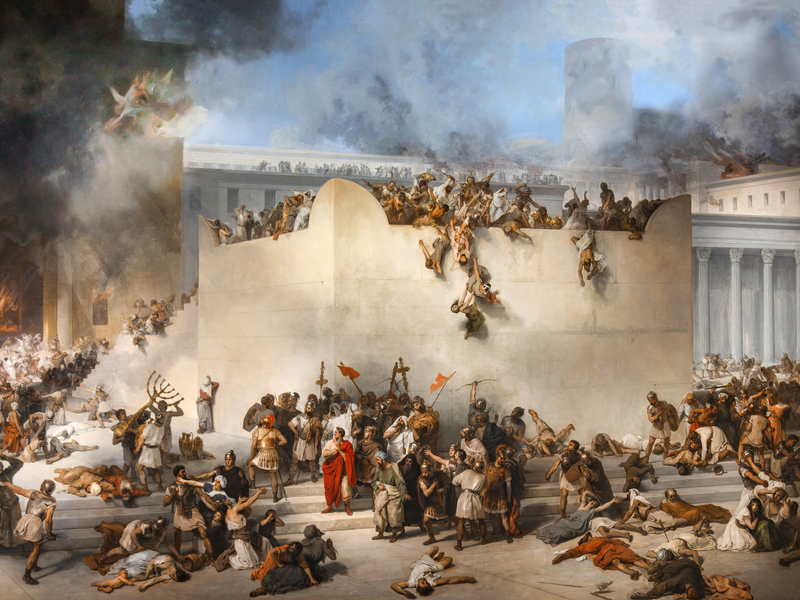
As we have seen in this series, each time there is a new covenant, there is a break in the year-by-year chronology. At the same time, each time the break is crossed by information provided in the text. Thus, the year-by-year chronology breaks down at the birth of Abraham, but…

by James B. JordanNovember 4, 1992
europeana-h-4wme4eooo-unsplash
Art

The Openness of Literature & the Mystery of Art

The Openness of Literature Let’s discuss literature for a moment. There are two ways a story or novel can close. The first is called poetic justice. When a story ends with poetic justice, the bad guys are all punished and the good guys are all rewarded. This kind of story…

by James B. JordanNovember 4, 1992

Showing page 287 of 309

See all

Showing page 39 of 43

See all

Objective/Subjective

McGrath notes that Augustine interpreted the genitive in the phrase “righteousness of God” in Rom 1 objectively, so that it was understood as the righteousness that God gives in saving sinners (in “making” them righteous). Ambrosiaster, as I pointed out in an earliet post, interpreted the genitive subjectively - the…

April 20, 2006

Old Perspective on Paul

Ambrosiaster writes, “Iustitia est Dei, quia quod promisit dedit, ideo credens hoc esse se consecutum quod promiserat Deus per prophetas suos, iustum Deum probat et testis est iustitiae eius” (PL, 17.56b). McGrath explains: “God, having promised to give salvation, subsequently gives it, and as a result is deemed to be…

April 20, 2006
History

Unfinished Reformation

Nevin wrote: “There is more a great deal in Christianity, I firmly believe, more in the idea of hte Holy Catholic Church, than has yet been attained, either in the way of knowledge or in the way of life, by the Protestant Reformation.”

April 20, 2006

Factitive Justification

There was a consensus among the theologians of Trent, McGrath argues, that justification was “factitive,” a view that excluded that “a sinner may be justified solely as a matter of reputation or imputation, while remaining a sinner in fact.” But of course that raises the question, What exactly is a…

April 20, 2006

True Lutherans

McGrath traces the odd development in Lutheran Orthodoxy of the notion that regeneration and faith precede justification in such a way that “where Luther had understood justification to concern the unbelieving sinner, orthodoxy revised this view, referring justification to the believing sinner.” This takes Lutheran Orthodoxy back in the direction…

April 20, 2006

Ontological change

McGrath notes, “While justification was universally understood to involve the regeneration of humanity, the opinion that an ontological change is thereby effected within humans is particularly associated with the period of High Scholasticism and the development of the concept of created grace. The earlier medieval theologians expressed the change effected…

April 20, 2006

Showing page 1854 of 2212

Browse by Category

In Medias Res

Your weekly digest for all things Theopolis.

Donate

Theopolis is nearly 100% donor-supported. Consider joining us on our mission.