Theopolis Logo

Writing

Explore our collection of theological essays, biblical studies, and reflections on faith and culture.

See all
e99a9081
American Culture

Arts & Play, Part 2

Gambling The Bible nowhere condemns gambling, and so we need to be careful in our assessment of it. Let me begin by making a strong case against gambling. Then I will surprise most readers by pointing out that gambling may not always be sinful. The reader should bear in mind…

by James B. JordanNovember 22, 1991

trnava-university-beeyeib-am8-unsplash
Biblical Horizons

Tim Powers, The Stress of Her Regard

Tim Powers, The Stress of Her Regard (Ace Books, 1991). Reviewed by Jeffrey Meyers. Tim Power’s latest novel is now available in paperback. The story is set in early nineteenth century England and Italy, in the world of the poets John Keats, Percy Shelley, and Lord Byron. Michael Crawford, a…

by Jeff MeyersNovember 5, 1991
dan-burton-nrw4i8kuyd8-unsplash
Biblical Horizons

What About Boycotting?

A close supporter of Biblical Horizons asks whether it is proper and wise to get involved in all the boycotts that Christians are being asked to observe today. She raises the point that Paul’s advice about eating meat sacrificed to idols seems relevant to the discussion. I think she is…

by James B. JordanOctober 22, 1991
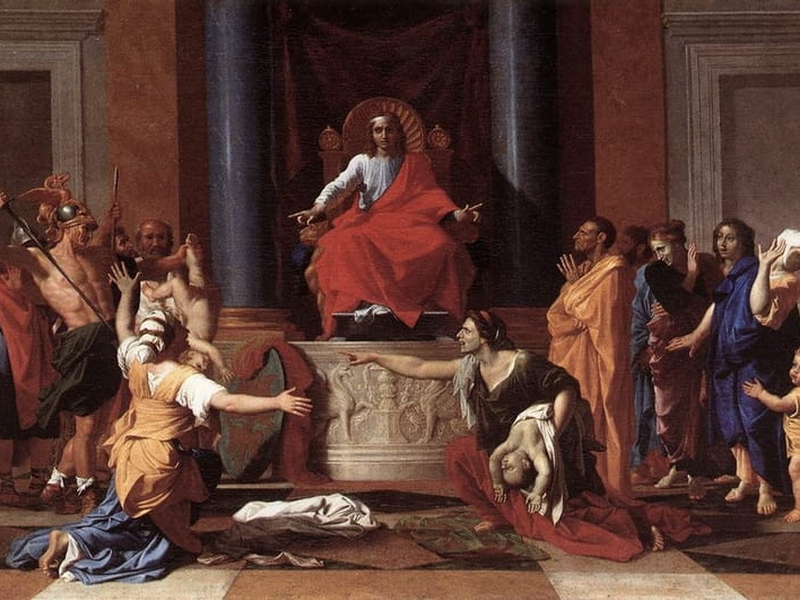
49980-nicolas_poussin_-_the_judgment_of_solomon_-_wga18330-800w-tn
Biblical Chronology

Chronologies and Kings, Part 4: Solomon’s Disastrous Geopolitics

Solomon began to build the Temple of the Lord in the fourth year of his reign, which was 480 years after Israel came out of Egypt, the year A.M. 2993 (1 Kings 6:1). Seven years later, in the year A.M. 3000, the Temple building was finished (1 Kings 6:38). The…

by James B. JordanOctober 22, 1991
ben-white-w8qqn1pmqh0-unsplash
Baptism

What Is a Sacrament? Some Problems of Definition

Several months back, a candidate for ordination was being examined for entrance into the Presbytery of which I am a member. The candidate had a good deal of trouble with the exam on the sacraments, stumbling badly as he tried to define the "nature of the sacrament." Apparently in an…

by Peter LeithartOctober 14, 1991
ivan-aleksic-16yxcjsoaek-unsplash
Biblical Horizons

The Mabelized Church

Exploring the influence of televangelism on American religion in his book, The Struggle for America’s Soul , Princeton sociologist Robert Wuthnow presents a typical, though hypothetical, case study: Mabel Miller. Mabel lives alone, thousands of miles from her family. She grew up in a Baptist Church, but now, approaching 65,…

by Peter LeithartOctober 13, 1991

Showing page 294 of 309

See all

Showing page 39 of 43

See all

Objective/Subjective

McGrath notes that Augustine interpreted the genitive in the phrase “righteousness of God” in Rom 1 objectively, so that it was understood as the righteousness that God gives in saving sinners (in “making” them righteous). Ambrosiaster, as I pointed out in an earliet post, interpreted the genitive subjectively - the…

April 20, 2006

Old Perspective on Paul

Ambrosiaster writes, “Iustitia est Dei, quia quod promisit dedit, ideo credens hoc esse se consecutum quod promiserat Deus per prophetas suos, iustum Deum probat et testis est iustitiae eius” (PL, 17.56b). McGrath explains: “God, having promised to give salvation, subsequently gives it, and as a result is deemed to be…

April 20, 2006
History

Unfinished Reformation

Nevin wrote: “There is more a great deal in Christianity, I firmly believe, more in the idea of hte Holy Catholic Church, than has yet been attained, either in the way of knowledge or in the way of life, by the Protestant Reformation.”

April 20, 2006

Factitive Justification

There was a consensus among the theologians of Trent, McGrath argues, that justification was “factitive,” a view that excluded that “a sinner may be justified solely as a matter of reputation or imputation, while remaining a sinner in fact.” But of course that raises the question, What exactly is a…

April 20, 2006

True Lutherans

McGrath traces the odd development in Lutheran Orthodoxy of the notion that regeneration and faith precede justification in such a way that “where Luther had understood justification to concern the unbelieving sinner, orthodoxy revised this view, referring justification to the believing sinner.” This takes Lutheran Orthodoxy back in the direction…

April 20, 2006

Ontological change

McGrath notes, “While justification was universally understood to involve the regeneration of humanity, the opinion that an ontological change is thereby effected within humans is particularly associated with the period of High Scholasticism and the development of the concept of created grace. The earlier medieval theologians expressed the change effected…

April 20, 2006

Showing page 1854 of 2212

Browse by Category

In Medias Res

Your weekly digest for all things Theopolis.

Donate

Theopolis is nearly 100% donor-supported. Consider joining us on our mission.