
Theopolis Logo

Writing

Explore our collection of theological essays, biblical studies, and reflections on faith and culture.

See all
jonathan-borba-lgj3qbhoqui-unsplash
Art

Toward a Biblical Definition of Obscenity

My copy of Webster’s New Collegiate Dictionary (1976: not so new, really) defines obscene as (1) "disgusting to the senses; repulsive" and (2) "abhorrent to morality or virtue; specif: designed to incite lust or depravity." Definitions such as this serve a useful purpose only when there is agreement on what…

by Peter LeithartMay 30, 1991
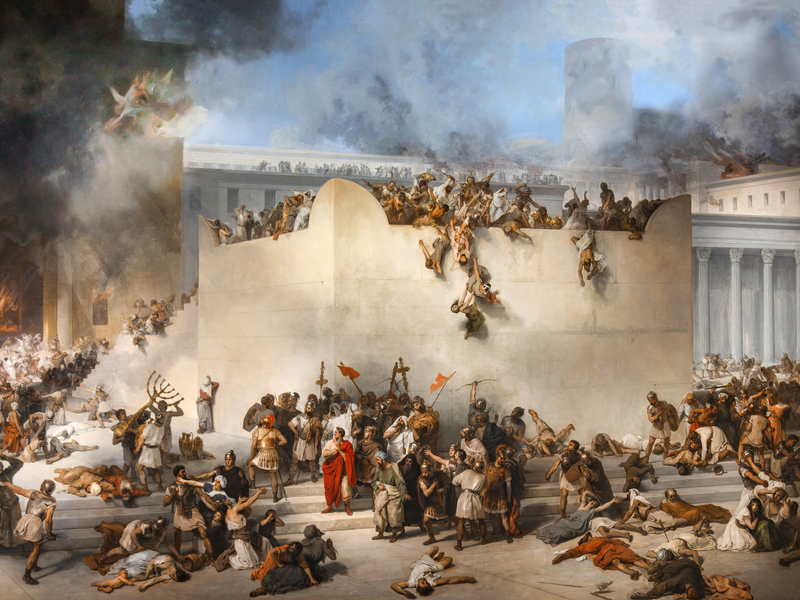
venice-la-distruzione-del-tempio-di-gerusalemme-francesco-hayez-gallerie-accademia-venice
Biblical Studies

The Abomination of Desolation, Part 1

An Overview Here begins a series of studies in the Abomination of Desolation, or Desolating Sacrilege. This month and next I shall set out an overview of what I regard as the best interpretation of the phenomenon. Later essays will look at it in more detail. (The original form of…

by James B. JordanMay 22, 1991
49980-nicolas_poussin_-_the_judgment_of_solomon_-_wga18330-800w-tn
Biblical Studies

Advice From a Sojourner, Part 12

29. There are three things that are stately in their march, Even four that are stately when they walk: 30. The lion is mighty among beasts And does not turn back before any, 31. The strutting cock, The male goat, And a king with his army around him. 32. If…

by James B. JordanMay 22, 1991
tanner-mardis-xuxghzhibn4-unsplash-1-2
Biblical Studies

The Chronology of Ezra & Nehemiah, Part 4

We have seen that it is likely that the Artaxerxes of Ezra-Nehemiah is the same as Darius the Great. If this solution be correct, and I think it is, possibly there is another problem in Ezra that can be resolved by it. In Ezra 4:6 we are told that "in…

by James B. JordanMay 22, 1991
giammarco-zeh-ljawhtg-unsplash
Biblical Horizons

The Weight of Being

Czech novelist Milan Kundera, though hardly a household name in the English-speaking world, has achieved a certain notoriety in America in recent years, largely on the strength of the English translation and film version of his novel, The Unbearable Lightness of Being. 1 The Unbearable Lightness of Being — the…

by Peter LeithartMay 6, 1991
49980-nicolas_poussin_-_the_judgment_of_solomon_-_wga18330-800w-tn
Proverbs

Advice From a Sojourner, Part 11

24. Four things are small on the earth, But they are exceedingly wise; 25. The ants are not a strong folk, But they prepare their food in the summer; 26. The coneys are not a mighty folk, Yet they make their houses in the rocks; 27. The locusts have no…

by James B. JordanApril 22, 1991

Showing page 297 of 309

See all

Showing page 39 of 43

See all

Objective/Subjective

McGrath notes that Augustine interpreted the genitive in the phrase “righteousness of God” in Rom 1 objectively, so that it was understood as the righteousness that God gives in saving sinners (in “making” them righteous). Ambrosiaster, as I pointed out in an earliet post, interpreted the genitive subjectively - the…

April 20, 2006

Old Perspective on Paul

Ambrosiaster writes, “Iustitia est Dei, quia quod promisit dedit, ideo credens hoc esse se consecutum quod promiserat Deus per prophetas suos, iustum Deum probat et testis est iustitiae eius” (PL, 17.56b). McGrath explains: “God, having promised to give salvation, subsequently gives it, and as a result is deemed to be…

April 20, 2006
History

Unfinished Reformation

Nevin wrote: “There is more a great deal in Christianity, I firmly believe, more in the idea of hte Holy Catholic Church, than has yet been attained, either in the way of knowledge or in the way of life, by the Protestant Reformation.”

April 20, 2006

Factitive Justification

There was a consensus among the theologians of Trent, McGrath argues, that justification was “factitive,” a view that excluded that “a sinner may be justified solely as a matter of reputation or imputation, while remaining a sinner in fact.” But of course that raises the question, What exactly is a…

April 20, 2006

True Lutherans

McGrath traces the odd development in Lutheran Orthodoxy of the notion that regeneration and faith precede justification in such a way that “where Luther had understood justification to concern the unbelieving sinner, orthodoxy revised this view, referring justification to the believing sinner.” This takes Lutheran Orthodoxy back in the direction…

April 20, 2006

Ontological change

McGrath notes, “While justification was universally understood to involve the regeneration of humanity, the opinion that an ontological change is thereby effected within humans is particularly associated with the period of High Scholasticism and the development of the concept of created grace. The earlier medieval theologians expressed the change effected…

April 20, 2006

Showing page 1854 of 2212

Browse by Category

In Medias Res

Your weekly digest for all things Theopolis.

Donate

Theopolis is nearly 100% donor-supported. Consider joining us on our mission.