Theopolis Logo

Writing

Explore our collection of theological essays, biblical studies, and reflections on faith and culture.

See all
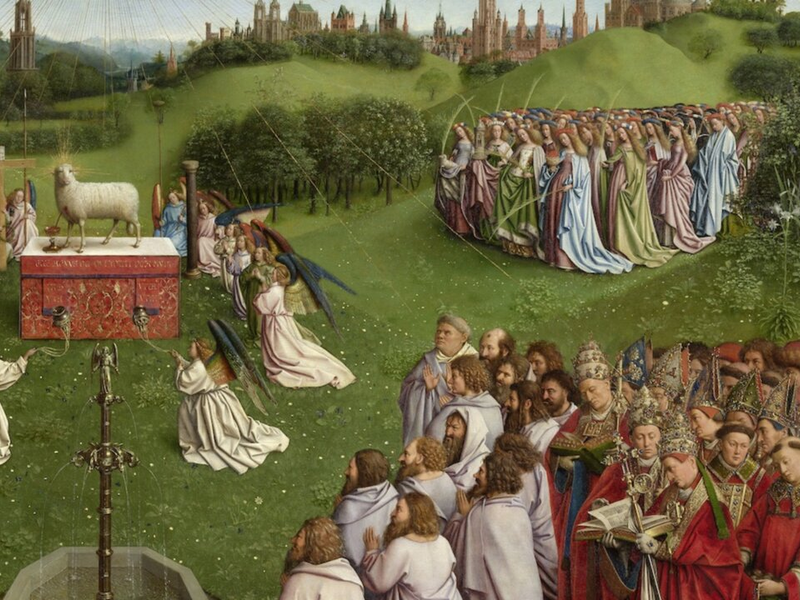
20_van-eyck_bavo-altar_adoration-of-the-lamb-copy-67f4f94b
Culture

An Introduction to the Sacred Music of Josquin

This essay is adapted from my articles in Theopolis’s In Medias Res as a series of Holy Week meditations. Like many celebrities such as Kanye or Beyoncé or Adele, Josquin des Prez (d. 1521) was often known only by his first name, in his own time as now. “Josquin” is…

by John AhernJuly 29, 2025
screenshot-2025-07-22-at-11-57-58-am
Numbers

Sight and Memory: Examining the Monuments of Numbers

Sight is a major theme in the scriptures. The church has long identified sight’s relationship to the future fulfillment of the eschaton. As Paul says, “For now we see only a reflection as in a mirror; then we shall see face to face” (1 Cor 13.12). Sight is associated with…

by Matthew DarbyJuly 22, 2025
tengyart-aaz5-as3io-unsplash
Biblical Theology

Yahweh’s Flame: the Gospel through Symbolism

What is the chief end of man? —yes, to glorify God and enjoy him forever. But how ought man–and all creation–so glorify him? I propose a Theopolitan addition to the catechism, question and answer number 1.5, begun in the last question and answered as follows: Earth’s inhabitants were created to…

by Ben LoveladyJuly 16, 2025
screenshot-2025-07-08-at-8-31-22-am
Culture

Morality and the Practice of Poetry

Naphtali is a hind let loose: he giveth goodly words. Genesis 49:21 Frederick Buechner once said, “We move into the extraordinary by way of the ordinary.” In poetry, this happens by way of a compressed code of analogs; often, two or more very ordinary things begin to reveal something that…

by Garrett SoucyJuly 8, 2025
screenshot-2025-07-03-at-9-26-50-am
Ephesians

The Trinitarian Structure of Obedience

The evangelical milieu of America has often lost a vision of the fruit of repentance. We tend to simplify repentance by asking for forgiveness. After all, Jesus tells Peter to forgive 70 times 7. This verse must be paired with Paul’s scoffing at the question: why not sin more so…

by Matthew CoreyJuly 3, 2025
33255drsdl
Luke

The Hemorrhaging Woman, the Eucharist, and the Sermon

I. The hemorrhaging woman. En route to Jairus’ house, Jesus is touched by a woman with a hemorrhage of blood (Matt 9:18–26; Mk 5:21–34; Lk 8:40–48). The story is one that many of us know very well. She has been yoked to her illness for twelve years, all of her…

by Mark BriansJuly 1, 2025

Showing page 7 of 309

See all

Showing page 39 of 43

See all
History

Modernity and antiquity

Kumar suggests that “some of the principal hall-marks of modernity” are already evident in the Christian notions of time and history. Both Christianity and modernity separate time from nature, and humanize time; time is seen by both as “linear and irreversible”; both see history as an Aristotelian drama with beginning,…

February 24, 2006
History

First Modernity

The Latin modernus was coined in the late fifth century, as an antonym to antiquus , and variations of modernus became particularly common after the 10th century. Thus, Krishan Kumar writes, “Modernity is . . . an invention of the Christian Middle Ages,” and was used to emphasize the radical…

February 24, 2006
Philosophy

Computer Communications and the Self

Poster lists four effects that computer communications (email, chat groups, etc) have on the self: “1 they introduce new possibilities for playing with identities; 2 they degender communications by removing gender cues; 3 they destabilize existing hierarchies in relationships and re-hierarchize communications according to criterio that were previously irrelevant; and…

February 24, 2006
Philosophy

Computers, subjects and objects

Descartes famously contrasted the mind (res cogitans) with the external world (res extensa), but Mark Poster suggests that computer writing fudges that distinction: “the computer dematerializes the written trace. As inputs are made to the computer through the keyboard, pixels of phosphor are illuminated on the screen, pixels that are…

February 24, 2006
Media

Community and New Communications

Mark Poster points to a tension between the modern institutions of production and the postmodern technologies of communication, particularly as they impact the formation of the self: “If modernity or the mode of production signifies patterned practices that elicit identities as autonomous and (instrumentally) rational, postmodernity or the mode of…

February 24, 2006
Media

Telephone

Prior to World War I, Telefon Hirmondo, the telephone system of Budapest, was used as a broadcast system, with a published schedule of programs that were restricted to certain classes of people in Hungary. Only later did it develop into a communications system in which everyone could pass information to…

February 24, 2006

Showing page 1878 of 2212

Browse by Category

In Medias Res

Your weekly digest for all things Theopolis.

Donate

Theopolis is nearly 100% donor-supported. Consider joining us on our mission.