Theopolis Logo

Writing

Explore our collection of theological essays, biblical studies, and reflections on faith and culture.

See all
timothy-eberly-djj49s6ud2o-unsplash
Leviticus

Yahweh's War Against Death

Stories, frankly all human stories are practically always about one thing aren’t they? Death. The inevitability of death. . . . “There is no such thing as a natural death. Nothing that happens to man is ever natural, since his presence calls the whole world into question. All men must…

by Brian MarrApril 14, 2014

screenshot-2023-09-21-at-4-52-42-pm
Matthew

Inescapable Blood

Matthew is organized around 5 discourses, which trace out the history of Jesus as a recapitulation of the history of God and Israel in the Old Testament. Jesus first speaks as a new Moses, instructing His disciples on a mountain about a righteousness that surpasses the righteousness of the scribes…

by Peter LeithartApril 10, 2014
screen-shot-2022-05-12-at-12-07-23-pm
Angels

Did Angels Marry People? The Sin of Cultural Intermarriage

The fall of the Sethites in Genesis 6 is the third fall of mankind, or the third degree of Adam’s original fall. Adam sinned in a Garden against his Father by stealing something he was supposed to wait to obtain. (“Every tree shall be food for you” Genesis 1:29.) Cain…

by James B. JordanApril 7, 2014
sixteen-miles-out-al48tflf4e8-unsplash
Angels

Did Angels Marry People? The Sons of God in Genesis 6

The recent fantasy film Noah and a slightly related blog comment by my friend Douglas Wilson have stirred up again the question of whether the “sons of God” in Genesis 6 who married the “daughters of men” were fallen angels or the priestly line of Seth. Doug argues for angels,…

by James B. JordanApril 4, 2014
kiwihug-l4gw27xzn1i-unsplash
Angels

The Angels of Jude

The prophecy of Jude concerns apostasy. An illustration of apostasy and its consequences is found in verse 6, which the New American Standard Bible translates this way: "And angels who did not keep their own domain, but abandoned their proper abode, He has kept in eternal bonds under darkness for…

by James B. JordanApril 3, 2014
screenshot-2023-09-21-at-4-22-42-pm
Matthew

Women at the Cross

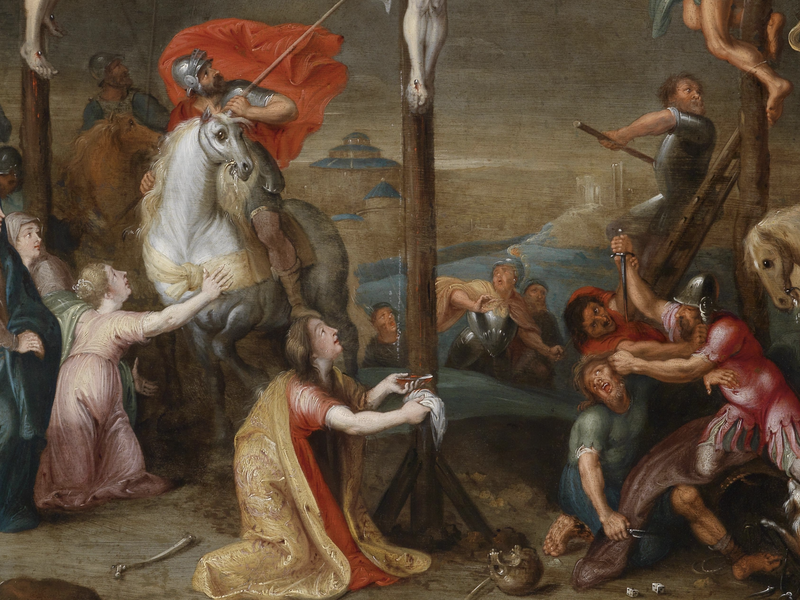
At His death, Jesus is surrounded by a Roman centurion and his cohort of Gentile solders. Matthew doesn't say that any disciples are there. But women are, and so is Joseph of Arimathea, identified as a “disciple” but, as John tells us, a “secret disciple for fear of the Jews,”…

by Peter LeithartMarch 31, 2014

Showing page 176 of 309

See all

Showing page 39 of 43

See all

Age of Silver

D avid's plan for the temple is partly a floor plan. He gives Solomon the pattern for the “porch” and its associated buildings, treasuries, rooms, courts (1 Chronicles 28:11-12). The plan also includes instructions for organizing the priests and Levites (28:13a) and for the utensils of service for the temple…

March 14, 2017

Sources of Inequality

I n his recently-published The Great Leveller , Walter Scheidel summarizes evidence from archeology and anthropological studies to answer the question, Has inequality always been with us? The answer is: Sort of yes. Inequality is a constant in societies that farm and herd. But farming and land ownership weren't the…

March 14, 2017

Classicists and Romantics

D avid gives Solomon the “plan” (Heb. tabnit ) for the temple. Unlike Moses, David doesn't have to climb a mountain to get it (cf. Exodus 25:9, 40). It comes from “the spirit ( ruach ) with him” (1 Chronicles 28:12), and from a “writing” from the Lord that comes…

March 13, 2017

Nietzsche, Destroyer of Idols

I n an essay in the journal European Legacy , Norman Fiering summarizes the thought of Eugen Rosenstock-Huessy on biography. Fiering asks whether there are recurring patterns in the lives of significant individuals, and, relying on Rosenstock-Huessy, calls attention to moments of “conversion” (not necessarily religious) and “grace” (unexpected encounters…

March 10, 2017

Modernist Puritanism

I n his 1971 study of Modernist architecture, The Golden City , Henry Hope Reed observed that Modernists transferred moral categories to architecture. Buildings could be “honest” (if they revealed their structure on the surface) or “false” (if they hid structure under ornamentation). Purity was invoked regularly as a positive…

March 10, 2017

Happy Gothic

W hat is “the Gothic”? Answers vary, and that is, Catherine Spooner argues (in Post-Millennial Gothic ), because Gothic bears “multivalent meanings” and “has adapted and changed with the times” (9–10). This isn't a recent development: “After Gothic's initial phase of popularity fizzled out around 1820, it quickly renewed itself…

March 10, 2017

Showing page 197 of 2212

Browse by Category

In Medias Res

Your weekly digest for all things Theopolis.

Donate

Theopolis is nearly 100% donor-supported. Consider joining us on our mission.