Theopolis Logo

Writing

Explore our collection of theological essays, biblical studies, and reflections on faith and culture.

See all
800124htsdl
Authority

The Restrainer

When Samuel saw Saul, Yahweh answered him, "Behold, the man of whom I spoke to you! This one will restrain My people" (1 Samuel 9:17) Many English versions of 1 Samuel 9:17 read, "This one will rule over My people," but that is a mistranslation. The Hebrew verb is `atsar…

by James B. JordanDecember 4, 1992

screen-shot-2022-05-12-at-12-07-23-pm
Acts

Chronology of the Gospels

We have arrived at the tentative date of A.M. 3474 for the decree of Cyrus, and we have determined to operate as if the 70 weeks of Daniel 9 are literal years. We also decided that Messiah the Prince arrives at the beginning of the 70th week, after the 69…

by James B. JordanDecember 4, 1992
alex-shute-oz2yqcaszw-unsplash
Biblical Studies

The Dramatic Structure of Proverbs

The book of Proverbs appears as a largely random collection of aphorisms drawn from experience saturated in law. Despite its random arrangement, however, the book does have an over-arching structure that reinforces its main themes. One way to gather clues regarding the structure of a biblical book (or any book)…

by Peter LeithartNovember 17, 1992
sincerely-media-bhaswrjttzw-unsplash-2
Leviticus

Leviticus 27

I recently had the privilege and pleasure of reading the first draught of Gary North’s Economic Commentary on Leviticus , which will be out some time next year. Gary’s comments on Leviticus 27 were stimulating, and caused me to take another look at the passage. The results, which I sent…

by James B. JordanNovember 4, 1992
venice-la-distruzione-del-tempio-di-gerusalemme-francesco-hayez-gallerie-accademia-venice
Daniel

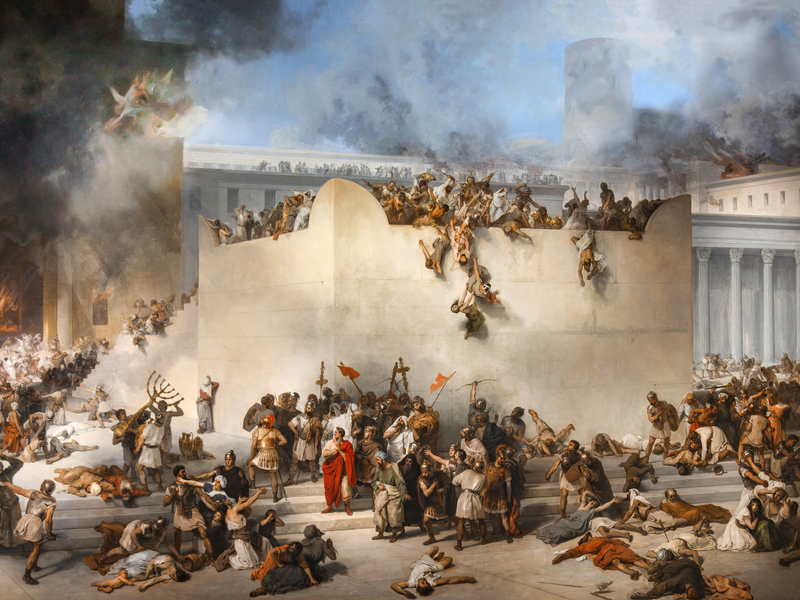
Bridging the Last Gap: Daniel’s Seventy Weeks Revisited

As we have seen in this series, each time there is a new covenant, there is a break in the year-by-year chronology. At the same time, each time the break is crossed by information provided in the text. Thus, the year-by-year chronology breaks down at the birth of Abraham, but…

by James B. JordanNovember 4, 1992
europeana-h-4wme4eooo-unsplash
Art

The Openness of Literature & the Mystery of Art

The Openness of Literature Let’s discuss literature for a moment. There are two ways a story or novel can close. The first is called poetic justice. When a story ends with poetic justice, the bad guys are all punished and the good guys are all rewarded. This kind of story…

by James B. JordanNovember 4, 1992

Showing page 287 of 309

See all

Showing page 39 of 43

See all

Day of Wrath (Romans 2)

What about taking “day of wrath” in Romans 2 as AD 70? Some arguments: 1) Dunn lists the verses that use similar phrases for “wrath and indignation” and “tribulation and distress,” and most of them are about historical judgments on Israel. There’s a cluster of uses in Deut 28:55ff, which…

November 7, 2003
Theology

Intellectualism and Voluntarism both arise

Intellectualism and voluntarism both arise from the same theological error: from the assumption that there is some realm that is independent and autonomous. This is most obvious with intellectualism: For intellectualists, things have indepdendent value that God recognizes and evaluates. Voluntarists are, however, making the same error. They assume that…

November 6, 2003

Studebaker on Pauw

Steve Studebaker writers in the Scottish Journal of Theology (56:3) about Edwards’s trinitarian theology, and includes an extended critique of Amy Plantinga Pauw’s treatment of Edwards’s incipient “social trinitarianism.” According to Studebaker, Pauw’s analysis only works if one assumes that the history of Trinitarian theology can be sketched out as…

November 5, 2003

The Olive Tree (Romans 11)

In the same issue of JSNT, Philip Esler examines ancient oleiculture to illumine Paul’s use of the olive tree image in Romans 11. When he describes branches being grafted into an olive tree, Paul refers to a common practice. But the normal practice is to graft cultivated olive branches onto…

November 5, 2003

Acts 20:20

Jerome Neyrey has an interesting article on Acts 20:20 in the current issue of JSNT. He examines the cultural background to Paul’s use of the phrase “in public and from house to house” by examining various expressions in Greek and Latin writers that correspond to modern “public” and “private.” These,…

November 5, 2003
Literature

Modernity

To what extent is modernity merely a recovery of the tragic? Tragedy, to my knowledge, simply didn’t exist in the medieval world. Drama revived late in the medieval period, but tragedy was reintroduced by the Renaissance. In Shakespeare, the tragic is set in a larger Christian comic setting, with profoundly…

November 5, 2003

Showing page 2170 of 2212

Browse by Category

In Medias Res

Your weekly digest for all things Theopolis.

Donate

Theopolis is nearly 100% donor-supported. Consider joining us on our mission.