Theopolis Logo

Writing

Explore our collection of theological essays, biblical studies, and reflections on faith and culture.

See all
denise-jans-dpemksg59la-unsplash
Art

Glorifications Versus Debasement

Because of sin, the arts sometimes do not serve to glorify but to debase. Sinful men make their environments ugly, and create ugly art to “enhance” their ugly words. But since all men are still God’s images, no men are able to live with such ugliness all the time. Thus,…

by James B. JordanMay 25, 1994

jeremy-yap-j39x2xx_8cq-unsplash
Art

Words and Glory

Arts and literature reviews in most evangelical Christian publications generally approach their subjects in terms of ideology. We are told whether or not the film or book is acceptable in terms of morals, sexual graphicness, and theological accuracy. While there is definitely a place for such reviews, I fear that…

by James B. JordanMay 25, 1994
screen-shot-2018-04-12-at-9-48-08-am
Biblical Horizons

Broadening Our View of the Trinity

We speak of God as Father, Son, and Holy Spirit. The early Church tended to speak of Him as Father, Word, and Spirit. In this short essay, I want to suggest some other ways to think of the Trinity, ways that I have found pastorally helpful in my own life…

by James B. JordanMay 5, 1994
Biblical Studies

Thousands of Generations

I, Yahweh your God, am a jealous God, visiting the iniquity of the fathers on the children, on the third and fourth of those who hate Me, but showing lovingkindness to thousands, to those who love Me and guard My commandments (Ex. 20:5-6). The Second Word forbids acts of ceremonial…

by James B. JordanMay 5, 1994
ben-white-w8qqn1pmqh0-unsplash
Biblical Chronology

The Chronology of the Pentateuch (Part 3)

8. The Table of Nations If we assume births every two years, and about 30 years between generations (cp. Gen. 11:12-24), we can come up with an approximate series of dates for the generations recorded in Genesis 10. We shall assume that all three of Noah’s sons had their firstborn…

by James B. JordanMay 5, 1994
49980-nicolas_poussin_-_the_judgment_of_solomon_-_wga18330-800w-tn
Biblical Studies

The Eighth Month

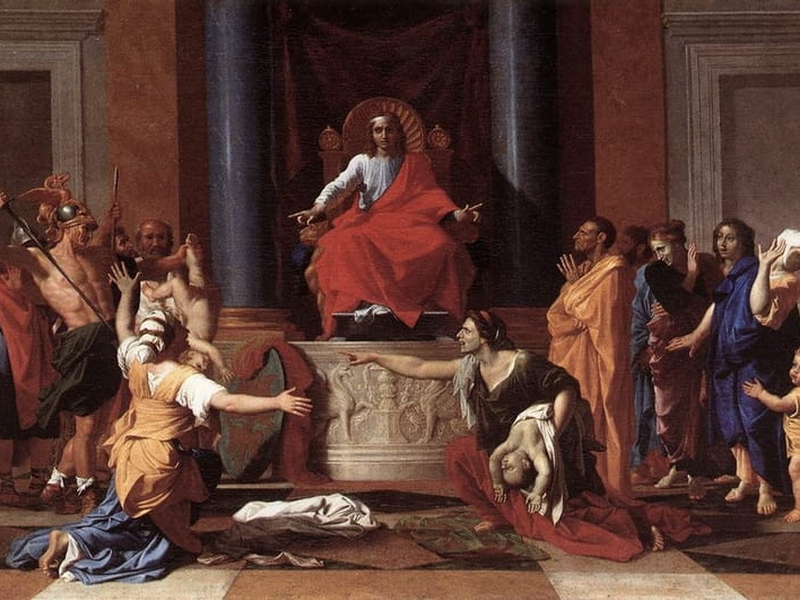
Zechariah’s first prophecy (Zech. 1:1-6) was delivered in the eighth month of the second year of Darius. The notation of this date serves a number of purposes. Most obviously, it relates Zechariah’s prophecies to those of Haggai. By the time Zechariah delivered his first prophecy, Haggai had already chided the…

by Peter LeithartApril 23, 1994

Showing page 279 of 309

See all

Showing page 39 of 43

See all

Shakespeare on Sacraments

In their essay on the Eucharist in Cultural Reformations , David Aers and Sarah Beckwith notes that “one of the central images in the exhortations to Holy Communion in the Book of Common Prayer and also in the ‘Homily of the Worthy Reception’ is the image of the heavenly banquet…

May 13, 2016

Reformation Crucifixion

In the second volume of his study of the cross in Western art ( The Triumph of the Cross ), Richard Viladesau notes that “the period immediately preceding the Reformation was one in which Christ's passion was treated with graphic emphasis on the violence of the events and on the…

May 13, 2016

Worthy Reception

In a contribution to Cultural Reformations , David Aers and Sarah Beckwith explain that “One of the chief reasons why Cranmer and other reformers thought the rejection of transubstantiation was so essential was that it negated the act of repentance and reception. If the body of Christ was e x…

May 12, 2016

Augustinian Eucharist

David Aers and Sarah Beckwith argue that Augustine's interpretation of John 6 cannot be understood in a Zwinglian or Wycliffite sense (essay in Cultural Reformations , 153). Augustine does say “Believe and you have eaten,” but Augustine's framework for saying this is corporate and ecclesial. As evidence, they summarize Augustine's…

May 12, 2016

Disenchantment and the Sacrifice of Intellect

Theology often lays claim to scientific status, Weber observes, but in doing so does something that no genuine science does: It operates with substantive presuppositions, especially the assumption that the cosmos is meaningful. In “Science as a Vocation,” he writes, “All theology represents an intellectual rationalization of the possession of…

May 12, 2016

From the Mountain

John is carried by the Spirit to a “great and high mountain” (Revelation 21:9-10), where he sees new Jerusalem descend from heaven. It's the last mountain in Bible, in line with Eden, Sinai, Zion, Moriah, Tabor, Olives. The link with Sinai is especially important, but not because this is a…

May 11, 2016

Showing page 290 of 2212

Browse by Category

In Medias Res

Your weekly digest for all things Theopolis.

Donate

Theopolis is nearly 100% donor-supported. Consider joining us on our mission.