Theopolis Logo

Writing

Explore our collection of theological essays, biblical studies, and reflections on faith and culture.

See all
timothy-eberly-djj49s6ud2o-unsplash
Leviticus

Yahweh's War Against Death

Stories, frankly all human stories are practically always about one thing aren’t they? Death. The inevitability of death. . . . “There is no such thing as a natural death. Nothing that happens to man is ever natural, since his presence calls the whole world into question. All men must…

by Brian MarrApril 14, 2014

screenshot-2023-09-21-at-4-52-42-pm
Matthew

Inescapable Blood

Matthew is organized around 5 discourses, which trace out the history of Jesus as a recapitulation of the history of God and Israel in the Old Testament. Jesus first speaks as a new Moses, instructing His disciples on a mountain about a righteousness that surpasses the righteousness of the scribes…

by Peter LeithartApril 10, 2014
screen-shot-2022-05-12-at-12-07-23-pm
Angels

Did Angels Marry People? The Sin of Cultural Intermarriage

The fall of the Sethites in Genesis 6 is the third fall of mankind, or the third degree of Adam’s original fall. Adam sinned in a Garden against his Father by stealing something he was supposed to wait to obtain. (“Every tree shall be food for you” Genesis 1:29.) Cain…

by James B. JordanApril 7, 2014
sixteen-miles-out-al48tflf4e8-unsplash
Angels

Did Angels Marry People? The Sons of God in Genesis 6

The recent fantasy film Noah and a slightly related blog comment by my friend Douglas Wilson have stirred up again the question of whether the “sons of God” in Genesis 6 who married the “daughters of men” were fallen angels or the priestly line of Seth. Doug argues for angels,…

by James B. JordanApril 4, 2014
kiwihug-l4gw27xzn1i-unsplash
Angels

The Angels of Jude

The prophecy of Jude concerns apostasy. An illustration of apostasy and its consequences is found in verse 6, which the New American Standard Bible translates this way: "And angels who did not keep their own domain, but abandoned their proper abode, He has kept in eternal bonds under darkness for…

by James B. JordanApril 3, 2014
screenshot-2023-09-21-at-4-22-42-pm
Matthew

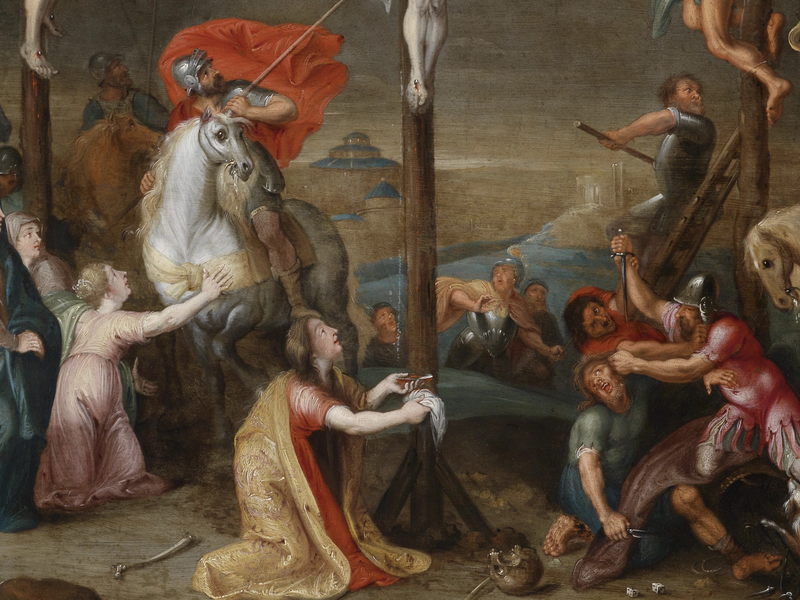
Women at the Cross

At His death, Jesus is surrounded by a Roman centurion and his cohort of Gentile solders. Matthew doesn't say that any disciples are there. But women are, and so is Joseph of Arimathea, identified as a “disciple” but, as John tells us, a “secret disciple for fear of the Jews,”…

by Peter LeithartMarch 31, 2014

Showing page 176 of 309

See all
See all

Essential/Accidental Meaning

Gracia’s own suggestion is that we can make sense of the determinateness and indeterminateness of meaning by distinguishing between “essential” and “accidental” meanings: “although texts may have a well-delimited core of meaning (an essential meaning), they may have other meanings that are the result of contingent conditions, such as changes…

June 6, 2008

No Smoking

In the entry on meaning in the Dictionary for Theological Interpretation of the Bible (Baker), Jorge Gracia responds to the view that textual meaning has no limits with this: It is true that “texts are understood by different persons, or even by the same person at different times, to mean…

June 6, 2008

Tallis

Joel Garver writes, in response to several posts from Raymond Tallis’s Not Saussure : “Most post-structuralist authors I’ve read aren’t dealing with things such as cups or trees or rocks, but rather things such as rationality, madness, criminality, virtue, etc. Foucault, for instance, seems to take bodies as ontologically basic,…

June 5, 2008
Literature

Bible and poetry

Fisch yet again: After reviewing the influence of the Old Testament, especially the Psalms, on prose writing in the seventeenth century, he adds: “it is worth bearing in mind that this is not only a matter of the seventeenth century. It is found earlier in the antiphonal plain-song of the…

June 5, 2008
Literature

Hebraic prose

Fisch again: Hebraic prose is different from the grand style of the sixteenth century, and different too from the pared-down plain style shared by many Puritans and all Baconians. It is a rhetoric, not an anti-rhetoric, but it is a rhetoric purified by Puritanism, Senecanism, and scientism. It is biblical…

June 5, 2008
Literature

Jerusalem and Albion

In his 1964 book, Jerusalem and Albion: The Hebraic Factor in Seventeenth-Century Literature , Harold Fisch argues that Blake provides a more insightful and broader account of the seventeenth century’s “dissociation of sensibility” than Eliot, who coined the phrase. For Blake, the great crisis of England was the dissociation of…

June 5, 2008

Showing page 1507 of 2212

Browse by Category

In Medias Res

Your weekly digest for all things Theopolis.

Donate

Theopolis is nearly 100% donor-supported. Consider joining us on our mission.