Theopolis Logo

Writing

Explore our collection of theological essays, biblical studies, and reflections on faith and culture.

See all
5f72533d0afa437fcaa7e5cf_hero_history
Apologetics

Presumptuous Presuppositions: The Apologetics of Cornelius Van Til

Whether one entirely agrees with him or not, no Christian interested in apologetics–the reasoned defense of the Faith–can afford to be uninterested in Cornelius Van Til, the late professor of Apologetics at Westminster Theological Seminary in Philadelphia. According to John Frame, Van Til “is perhaps the most important thinker since…

by Mark HorneJuly 15, 1997

trnava-university-beeyeib-am8-unsplash
Baptism

Richard Bacon’s “What Mean Ye By This Service? Paedocommunion in Light of the Passover” A Brief Response

Reverend Richard Bacon is the pastor of First Presbyterian Church of Rowlett, Texas. He has written a tract entitled “What Mean Ye By This Service? Paedocommunion in Light of Passover,” printed by Presbyterian Heritage Publications (P.O. Box 180922, Dallas, TX 75218). I am writing this brief response to set forth…

by Mark HorneJuly 6, 1997
aaron-burden-qjdzyt_k8xg-unsplash
Angels

Twelve Fundamental Avenues of Revelation, Part 5

As we move toward a consideration of Dynamic Cosmic Revelation, there is a further aspect of revelation through action that should be discussed here, and that is this: God is particularly revealed to us in times of crisis and distress. When things are going well, we forget God. When distress…

by James B. JordanJuly 3, 1997
jan-kahanek-g3o5ztrk2e4-unsplash
Biblical Chronology

John Sailhamer Weighs In, Part 4

We conclude our analysis of John Sailhamer’s book *Genesis Unbound: A Provocative New Look at the Creation Account* (Multnomah Books, 1996), which argues that Genesis 1:2ff. is not about the creation of the whole world, but about the preparation of the Land of Eden, which is also the Promised Land.…

by James B. JordanJuly 3, 1997
screenshot-2023-09-04-at-10-37-01-am
Biblical Horizons

The Sin of Ham and the Curse of Canaan, Part 2 (An Exposition of Genesis 9:20-27)

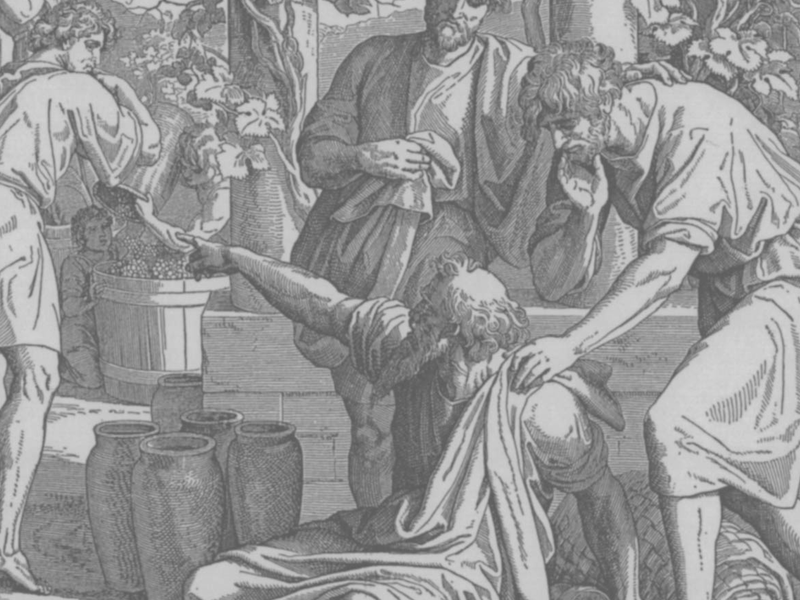
Commentary A. Noah’s God-like Labor: 8:20 And Noah, a master of the ground, was the first, And he planted a vineyard. 21 And he drank from the wine, And became drunk, And lay uncovered inside his tent. It appears to me that there is a balance between "ground" and "tent"…

by James B. JordanJuly 3, 1997
e99a4713
How to Worship

Why Does the Pastor Wear a Robe?

A Defense of the Use of the Ministerial Robe in Public Worship The purpose of this series of articles is to explain our biblical philosophy of worship and how we have sought to implement it here at Providence Reformed Presbyterian Church. We have thought through our worship services. We have…

by Jeff MeyersJune 20, 1997

Showing page 255 of 309

See all
See all

Exhortation

Most of the Beatitudes in Matthew are stated in third person. “Blessed are the poor in spirit, for theirs is the kingdom of heaven.” ” They shall be comforted,” ” they shall inherit the earth,” ” they shall be called the sons of God.” At the end, Jesus changes the…

September 2, 2007
Theology

Music, Time, and Augustine

One of the best discussions of Augustine’s views on time comes from Jeremy Begbie’s Theology, Music, and Time (ch. 3). Following Ricoeur’s discussion, Begbie claims that Augustine’s distentio “is conceived as the three-fold present, and the threefold present as distentio . The distentio consists in the non-coincidence of the mind’s…

August 30, 2007
Theology

Escaping time

John Rist offers some important insights into Augustine’s view of time. He notes, as many commentators do, that Augustine is not aiming to provide a definition of time but to answer the question of how time can be measured. The dilemma is: If the past no longer is, and the…

August 30, 2007

Distention and eschatology

In a 1957 essay in Man and Time , Gilles Quispel claims that Augustine’s views of time have been extracted from the “great struggle between a cyclical and a historical view of the world, between archaism and Christianity,” and therefore have been misunderstood. Augustine “comes to grips with the Neoplatonists…

August 30, 2007
Philosophy

Augustine’s non-Aristotelian Universe

Augustine argues in Confessions that time is not reducible to the movement of the celestial bodies. Aristotle agreed; but, as Ricoeur points out, the arguments that Augustine used departed radically from Aristotle. First, if the sun and stars stopped moving, and yet a potter’s wheel continued to move, time would…

August 30, 2007

Showing page 1638 of 2212

Browse by Category

In Medias Res

Your weekly digest for all things Theopolis.

Donate

Theopolis is nearly 100% donor-supported. Consider joining us on our mission.