Theopolis Logo

Writing

Explore our collection of theological essays, biblical studies, and reflections on faith and culture.

See all
tanner-mardis-xuxghzhibn4-unsplash-1-2
Biblical Studies

Tweets-turned-Notes on the Bible’s Chronology

Summary In what follows, I will consider the “year-stamps” employed in Scripture, i.e., statements of the form, “Such-and-such an event took place in the Xth year of Y.” In the process, I will suggest some ways in which the Biblical narrative might relate to events in the extra-Biblical world, though…

by James BejonJuly 16, 2019
durer-prodigal-son-2
Luke

Perspectives on the Prodigal, (Part 2)

In the first essay on the parable of the Prodigal Son, I suggested that the problems commentators and others encounter in interpreting Jesus three-part parable are not accidental. These are not just problems in our ignorance of cultural background. They are intentional features of the stories —stories designed to poke…

by Ralph Allan SmithJuly 11, 2019
durer-prodigal-son-2
Luke

Perspectives on the Prodigal, (Part 1)

The story of the Prodigal Son is perhaps the most well-known story in the Bible. As others have observed, it may also be one of the most misunderstood. In two short essays, I will point out features of this story that are commonly neglected, aspects of Jesus’ parable that might…

by Ralph Allan SmithJuly 9, 2019
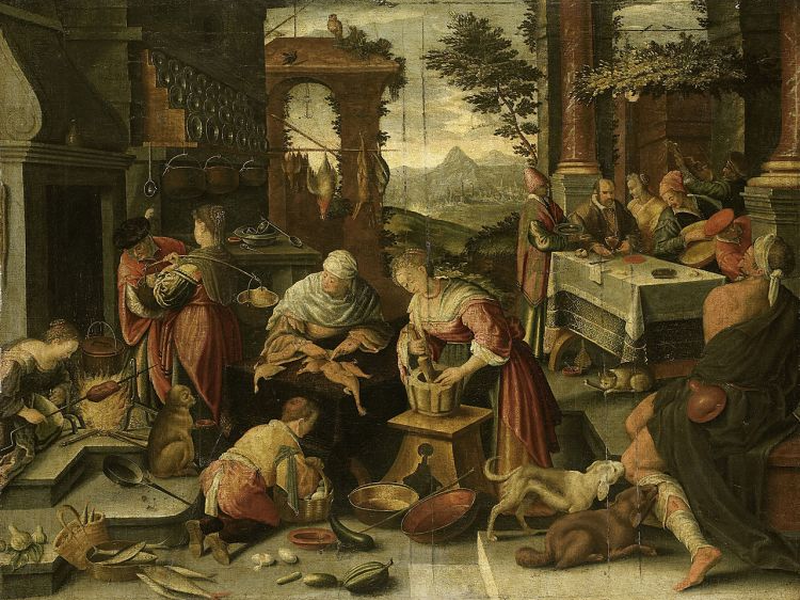
de-rijke-man-en-de-arme-lazarus-by-jacopo-da-ponte-16th-century
Luke

Lazarus and the Rich Man

The parable of Lazarus and the nameless rich man is not an independent story. It is part of a long context that begins in Luke 15:1, where Jesus is eating with tax collectors and sinners and the scribes and Pharisees grumble. In response to their hardheartedness, Jesus tells a three-part…

by Ralph Allan SmithJuly 4, 2019
aaron-burden-uynrnfdkjwg-unsplash
Luke

Everybody has Dropsy - Luke 14:1-24

The Bible is written so that even when a reader cannot pick up on what might be deeper or more detailed aspects of a text, there is virtually always a message to be heard. In the ancient world, where the “reader” of Scripture would likely be a church official facing…

by Ralph Allan SmithJuly 2, 2019
communion
Biblical Theology

Fruit Trees and Grain Plants

The distinction between garden (or vineyard) and field begins in Genesis 2. This relates to the ordering of the formless world. Plants of the field are contrasted with the garden planted by God in Genesis 2:5&8. Later on, under the Old Covenant the Israelites will be required to keep their…

by James B. JordanJune 27, 2019

Showing page 77 of 309

See all
See all

Luther and Medieval Piety

T he great question haunting late medieval piety was that of the inadequacy of human piety. As Berndt Hamm puts it ( Reformation of Faith ), the “harrowing question” was that of the “spiritual inadequacy” of Christians (88). The late medieval answer was to reduce the requirements necessary to meet…

April 14, 2017

Politics of the Picturesque

I n his Landscape, Liberty and Authority , Tim Fulford examines the paradox of William Gilpin's travel writings and tour-leading in the picturesque wilds of Wales, England, and Scotland. Gilpin was aware that “the picturesque might be socially dangerous,” so much so that he apologizes to the noble landowners whose…

April 14, 2017

Separation and Incorporation

I n his contribution to Signifying Identities , Fredrik Barth suggests that our notion of political, economic and social boundaries is an extension of the feeling that a tool extends the body: When you hold a knife or a spoon in your hand and use it as an implement, the…

April 14, 2017

Early Christian Disenchantment

G uy G. Stroumsa writes in The Making of the Abrahamic Religions in Late Antiquity that “For Weber, as is well known, the most striking ‘disenchantment of the world' in history occurred with the rise of the ‘inner-worldly' asceticism ( innerweltliche Askese ) of the Calvinist Reformation. And yet, it…

April 14, 2017

From Reform to Revolution?

M ichel de Certeau ( The Writing of History , 126-7) quotes Alphonse Dupront on the post-Reformation situation of the church: “a first piece of raw material, as obvious as capital for the modern mind, is the progressive promotion of heresy in confession and of confession in church. . .…

April 14, 2017

The Unity of Christian Europe

In a 1971 essay, H.G. Koenigsberger challenged the notion that the Reformation broke up a unified Europe. He criticizes historians and social scientists for assuming a norm of unity: “We have assumed that the theological and ecclesiastical unity of Catholic Christendom was its natural condition and that, in consequence, the…

April 13, 2017

Showing page 186 of 2212

Browse by Category

In Medias Res

Your weekly digest for all things Theopolis.

Donate

Theopolis is nearly 100% donor-supported. Consider joining us on our mission.