Theopolis Logo

Writing

Explore our collection of theological essays, biblical studies, and reflections on faith and culture.

See all
timothy-eberly-djj49s6ud2o-unsplash
Leviticus

Yahweh's War Against Death

Stories, frankly all human stories are practically always about one thing aren’t they? Death. The inevitability of death. . . . “There is no such thing as a natural death. Nothing that happens to man is ever natural, since his presence calls the whole world into question. All men must…

by Brian MarrApril 14, 2014

screenshot-2023-09-21-at-4-52-42-pm
Matthew

Inescapable Blood

Matthew is organized around 5 discourses, which trace out the history of Jesus as a recapitulation of the history of God and Israel in the Old Testament. Jesus first speaks as a new Moses, instructing His disciples on a mountain about a righteousness that surpasses the righteousness of the scribes…

by Peter LeithartApril 10, 2014
screen-shot-2022-05-12-at-12-07-23-pm
Angels

Did Angels Marry People? The Sin of Cultural Intermarriage

The fall of the Sethites in Genesis 6 is the third fall of mankind, or the third degree of Adam’s original fall. Adam sinned in a Garden against his Father by stealing something he was supposed to wait to obtain. (“Every tree shall be food for you” Genesis 1:29.) Cain…

by James B. JordanApril 7, 2014
sixteen-miles-out-al48tflf4e8-unsplash
Angels

Did Angels Marry People? The Sons of God in Genesis 6

The recent fantasy film Noah and a slightly related blog comment by my friend Douglas Wilson have stirred up again the question of whether the “sons of God” in Genesis 6 who married the “daughters of men” were fallen angels or the priestly line of Seth. Doug argues for angels,…

by James B. JordanApril 4, 2014
kiwihug-l4gw27xzn1i-unsplash
Angels

The Angels of Jude

The prophecy of Jude concerns apostasy. An illustration of apostasy and its consequences is found in verse 6, which the New American Standard Bible translates this way: "And angels who did not keep their own domain, but abandoned their proper abode, He has kept in eternal bonds under darkness for…

by James B. JordanApril 3, 2014
screenshot-2023-09-21-at-4-22-42-pm
Matthew

Women at the Cross

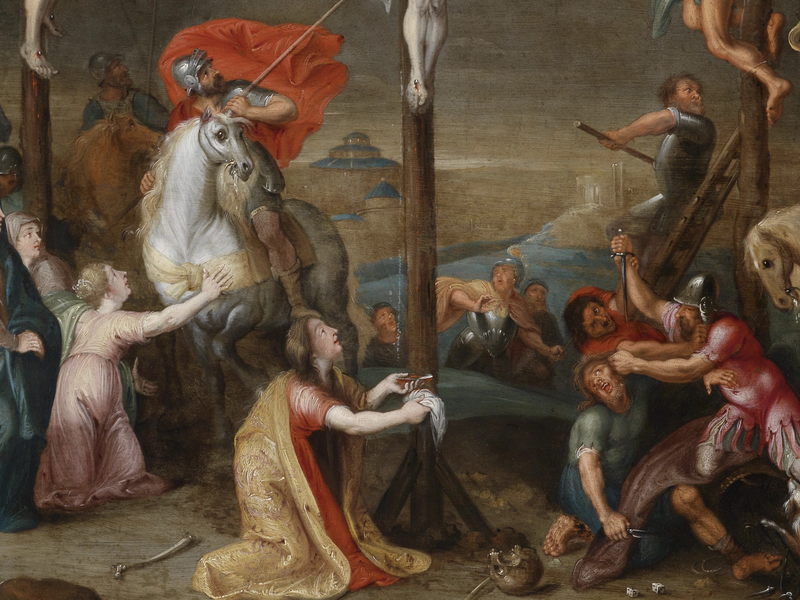
At His death, Jesus is surrounded by a Roman centurion and his cohort of Gentile solders. Matthew doesn't say that any disciples are there. But women are, and so is Joseph of Arimathea, identified as a “disciple” but, as John tells us, a “secret disciple for fear of the Jews,”…

by Peter LeithartMarch 31, 2014

Showing page 176 of 309

See all
See all
Theology

Time and the end of actions

Why should there be a final judgment when God judges in time? Aquinas answers: “Judgment on something changeable cannot be rendered fully before its consummation. Thus judgment cannot be rendered fully regarding the quality of any action before its completion, both in itself and its results, because many actions appear…

April 6, 2006

Observations on 2 Corinthians 1

1) Verse 4 moves from the affliction of the apostles (“our”) to the comfort of “those who are in any affliction.” This movement does not depend on any similarity or identity between the affliction of the apostles and the affliction of other sufferers (though cf. v. 6b). Members of the…

April 6, 2006
Philosophy

Descartes, Meditations

A few notes on Descartes, Meditations 1-2, with lots of help from Jean-Luc Marion. Descartes’s ego cogito, ergo sum is not, Marion points out, original, at least in its form. It has origins in Augustine, who offered this response to the skeptics: “I have no fear of the arguments of…

April 6, 2006

Copernican Revolution

Some scattered thoughts inspired by comments from Chris Schlect and Doug Wilson at a faculty discussion of de Lubac today: How is it that theologians (like Norman Shepherd, Steve Wilkins, Rich Lusk, and others) who want to expunge the notion of merit from theology get accused of being “neo-nomians” and…

April 5, 2006
Theology

Surnaturel and Protestantism

Milbank asks the intriguing question of whether de Lubac’s surnaturel thesis “rather deconstructs the terms of the Schleiermacher/Barth divide.” He appears to mean that the polarization of Schleiermacher’s “intrinicism” and Barth’s “extrinicisim” is dissolved by de Lubac’s Thomist understand of nature and grace. To adopt, for the moment, an idiom…

April 5, 2006

Against Yale

Milbank contrasts de Lubac’s advocacy of patristic and medieval hermeneutics, which insists that the allegorical fulfills and completes the literal, with the Yale school, which he sees as living in “the no-man’s land of ‘history-like narrative’ which at once abolishes real history and ignores the essential allegorical underpinning of Christian…

April 5, 2006

Showing page 1862 of 2212

Browse by Category

In Medias Res

Your weekly digest for all things Theopolis.

Donate

Theopolis is nearly 100% donor-supported. Consider joining us on our mission.