Theopolis Logo

Writing

Explore our collection of theological essays, biblical studies, and reflections on faith and culture.

See all
blocks-t3mkjxfdims-unsplash-2
Advent

Advent and Christmas Music Recommendations

Inspired by our recent podcast on Christmas and Advent music recommendations, we offer here a list of excellent recordings that are sure to enrich your Advent and Christmas season. Praetorius: Mass for Christmas Morning Paul McCreesh with the Gabrieli Consort and Players Amazon | Spotify | Apple Music 2. Christmas…

by John Ahern and Paul BuckleyDecember 23, 2020

sasha-stories-c6g-26myd34-unsplash
Advent

Between the Altar and the City: Isaiah 65:17-25

In the year 1483 in the city of Nuremberg, the leaders of the renowned Saint Lawrence Church were seeking to redesign their altar, and above the table where the priests presided over the eucharist, they wanted new art installed above the prestigious Krell altar. What they decided on took everyone…

by Casey BedellDecember 22, 2020
adam-and-eve-in-the-garden-of-eden-wenzel-peter
Advent

Why We're the Real Seventh Day Adventists

The consequences of disobedience start with exile from the garden of God and the Tree of Yahweh, but they do not end there. They cascade down through the structure of the dynastic order. Everything which had previously been given in the Kingdom of Elohim is either taken back or curtailed…

by Jerry BowyerDecember 18, 2020
herrmann-stamm-19il-6uc5c4-unsplash
Biblical Studies

Psalm 23: A Lesson in Reading Biblical Poetry

Parallelism: A Course Correction If you have ever studied Hebrew poetry, you have probably heard its basic poetic feature described as “parallelism.” Hebrew poetry is not metered, it does not rhyme, it does not employ many of the common poetical tropes, but its distinctive (and almost universal) feature is commonly…

by Ryan HandermannDecember 15, 2020
screen-shot-2020-12-11-at-10-04-32-am
Deuteronomy

Deuteronomy 17 and the Separation of Powers

In The Crown and the Courts , David C. Flatto traces the development of the idea of judicial independence in Jewish commentaries on the Scriptures – particularly Deuteronomy 17 – from the Second Temple and early rabbinic periods. These periods roughly span 400 BC to 300 AD. Flatto does not…

by James R. RogersDecember 11, 2020
67201-zechariah-verses-1200w-tn
Advent

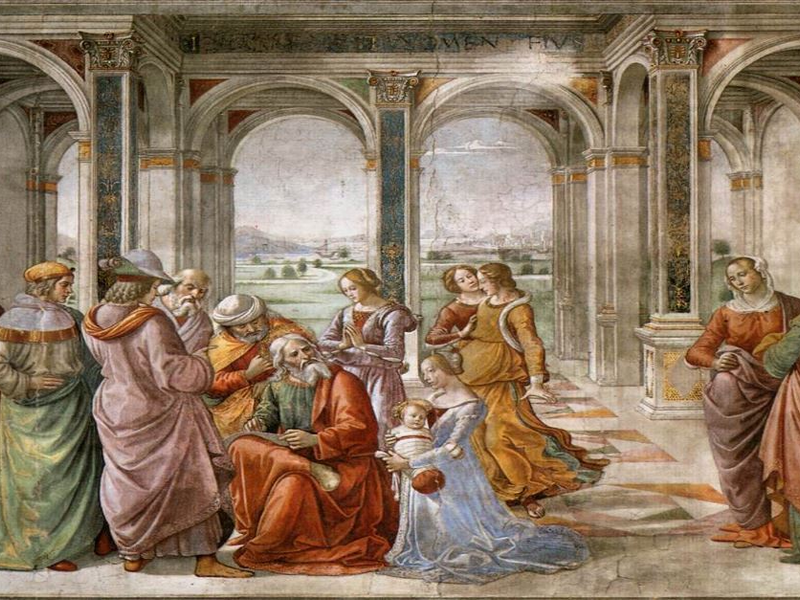
Zechariah and John: A Story in Names

A curious feature of the Infancy Narratives in the Gospel of Luke is the naming of John the Baptist. When the angel appears to Zechariah, he is instructed to give his promised son the name John (Luke 1:13). On the day of John’s circumcision, Luke tells us that “they [presumably…

by Rhys LavertyDecember 8, 2020

Showing page 60 of 309

See all
See all
Philosophy

Heidegger in his woods

Latour is tired of being accused of having forgotten Being, and offers this clever brush-off of Heidegger: “If, scorning empiricism, you opt out of the exact sciences, then the human sciences,, then traditional philosophy, then the sciences of language, and you hunker down in your forest - then you will…

November 15, 2006
History

Semi-modernism

Postmoderns, Latour suggests, think they are still modern, but in fact they have greatly oversimplified the modern Constitution. Postmoderns might emphasize the separation of subject and world, and stretch that opposition to a breaking point (Latour vividly describes them as doing the splits to keep subject and world apart); but…

November 15, 2006
History

Modern temporality

In his very good section on modern temporality, Latour argues that modernity assumes that everything in the present, modern moment, is purely modern, novel. Anything that appears that is not up-to-date is a “archaism,” and moderns worry constantly that this or that event or trend might “turn back the clock.”…

November 15, 2006
History

Representation

One of the key moves made since the 17th century, Latour argues, is a distinction between modes of “representation.” In the laboratory Boyle is representing things before selected witnesses through scientific experiments, giving mute nature a voice through the scientist, while in politics Hobbes suggests that the Sovereign speaks for…

November 15, 2006
History

We Have Never Been Modern

Bruno Latour’s We Have Never Been Modern (Harvard 1993) is a rich study. He describes modernity in terms of a dual process of “purification” and “hybridization.” Purification involves the clean construction of a nature (and science) separated off from society and the self, while hybridization involves mixtures of nature and…

November 15, 2006

Tears of things

And/Or: Virgil is aware that the furor of civil war can be curbed only by an opposing, and more intense, furor. That, as Milbank says, is the way of paganism - peace established only by superior violence against violence. But in those tears Virgil expresses the the painful recognition -…

November 13, 2006

Showing page 1763 of 2212

Browse by Category

In Medias Res

Your weekly digest for all things Theopolis.

Donate

Theopolis is nearly 100% donor-supported. Consider joining us on our mission.