Theopolis Logo

Writing

Explore our collection of theological essays, biblical studies, and reflections on faith and culture.

See all
screen-shot-2023-05-02-at-1-14-25-pm
Poetry

Seed-bearing Fruit

Ten-thousand ‘yeses’ and a single ‘no.’ From bough it dangles, beauty to the eyes, For belly, food, a fruit to make one wise. Too soon, they eat; they know; the leaves they sew, But, oh! the Love who asks, “Where did you go?” Confessions flow from under leaf’s disguise; A…

by Marc HaysAugust 16, 2023
screenshot-2023-08-15-at-8-22-28-am
Augustine

Eternal Life Chiasm in John's Gospel

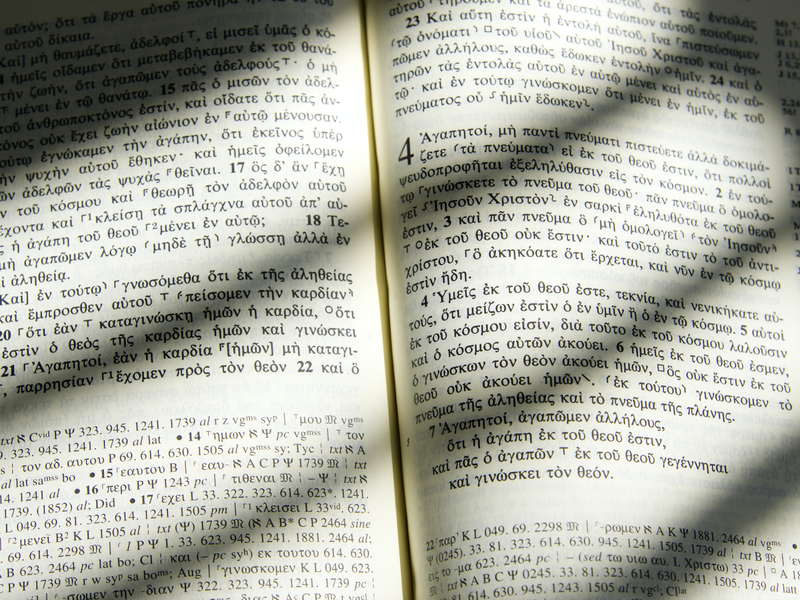
In his masterful work, De Doctrina Christiana , Augustine of Hippo writes: I would have learned men to know that the authors of our Scriptures use all those forms of expression which grammarians call by the Greek name tropes, and use them more freely and in greater variety than people…

by Doug PonderAugust 15, 2023
screenshot-2023-08-08-at-11-13-28-am
Ruth

Lot, Ruth, and the Work of New Creation

“In accordance with the creation pattern, God sovereignly took hold of Adam and put him to sleep. Then God divided Adam by removing flesh and bone from his side, and restructured humanity into male and female. When Adam awoke, God distributed the woman to him. Adam gazed upon her and…

by Josh JensenAugust 8, 2023
rev-1-barbie-tp-0002-high-res-jpeg-647e152f50df6-2
Culture

The Barbie Movie

Greta Gerwig’s new film, Barbie, has been criticized, probably rightly, for having too many ideas and layers to properly bring in any for a landing. Gerwig herself thought the script was so “ wild and anarchic ” that she was surprised WB agreed to make it. Many see it as…

by Robin HarrisAugust 1, 2023
mariam-soliman-ht5xmeulydg-unsplash-2
Matthew

Why Does John the Baptizer Look Like a Camel?

“Now John wore a garment of camel’s hair and a leather belt around his waist, and his food was locusts and wild honey” (Matt. 3:4). Why is John the Baptizer clothed with camel’s hair? Why does he want to look like a camel? Or at least: what does he expect…

by Jeff MeyersJuly 26, 2023
darwin
Literature

Stinking, Rotten Ministers of the Gospel

In the second greatest story ever told, The Brothers Karamazov , Fyodor Dostoyevsky tells the story of a family plagued by the lasting legacy of sin’s destructive power and the all-surpassing truth that God is Light and in Him is no darkness. The young protagonist, Alyosha, is a monk committed…

by Garrett SoucyJuly 18, 2023

Showing page 29 of 309

See all
See all
History

Nature/Supernature in Luther

According to Oberman, “Luther’s critique of Aristotle concerns the disregard of that fundamental nominalist axioma , the demarcation line between the realms of reason and faith. Provided that this distinction is respected, Aristotle is not merely useful but indeed to be respected. In a Latin sermon probably preached to the…

May 4, 2006
Theology

Person v. Being

Oberman sees a crucial shift in late medieval theology from God as being to God as person, and sees Luther as both heir and critic of the late medieval theology proper. Without the earlier shift, “the Reformation breakthrough would be inconceivable,” but this does not mean that there is “unbroken…

May 4, 2006
History

Plague and Theology

Oberman again: “The experience of the [bubonic] plague may in fact help us understand the fifteenth-century ascendency of nominalism, its innovations in the whole field ranging from theology to science, and its successful invasion of schools and universities, where it was firmly established as the via moderna . What must…

May 4, 2006
History

Cultural history and religion

Heiko Oberman notes the impact of cultural history in his posthumously published book, The Two Reformations : “By moving from established politicla history to cultural and mentality studies, historians reestablished the crucial importance of religion, although they frequently marginalized it under the misleading category of popular religion . . .…

May 4, 2006

Proverbs 14:8-15

INTRODUCTION Waltke points to links between verses 8-9 and verses 1-2 of the same chapter: Wisdom and folly are contrasted in verses 1 and 8; the image of the “way” is used in both verses; and the term “upright” appears in verse 2 and 9. These links suggests that verses…

May 4, 2006
Theology

Simmel, Faithfulness and Gratitude

Notes on Georg Simmel, “Faithfulness and Gratitude,” printed in Kurt H. Wolff, The Sociology of Georg Simmel (Free Press, 1950). 1) Simmel describes faithfulness as “the inertia of the soul.” Less impressionistically, faithfulness is “the peculiar feeling which is not directed toward the possessor’s eudaemonistic good, nor toward the other’s…

May 3, 2006

Showing page 1846 of 2212

Browse by Category

In Medias Res

Your weekly digest for all things Theopolis.

Donate

Theopolis is nearly 100% donor-supported. Consider joining us on our mission.