Theopolis Logo

Writing

Explore our collection of theological essays, biblical studies, and reflections on faith and culture.

See all
denise-jans-dpemksg59la-unsplash
Art

Glorifications Versus Debasement

Because of sin, the arts sometimes do not serve to glorify but to debase. Sinful men make their environments ugly, and create ugly art to “enhance” their ugly words. But since all men are still God’s images, no men are able to live with such ugliness all the time. Thus,…

by James B. JordanMay 25, 1994

jeremy-yap-j39x2xx_8cq-unsplash
Art

Words and Glory

Arts and literature reviews in most evangelical Christian publications generally approach their subjects in terms of ideology. We are told whether or not the film or book is acceptable in terms of morals, sexual graphicness, and theological accuracy. While there is definitely a place for such reviews, I fear that…

by James B. JordanMay 25, 1994
screen-shot-2018-04-12-at-9-48-08-am
Biblical Horizons

Broadening Our View of the Trinity

We speak of God as Father, Son, and Holy Spirit. The early Church tended to speak of Him as Father, Word, and Spirit. In this short essay, I want to suggest some other ways to think of the Trinity, ways that I have found pastorally helpful in my own life…

by James B. JordanMay 5, 1994
Biblical Studies

Thousands of Generations

I, Yahweh your God, am a jealous God, visiting the iniquity of the fathers on the children, on the third and fourth of those who hate Me, but showing lovingkindness to thousands, to those who love Me and guard My commandments (Ex. 20:5-6). The Second Word forbids acts of ceremonial…

by James B. JordanMay 5, 1994
ben-white-w8qqn1pmqh0-unsplash
Biblical Chronology

The Chronology of the Pentateuch (Part 3)

8. The Table of Nations If we assume births every two years, and about 30 years between generations (cp. Gen. 11:12-24), we can come up with an approximate series of dates for the generations recorded in Genesis 10. We shall assume that all three of Noah’s sons had their firstborn…

by James B. JordanMay 5, 1994
49980-nicolas_poussin_-_the_judgment_of_solomon_-_wga18330-800w-tn
Biblical Studies

The Eighth Month

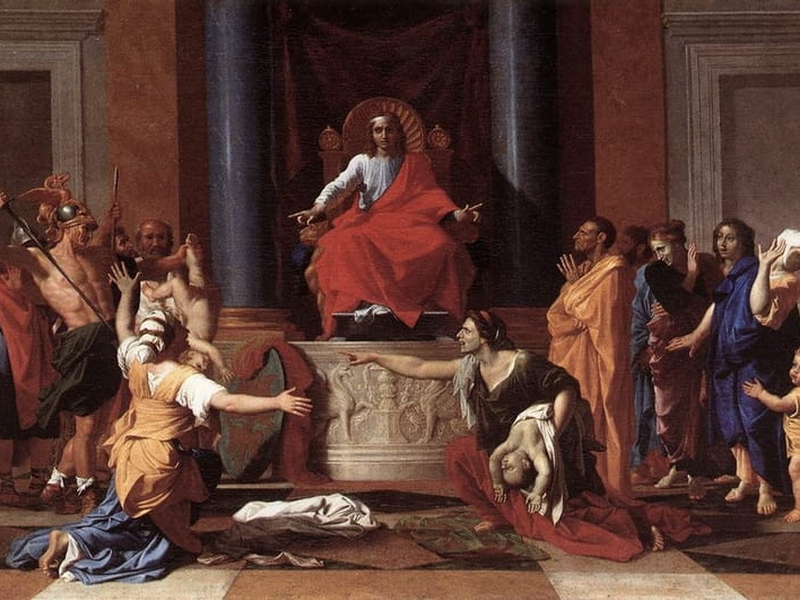
Zechariah’s first prophecy (Zech. 1:1-6) was delivered in the eighth month of the second year of Darius. The notation of this date serves a number of purposes. Most obviously, it relates Zechariah’s prophecies to those of Haggai. By the time Zechariah delivered his first prophecy, Haggai had already chided the…

by Peter LeithartApril 23, 1994

Showing page 279 of 309

See all
See all
Liturgy

Sabbath Threshing

Solomon built the temple on the threshing floor that David bought from Araunah the Jebusite (2 Samuel 24; 2 Chronicles 3). What might that mean? Grain is threshed when an animal walks over it, sometimes dragging a threshing sledge, to separate the grain from the chaff. Threshed grain is winnowed,…

October 23, 2015
Art

Life and Culture Series

These are remarks delivered to introduce conductor John Mason Hodges as the first Birmingham Life and Culture speaker. This is the first of what we hope will be an annual lecture on the arts and culture. Each year, we’ll bring a painter, musician, poet, sculptor, novelist, critic, architect, or scholar…

October 22, 2015

Two Tables

Jesus’ action in the temple was a symbolic enactment of the coming destruction of the temple. The Jewish leaders had turned what should have been a house of prayer for the Gentiles into a den of brigands. Jesus overturned the tables and chairs to dramatize what lay on the horizon…

October 22, 2015

Double Time in Othello

AC Bradley ( Shakespearean Tragedy ) points out that Othello has an unusual structure for a Shakespeare tragedy. The main conflict doesn't arise until the third act, and then the pressure and movement is relentless from that point to the end. In the other tragedies, the crisis emerges earlier, Act…

October 22, 2015

The Quadrigal Form of Christian Thought

The quadriga - the fourfold sense, consisting of literal, allegorical, tropological, and anagogical - isn't only a “method” for interpreting Scripture but a framework for interpreting everything . Two assumptions guide my reflections here. First, medieval biblical scholars insisted that biblical allegory and typology was not merely a method of…

October 22, 2015
Rosenstock-Huessy

Listening

Theories of language, Rosenstock-Huessy comments, focus almost exclusive attention on the speaker or writer, and almost none on the listener: “Our philology is built around the process of talking, speaking, writing.” Listening is emphasized in “military training for obedience, understanding to psychology, listening and learning to acoustics and education.” But…

October 21, 2015

Showing page 360 of 2212

Browse by Category

In Medias Res

Your weekly digest for all things Theopolis.

Donate

Theopolis is nearly 100% donor-supported. Consider joining us on our mission.