Theopolis Logo

Writing

Explore our collection of theological essays, biblical studies, and reflections on faith and culture.

See all
e99a2191
Theopolis News

New Season & New Relationships

We have moved from death to new life, from Lenten darkness to Easter light. And while Easter Sunday may have come and gone, it's effects are continually with us. This season has brought with it several new relationships, events, and signs of growth for Theopolis. We have been networking with…

by Peter LeithartMay 9, 2016

eucharist-2
Eucharist

Social Eucharist in the Middle Ages

In The People's Work , a social history of Christian Worship, Frank Senn summarizes the developments of the medieval period with regard to the Eucharist. He begins by challenging the assumption that medieval society was held together by “the church.” He notes that the church was often divided and conflicted,…

by Peter LeithartMay 5, 2016
turing-machine
Biblical Theology

What Is Systematic Typology? Part 4: Wheels Within Wheels

The structure of the Bible resembles something which was grown rather than built, composed rather than assembled. Its employment of “structure-as-sign” at every level from micro- to macrocosmic leads to the conclusion that a hermeneutic worthy of Scripture requires not only training in history, art and music but also the…

by Mike BullMay 3, 2016
giotto-noli-me-3
Luke

Eighth Day, Eighth Verdict

For some in first-century Israel, Easter was anything but good news. It was a terrifying surprise. For the rulers and powers that put Jesus to death, the idea that He had been raised by some power beyond their control was chilling. Early in Luke’s gospel, we're told that Herod thought…

by Peter LeithartApril 28, 2016
sebastian-pena-lambarri-yv593oymkmo-unsplash
Hermeneutics

153 Large Fish

Simon Peter went up, and drew the net to land, full of large fish, a hundred and fifty-three; and although there were so many, the net was not torn. (John 21:11) This is one of those texts in the Bible that many people puzzle over. It is not a puzzle…

by James B. JordanApril 26, 2016
jesus-on-trial
Philemon

Pilate the Kingmaker

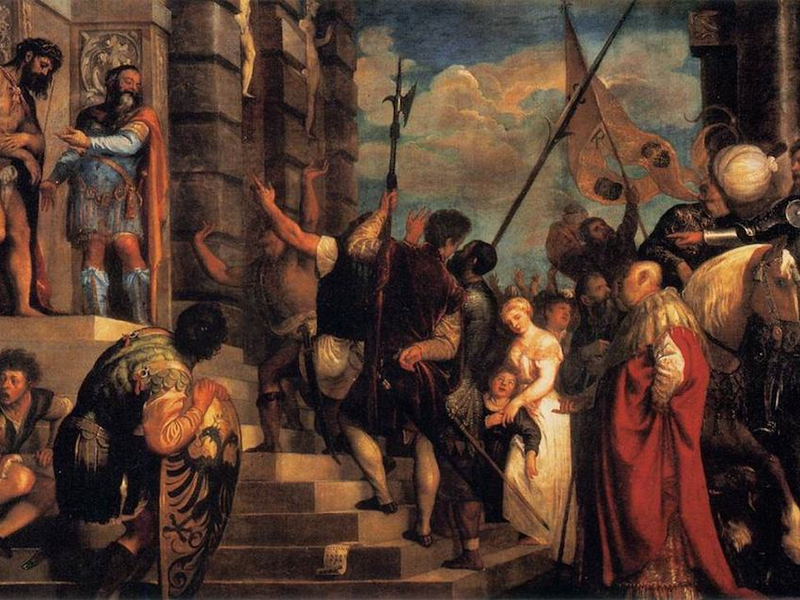
God is not mocked, Paul says. God is mocked, says Matthew. Who’s right? The two are in perfect harmony, but to see that, we need to run through the passage again. We’ll see that at every point, the mockery is being turned against the mockers. At every point, mockery is…

by Peter LeithartApril 21, 2016

Showing page 132 of 309

See all
See all
Economics

Rational Actors

Featherstone claims that economics has generally focused on the production rather than the consumption side of things, perhaps because of “the assumption that consumption was unproblematic because it was based upon the concept of rational individuals buying goods to maximize their satisfaction.” Only in the late 19th century was attention…

September 13, 2006
History

Elites and the Market

Cultural elites have, Featherstone suggests, an inherently ambivalent relationship with the market. His argument, if I understand it, goes something like this: Cultural elites want to preserve a monopolization of cultural products. Hence, for instance, peer review of scholarly work; work that hasn’t passed peer review can be dismissed as…

September 13, 2006
History

McDonald’s and Postmodernity

McDonald’s provides a helpful glimpse at the complexities surrounding postmodernity. On the one hand, the global reach of McDonald’s seems a perfect illustration of one part of the postmodern situation - the global diffusion of American culture and tastes, the plasticity and airiness of postmodern culture, the breaching of national…

September 13, 2006
History

Postmodernism and Globalization

Though often conceived as a crisis within Western civilization, postmodernism, Featherstone argues, is partly impelled by globalization. Globalization, he begins, usually conveys two images - the spread of a single, increasingly uniform culture throughout the world, and the “compression” or layering and juxtaposition of various cultures within a particular location…

September 13, 2006
History

Consumer Culture and Fragmentation

Culture, Mike Featherstone suggests in Undoing Culture , becomes problematic in consumer societies. How? As developed in cultural anthropology, culture is “somehow homologous to the distinctions, differences, and divisions between social groups who unconsciously use culture as relatively fixed markers in status games.” But in consumer societies, there is little…

September 12, 2006

Showing page 1795 of 2212

Browse by Category

In Medias Res

Your weekly digest for all things Theopolis.

Donate

Theopolis is nearly 100% donor-supported. Consider joining us on our mission.