
Theopolis Logo

Writing

Explore our collection of theological essays, biblical studies, and reflections on faith and culture.

See all
diego-gonzalez-i8ldurtfao-unsplash
Architecture

Arts and Play, Part 3

Let us now switch gears and move to a discussion of art, literature, architecture, and music. In English, we speak of "playing" games and also of "playing" musical instruments. There is a connection between the two, in that both involve some degree of pleasure and recreation. At the same time,…

by James B. JordanJanuary 23, 1992
venice-la-distruzione-del-tempio-di-gerusalemme-francesco-hayez-gallerie-accademia-venice
Daniel

The Abomination of Desolation, Part 4b: Abominable and Detestable

Leviticus 20:22-26 22. And you shall guard all My decrees and all My laws and do them, so that the land will not vomit you out, where I am bringing you thither to live in it. 23. And you shall not walk in the decrees of the nation that I…

by James B. JordanDecember 23, 1991
v4mkpbd70x7bkvc7mqvu
American Politics

The Original Low-Down Filthy Male Chauvinist Pig-Dog

For a year or so we have been reading about date rape. It amazes me how many "conservative" commentators have taken the attitude that "boys will be boys," and that it is somehow the girl’s fault if she lets the boy go too far. I have to agree that we…

by James B. JordanDecember 23, 1991
screen-shot-2023-04-04-at-5-01-54-pm
Biblical Chronology

Chronologies and Kings, Part 6: The Formation of the Remnant

According to 1 Kings 16:29, Ahab came to the throne of Israel in the 38th year of Asa of Judah, which was the year A.M. 3087. He reigned 22 years, dying in the year 3108. Ahab married a princess of Tyre named Jezebel (Jeze-baal). Under Jezebel’s influence, Ahab turned away…

by James B. JordanDecember 23, 1991
venice-la-distruzione-del-tempio-di-gerusalemme-francesco-hayez-gallerie-accademia-venice
Luke

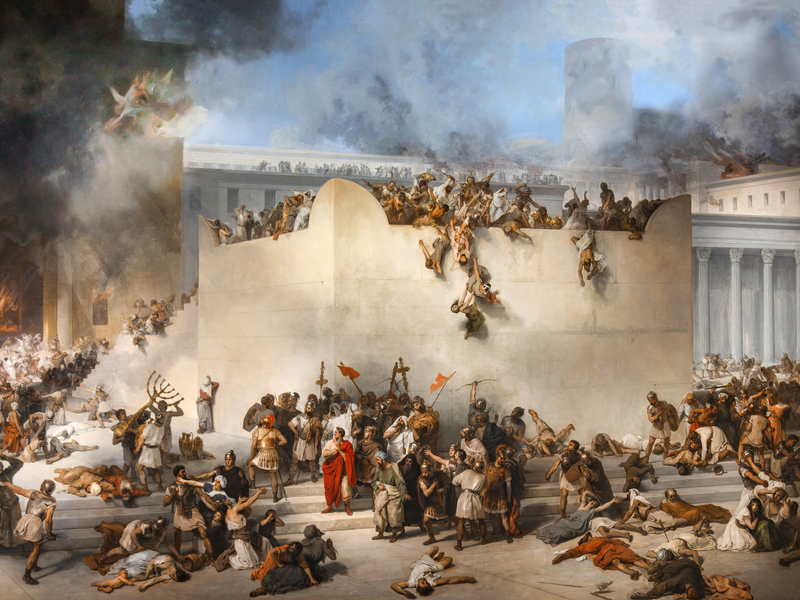
The Abomination of Desolation: Part 4, Abominable and Detestable

Part 1 Part 2 Part 3 Most Christians today, when they hear the phrase "abomination of desolation," think of some political figure who is to arrive on the scene some time in the future, and who will oppress God’s people. More careful exegetes have seen that the prophecies concerning "abomination…

by James B. JordanNovember 22, 1991
skyler-gerald-akljfvj5ym4-unsplash
Deuteronomy

Chronologies and Kings, Part 5: Testimonies of Two Witnesses

Deuteronomy 17:6 tells us that a matter is to be regarded as established if it is testified by two or three witnesses. One of the most important characteristics of Biblical chronology is that it is very often supported by more than one witness. A case in point is the fact…

by James B. JordanNovember 22, 1991

Showing page 293 of 309

See all
See all

Objective/Subjective

McGrath notes that Augustine interpreted the genitive in the phrase “righteousness of God” in Rom 1 objectively, so that it was understood as the righteousness that God gives in saving sinners (in “making” them righteous). Ambrosiaster, as I pointed out in an earliet post, interpreted the genitive subjectively - the…

April 20, 2006

Old Perspective on Paul

Ambrosiaster writes, “Iustitia est Dei, quia quod promisit dedit, ideo credens hoc esse se consecutum quod promiserat Deus per prophetas suos, iustum Deum probat et testis est iustitiae eius” (PL, 17.56b). McGrath explains: “God, having promised to give salvation, subsequently gives it, and as a result is deemed to be…

April 20, 2006
History

Unfinished Reformation

Nevin wrote: “There is more a great deal in Christianity, I firmly believe, more in the idea of hte Holy Catholic Church, than has yet been attained, either in the way of knowledge or in the way of life, by the Protestant Reformation.”

April 20, 2006

Factitive Justification

There was a consensus among the theologians of Trent, McGrath argues, that justification was “factitive,” a view that excluded that “a sinner may be justified solely as a matter of reputation or imputation, while remaining a sinner in fact.” But of course that raises the question, What exactly is a…

April 20, 2006

True Lutherans

McGrath traces the odd development in Lutheran Orthodoxy of the notion that regeneration and faith precede justification in such a way that “where Luther had understood justification to concern the unbelieving sinner, orthodoxy revised this view, referring justification to the believing sinner.” This takes Lutheran Orthodoxy back in the direction…

April 20, 2006

Ontological change

McGrath notes, “While justification was universally understood to involve the regeneration of humanity, the opinion that an ontological change is thereby effected within humans is particularly associated with the period of High Scholasticism and the development of the concept of created grace. The earlier medieval theologians expressed the change effected…

April 20, 2006

Showing page 1854 of 2212

Browse by Category

In Medias Res

Your weekly digest for all things Theopolis.

Donate

Theopolis is nearly 100% donor-supported. Consider joining us on our mission.