Theopolis Logo

Writing

Explore our collection of theological essays, biblical studies, and reflections on faith and culture.

See all
300298rgsdl
Biblical Studies

Is Abraham’s Life a Type?

The preceding essay has caused me to consider the possibility that the life of Abraham as recounted in Genesis contains a typological prophecy of the history of Israel; that is, that the events in Abraham’s life broadly anticipate events in Israel’s history. This kind of pattern is seen in the…

by James B. JordanMay 5, 2001

screen-shot-2022-05-12-at-12-07-23-pm
Hermeneutics

Thirty-Eight Years by the Sheep Pool

by: Jeff Meyers and James Jordan In the fifth chapter of John’s gospel we read of a man who had been ill for 38 years and who was lying by a pool located by the Sheep Gate of Jerusalem. This sheep waited, as did many other infirm people, for an…

by Jeff MeyersDecember 5, 2000
238070fgsdl
Biblical Horizons

How Are Women Saved?

What had been reduced to ruin by this sex, would by the selfsame sex be recovered to salvation. As Eve believed the serpent, so Mary believed the angel. The delinquency which the one occasioned by believing, the other by believing effaced. —Tertullian What is Paul saying about women and salvation…

by Jeff MeyersOctober 5, 2000
ben-white-w8qqn1pmqh0-unsplash
Jeremiah

The Return of Hamor

Back in Biblical Horizons 132 I discussed the horrible abuse of the converted men of Salem/Shechem in Genesis 34. These Hivites had joined the covenant by circumcision and then were slaughtered by Simeon and Levi. That, however, is not the end of their story. In Joshua 9 we find the…

by James B. JordanOctober 4, 2000
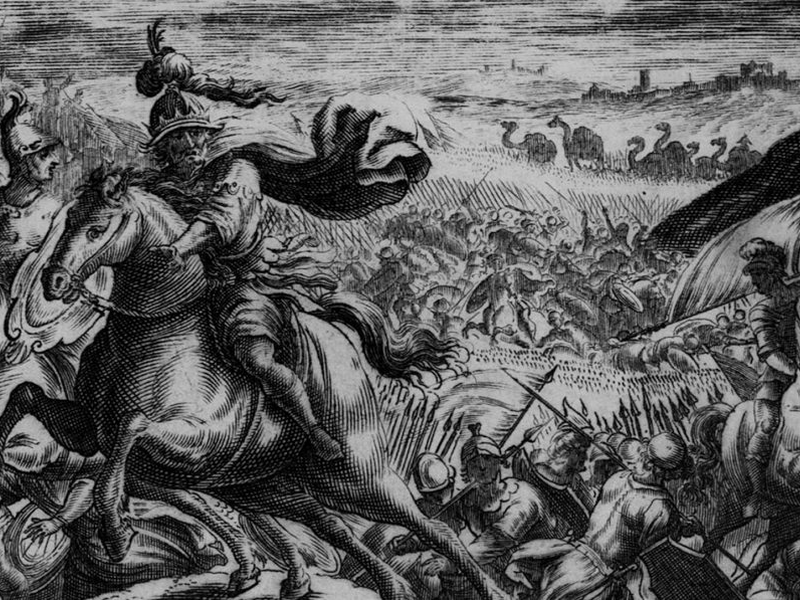
abraham-defeats-kings-g-jollain-2
Biblical Horizons

Abram’s 318 Men

Genesis 14:14 says that Abram mustered his trained men, “born in his house,” to rescue Lot, and gives their number as 318. It is clear that the precise number is provided for some reason, but what is it? S. Gevirtz notes that 318 is the sum of all the prime…

by James B. JordanSeptember 4, 2000
mikhail-preobrazhenskiy-9kszdpif_fo-unsplash
Hermeneutics

153 Large Fish

Simon Peter went up, and drew the net to land, full of large fish, a hundred and fifty-three; and although there were so many, the net was not torn. (John 21:11) This is one of those texts in the Bible that many people puzzle over. It is not a puzzle…

by James B. JordanSeptember 4, 2000

Showing page 241 of 309

See all
See all

Covenant lawsuit

John’s gospel is a contentious courtroom of a gospel. Legal language dominates the whole gospel - witnesses are called, Jesus promises an advocate, the Jews are constantly trying to put Jesus in the dock. But the whole gospel is really the trial of the Jews, just as what appears to…

February 28, 2006

Hidden Hero

Homer’s prologue to the Odyssey delays the identification of the hero until the end of the prologue, a literary sign that this hero comes hidden, disguised, in craft. That, of course, is precisely how Odysseus behaves throughout the epic. John’s gospel begins with similar techniques. We learn about the Word…

February 28, 2006
Literature

Coriolanus and Christ

Shakespeare’s Coriolanus can be read as dramatizing the Augustinian perspective most recently articulated by Oliver O’Donovan, namely, that “within every political society there occurs, implicitly, an act of worship of divine rule.” Through his dramatization of Roman society, Shakespeare points to another act of worship that constitutes a different sort…

February 28, 2006
Philosophy

J. L. Austin, Deconstructionist?

JL Austin famously distinguished between “performative” and “constative” utterances, the former of which perform the action to which they refer and the latter of which make assertions that can be judged as true or false. Modern philosophy has treated the constative as the norm, and performatives, if considered at all,…

February 28, 2006
Philosophy

structuralism, linguistic and other

How did the linguistic theory of Saussure become a model for anthropologists, sociologists, and analysts of pop culture? Jonathan Culler suggests that this move rests on “two fundamental insights: first, that social and cultural phenomena are not simply material objects or events but objects or events iwth meaning, and hence…

February 27, 2006
Philosophy

Anthropologized science

Foucault, in Canguilhem’s summary, argues that an anthropologization of the sciences took place in the late eighteenth and early nineteenth century, when Kantian philosophy combined with biology, economics, and linguistics to raise the question What is Man? Foucault argues: “From the moment when life, work, and language ceased to be…

February 27, 2006

Showing page 1874 of 2212

Browse by Category

In Medias Res

Your weekly digest for all things Theopolis.

Donate

Theopolis is nearly 100% donor-supported. Consider joining us on our mission.