Theopolis Logo

Writing

Explore our collection of theological essays, biblical studies, and reflections on faith and culture.

See all
jez-timms-8muutamcwu4-unsplash
Leviticus

Savage Judaism

​Should anthropological categories and tools be applied to Judaism? Seems a narrow and academic question, of interest to maybe ten people on the planet. It's one of the many virtues of Howard Eilberg-Schwartz's 1990 ​The Savage In Judaism to show that the question is a central one in the origins…

by Peter LeithartMarch 10, 2014
Leviticus

Obsessed with Sex?

Christians are often accused of being obsessed with sexual sin. Why can't two people, of whatever sex, do whatever they please in the enclosure of their own room? Who is hurt if a guy wants to get off looking at tantalizing pictures and videos on his computer? What's the big…

by Peter LeithartMarch 5, 2014
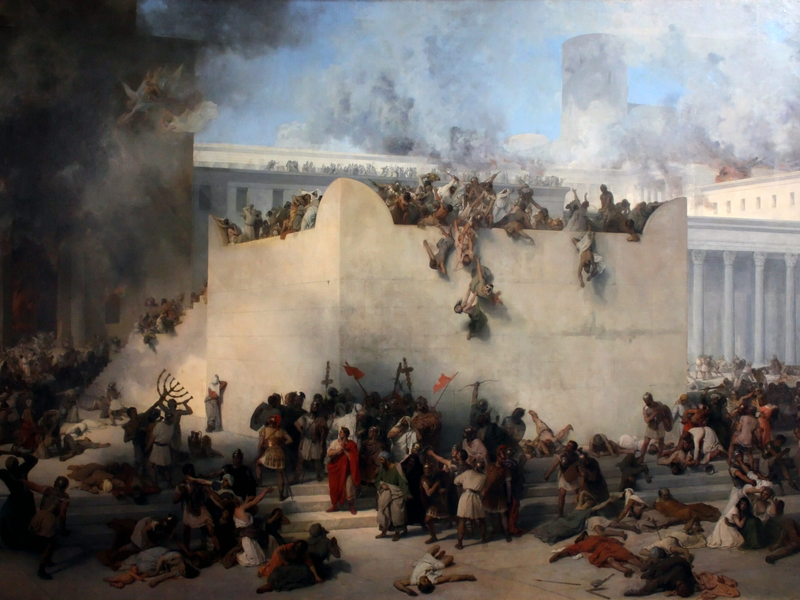
francesco_hayez_017
Mark

Binding and Loosing

“No one can enter a strong man’s house and plunder his goods, unless he first binds the strong man. And then he will plunder his house” (Mark 3:27 NKJV). Much commentary on the Revelation seems oblivious to its allusions to the Pentateuch (although there are many that do enlighten us…

by Mike BullMarch 3, 2014
Leviticus

Holiness, Ethics, Ritual

Leigh M. Trevaskis's 2011 monograph, Holiness, Ethics and Ritual in Leviticus , is an outstanding contribution to the study of Leviticus. His main thesis is directed at the world of Old Testament scholarship, in which there is a consensus that the ritual laws of Leviticus 1-16 come from a school…

by Peter LeithartMarch 1, 2014
6273e95e0f5ac766258d8cf3_joshuasconquestoftheland-2
Hermeneutics

Joshua Typology

Richard Ounsworth begins his Joshua Typology in the New Testament with an excellent discussion of what he calls "ontological" typology, which he handily summarizes in four points. Typology involves "correspondences between real historical events, personalities, institutions, etc. described in scripture," a correspondence that is discerned (not created) by the reader…

by Peter LeithartFebruary 26, 2014
alfons-morales-ylswjsy7stw-unsplash-1
Theopolis News

Book Release

Baylor University Press is sponsoring a reception to celebrate the official release of Peter Leithart's Gratitude: An Intellectual History . The reception will be held at the First Things offices in Manhattan on Thursday, March 6, at 6 PM. For more details, click here .

by Peter LeithartFebruary 26, 2014

Showing page 178 of 309

See all
See all

Sermon Outline, April 11

The Word, the Bread, and the Nations, Luke 24:1-53 INTRODUCTION Jesus was condemned to death, but throughout Luke?s account various people declare that Jesus is innocent. Seven times, someone states that he is righteous or treats Him as not guilty (Luke 23:4, 14, 15, 22, 41, 47, 51). On the…

April 7, 2004

Resurrection and Mission

Robert C. Tannehill points out that the resurrection narrative in Luke 24 has a generally chiastic structure. First, there is an inclusio with the idea of “return” (23:56; 24:52), and the emphasis on the fact that Jesus’ disciples are observant Jews (23:56b; 24:53). Second, within that, there is a chiastic…

April 7, 2004
Literature

Melville and the Bible

Who else but Melville could have written this line? He advises a sea captain examining a Portuguese for his crew to ask, “His knees, any Belshazzar symptoms there?”

April 6, 2004
Philosophy

Feminism and Identity

Feminism is a case study in the need to define identity through relationship, rather than by cutting the bonds of relationship. In a brief review of Dr. Laura’s new book for the Weekly Standard (March 22), Tammy Bruce suggests that Dr L has grasped something that feminists, with all their…

April 5, 2004

Acceptance and Apocalypse

As I’ve suggested in several recent posts, the turning point of Luke’s crucifixion narrative is the “conversion” of the criminal on the cross, and Jesus’ acceptance of Him into His kingdom. Jews and Romans had joined in mockery of Jesus’ claims to be “savior” and “king,” but the criminal entrusts…

April 5, 2004

Covenant and Counsel

Psalm 25:14 says that “the secret of Yahweh is for those who fear Him, and His covenant He will cause them to know.” The parallel structure of the verse indicates that “secret” and “covenant” are describing the same reality, and the parallel comes out more strongly in the Hebrew since…

April 5, 2004

Showing page 2102 of 2212

Browse by Category

In Medias Res

Your weekly digest for all things Theopolis.

Donate

Theopolis is nearly 100% donor-supported. Consider joining us on our mission.