Theopolis Logo

Writing

Explore our collection of theological essays, biblical studies, and reflections on faith and culture.

See all
jez-timms-8muutamcwu4-unsplash
Leviticus

Savage Judaism

​Should anthropological categories and tools be applied to Judaism? Seems a narrow and academic question, of interest to maybe ten people on the planet. It's one of the many virtues of Howard Eilberg-Schwartz's 1990 ​The Savage In Judaism to show that the question is a central one in the origins…

by Peter LeithartMarch 10, 2014
Leviticus

Obsessed with Sex?

Christians are often accused of being obsessed with sexual sin. Why can't two people, of whatever sex, do whatever they please in the enclosure of their own room? Who is hurt if a guy wants to get off looking at tantalizing pictures and videos on his computer? What's the big…

by Peter LeithartMarch 5, 2014
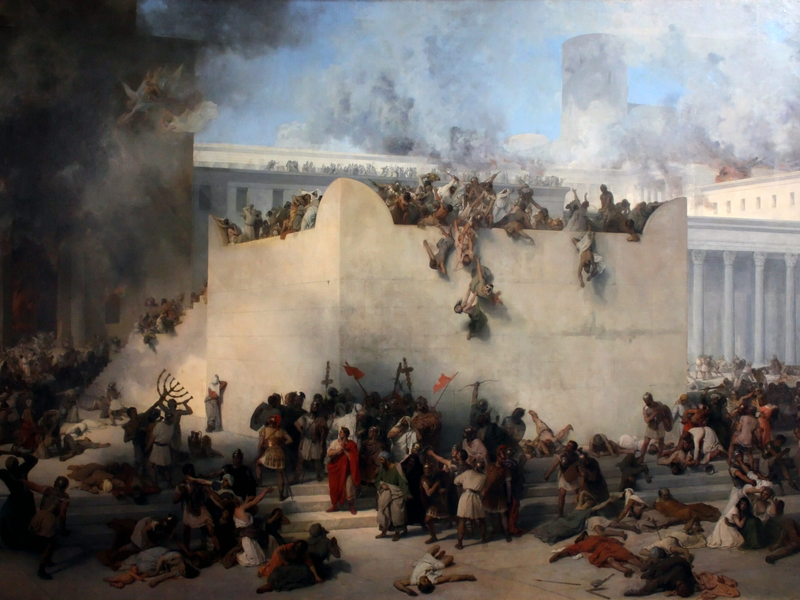
francesco_hayez_017
Mark

Binding and Loosing

“No one can enter a strong man’s house and plunder his goods, unless he first binds the strong man. And then he will plunder his house” (Mark 3:27 NKJV). Much commentary on the Revelation seems oblivious to its allusions to the Pentateuch (although there are many that do enlighten us…

by Mike BullMarch 3, 2014
Leviticus

Holiness, Ethics, Ritual

Leigh M. Trevaskis's 2011 monograph, Holiness, Ethics and Ritual in Leviticus , is an outstanding contribution to the study of Leviticus. His main thesis is directed at the world of Old Testament scholarship, in which there is a consensus that the ritual laws of Leviticus 1-16 come from a school…

by Peter LeithartMarch 1, 2014
6273e95e0f5ac766258d8cf3_joshuasconquestoftheland-2
Hermeneutics

Joshua Typology

Richard Ounsworth begins his Joshua Typology in the New Testament with an excellent discussion of what he calls "ontological" typology, which he handily summarizes in four points. Typology involves "correspondences between real historical events, personalities, institutions, etc. described in scripture," a correspondence that is discerned (not created) by the reader…

by Peter LeithartFebruary 26, 2014
alfons-morales-ylswjsy7stw-unsplash-1
Theopolis News

Book Release

Baylor University Press is sponsoring a reception to celebrate the official release of Peter Leithart's Gratitude: An Intellectual History . The reception will be held at the First Things offices in Manhattan on Thursday, March 6, at 6 PM. For more details, click here .

by Peter LeithartFebruary 26, 2014

Showing page 178 of 309

See all
See all
Philosophy

More Reflections on Postmodernism

Back to reflections on post-modernism: It seems that Freud, not Nietzsche, is the really grandfather of the movement, though, not unexpectedly, some sons and grandsons efface his memory and resist his influence (not all, of course).

October 28, 2003
History

Courtly Love

On courtly love: The basic shift is from the ancient and early medieval view that eros sapped and vitiated virtus to a belief that eros was a condition of the possibility of virtus and valor. This is, as Lewis said, a seismic shift in sensibility, one that we still do…

October 28, 2003

Structure of Romans 1:16ff.

Jouette Bassler’s 1984 article “Divine Impartiality in Romans” ( Novum Testamentum ) present structural arguments for saying that the section beginning in Rom 1:16-18 runs through the middle of chapter 2. This is evident from the repetition of the verb prasso in 1:32 and again in 2:1-3; thus the center…

October 28, 2003
Philosophy

Postmodernism and the ’60s

It’s not at all accidental that postmodernism takes its rise in the mid-1960s. Bloom wrote the first draft of the anxiety of influence in 1967, and revised it over several years before its initial publication in 1973. Derrida’s annus miraibilis was 1967, which saw the publication of Speech and Phenomena…

October 28, 2003
Philosophy

Postmodernism and the ’60s

It’s not at all accidental that postmodernism takes its rise in the mid-1960s. Bloom wrote the first draft of the anxiety of influence in 1967, and revised it over several years before its initial publication in 1973. Derrida’s annus miraibilis was 1967, which saw the publication of Speech and Phenomena…

October 28, 2003
Philosophy

Murder of Father

Turns out that Harold Bloom’s “anxiety of influence” is just another variation on the same set of themes that Derrida is obsessed with — the son’s murder of the father. For Bloom, the son is the “strong poet” who resists the influence of his predecessor/father in order to carve out…

October 28, 2003

Showing page 2176 of 2212

Browse by Category

In Medias Res

Your weekly digest for all things Theopolis.

Donate

Theopolis is nearly 100% donor-supported. Consider joining us on our mission.