Theopolis Logo

Writing

Explore our collection of theological essays, biblical studies, and reflections on faith and culture.

See all
rembrandt-main
Art

The Second Word V: On Images and Art, Part 3

The Failure of the Church Yet a third factor played an important role in this historical development, in addition to the imperial adoption of icons and the rise of the icons of the holy man. Brown writes: "The great Christian basilicas of the previous centuries tended to stand empty, except…

by James B. JordanSeptember 4, 1998
screenshot-2023-09-11-at-11-34-45-am
Biblical Horizons

Patriarchal Dominion

The three large patriarchal narratives of Genesis concern the three aspects of the cosmos: matter, space, and time. Over these three is man given dominion. Lucifer was originally appointed to train man in this dominion, but he chose to lead man into rebellion instead. Thus, the Angel of Yahweh replaced…

by James B. JordanAugust 4, 1998
trnava-university-beeyeib-am8-unsplash
Biblical Horizons

The Case Against Western Civilization, Part 6

Part 6: Living in a Dying World (continued) The "Trivium" (continued) The five stages of education are simply the five stages of the covenant as God administers it in human life and history, and in the liturgy of covenant renewal: First, God announces Himself. "I am Yahweh Your God." He…

by James B. JordanAugust 4, 1998
screen-shot-2022-05-12-at-12-07-23-pm
Biblical Studies

Re-creation in the Ascension Offering

The following essay is tentative and exploratory, offered for your consideration. It seems to me that the ritual of the Ascension Offering (incorrectly translated as Burnt Offering) of Leviticus 1 is a symbolic recapitulation of Genesis 1, which thereby portrays the sacrificial ritual as way of moving from a fallen…

by James B. JordanJuly 4, 1998
Biblical Horizons

The Framework Hypothesis: A Gnostic Heresy

Just as the vast majority of evangelical Christians in America today are Arminian and Baptist, so the vast majority do not believe in a creation around 4000 BC. I don’t expect any of these three situations to change anytime soon. Powerful presuppositions are at work in all three instances, along…

by James B. JordanJuly 4, 1998
picture-mosaic-cathedral-jesus-christ-cefalu-italy-copy
Art

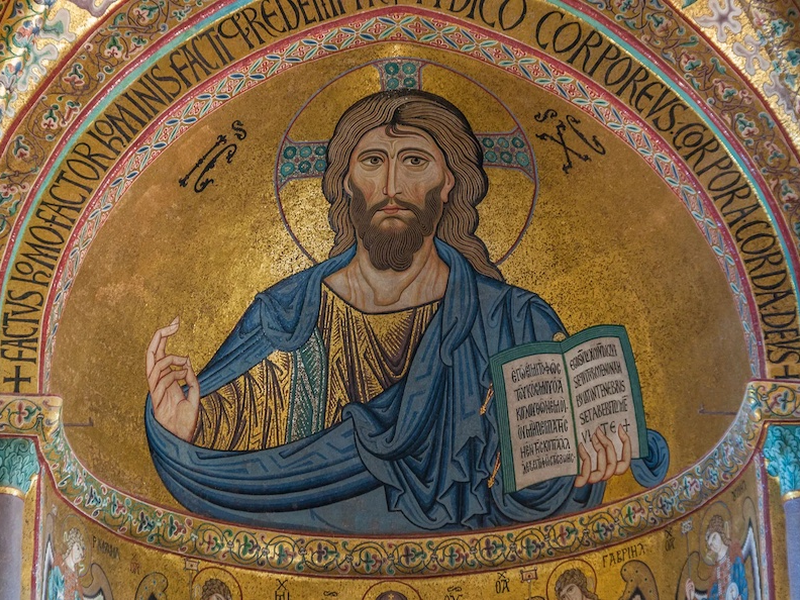
The Second Word V: On Images and Art, Part 2

The Iconoclastic Controversy Continuing Pagan Influence How did images creep in? To begin with, there was in the post-Constantinian Church a concerted effort on the part of the semi-pagans to interpret Christianity in essentially pantheistic terms. The heretics put God and man on a continuum of "being," so that God…

by James B. JordanJuly 4, 1998

Showing page 248 of 309

See all
See all

Semper reformanda

In his contribution to Denominationalism , Winthrop Hudson suggests that one of the principles of English Independent ecclesiology was the refusal to “make our present judgment and practice a binding law unto ourselves for the future” (25). It's a stance based on a recognition of fallibility and proneness to sin.…

June 10, 2015

Where there's fire...?

The Greek kapnos (“smoke”) appears twelve times in Revelation. Hold that number, because it might be significant. The twelve uses are grouped into six scenes, alternating between smoke having to do with the worship and glory of God and smoke from hell or hell's allies: A. Smoke of incense, 8:4…

June 9, 2015

On Subjects and Objects

“I believe in subjects and objects,” writes David Martin at the outset of his Future of Christianity (4). He illustrates with a sociological example: He believes in “religious visions of the world to come and the objective status of the dynamics of social and political action.” Martin intends to resist…

June 9, 2015

Notes Toward a Johannine Theory of Labor

Jesus tells His disciples that they are being sent into a field to harvest where they had not sown or labored. “One sows, and another reaps” (John 4:35-38). It's a principle of ministry: Ministry starts in the middle. Even in a fresh mission field, the missionary doesn't enter a place…

June 9, 2015

Sources of Schism

In a study of American Protestant schisms between 1890 and 1990, John Sutten and Mark Chaves claim that churches don't divide for purely doctrinal reasons, but rather “in response to attempts by denominational elites to achieve organizational consolidation” (171). The 1848 schism within the Plymouth Brethren, for instance, was about…

June 9, 2015

Owen and Mather on Union

In an essay on “Rules of Walking in Fellowship,” John Owen claimed that “Union is the main aim and most proper fruit of love ; neither is there any thing or duty of the saints in the gospel pressed with more earnestness and vehemency of exhortation than this.” For Owen,…

June 8, 2015

Showing page 415 of 2212

Browse by Category

In Medias Res

Your weekly digest for all things Theopolis.

Donate

Theopolis is nearly 100% donor-supported. Consider joining us on our mission.