Theopolis Logo

Writing

Explore our collection of theological essays, biblical studies, and reflections on faith and culture.

See all
25f3baab-e5a9-42ec-aab6-649e53879085-3
Revelation

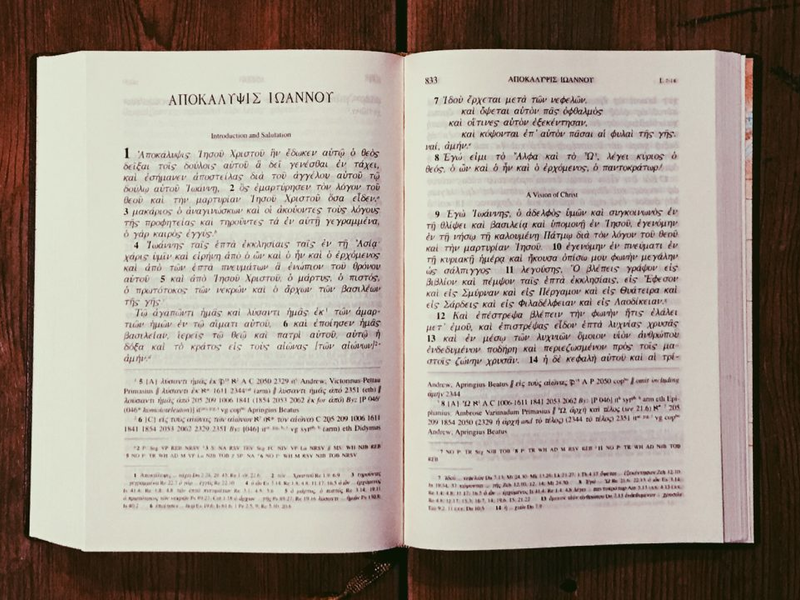
Rescuing Revelation: Part II

This is Part II of a 2-part essay. For Part 1, click HERE . Covenant context Most Bible teachers apply the teachings of Jesus and the Apostles directly to Christians today without any thought of the historical – and more importantly, legal – context. The ministry of Christ and the…

by Mike BullOctober 10, 2017

25f3baab-e5a9-42ec-aab6-649e53879085-3
Revelation

Rescuing Revelation: Part 1

Introduction The book of Revelation polarises Christians. Some become obsessed with ‘cracking its code’ while others throw it into the too hard basket. Thankfully, recent advances in biblical theology enable us to liberate this enigmatic book from both mistreatment and obscurity. The prophecy is attractive to some because of its…

by Mike BullOctober 5, 2017
aaron-burden-1ebsmyrau-s-unsplash
Biblical Theology

Abraham's Life as a Type

I'm considering the possibility that the life of Abraham as recounted in Genesis contains a typological prophecy of the history of Israel; that is, that the events in Abraham’s life broadly anticipate events in Israel’s history. This kind of pattern is seen in the case of Moses, for instance, because…

by James B. JordanOctober 3, 2017
e99a7787
Culture

Teenagers and the Smartphone Beast

According to this recent article in The Atlantic , teenage promiscuity is decreasing. Apparently there is a general "decline in dating" which also "tracks with a decline in sexual activity." The figures are startling: The drop is the sharpest for ninth-graders, among whom the number of sexually active teens has…

by Steve JefferySeptember 28, 2017
img_4660-2
Matthew

Fulfilling the First Commandment

"Jesus said to him, “‘You shall love the Lord your God with all your heart, with all your soul, and with all your mind.'" - Matthew 22:37 Jesus says that this is the most important commandment: to love God with our heart, soul, and mind. If we obey this command,…

by Lindsey TollefsonSeptember 26, 2017
david-weber-fwuo_zluhnw-unsplash
Eucharist

Strange and Glorious New Rites

At the last supper, Jesus took bread and, having given thanks, He broke it and gave it to His disciples while saying, "Take, eat, this is My body given for you. Do this for My memorial." What Jesus did was recognized by the disciples, because it took place every morning…

by James B. JordanSeptember 21, 2017

Showing page 105 of 309

See all
See all

Why Now?

Jesus prayed that the church's unity would reflect the unity of the Father and Son. Paul urged the Ephesians to cultivate the virtues of peace that would express the sevenfold unity of the church (Ephesians 4). That demand is a perennial one. But we've been divided for a long time.…

March 12, 2015

Fragile Fruitfulness

Israel is a vine, transplanted from Egypt (Psalm 80; Isaiah 5). She exists to produce wine that gladdens the hearts of men. Israel is the Dionysian people. Ezekiel brings out another dimension of the vine image: “Son of man, how is the wood of the vine better than any wood…

March 12, 2015

Judgment to the Corners

The oracle of judgment in Ezekiel 14:12-23 is structured as a fourfold judgment: sword, famine, beasts, plague (v. 21). The descriptions of judgment are laid out in four paragraphs that use repetitive, stereotyped language. Throughout, Yahweh says that even the intercession of Noah, Daniel, and Job could not rescue Judah…

March 12, 2015
Fairy Tales

The Political Economy of Fairy Tales

In a TLS review of several recent books on fairy tales, Fracesca Wade points to the political context and economic setting of early folk and fairy tale collections. Inspired by Herder, the Grimms, she observes, intended to recover Germanitas by study of natural German poetry: “Although the brothers drew widely…

March 12, 2015

Remembering the Present

In his Deja Vu and the End of History , Italian philosopher Paolo Virno explores the phenomenology of memory, especially in its relation to philosophies of history. The deja vu of the title isn't a metaphor; following Henri Bergson, Virno argues that it represents “the untrammelled extension of memory's jurisdiction,…

March 11, 2015

Potential, Act, and Violence

Paolo Virno ( Deja Vu and the End of History ) observes that potential and act occur simultaneously. Take language: “The language faculty irrupts into becoming in concomitance with the phrase that I am speaking. It appears precisely now, as I speak, neither before nor afterwards: but, note, right now…

March 11, 2015

Showing page 453 of 2212

Browse by Category

In Medias Res

Your weekly digest for all things Theopolis.

Donate

Theopolis is nearly 100% donor-supported. Consider joining us on our mission.