Theopolis Logo

Writing

Explore our collection of theological essays, biblical studies, and reflections on faith and culture.

See all
sculptor
Art

The Artist's Litany

If we say that we have no sin, we deceive ourselves, and the truth is not in us. (1 John 1:8) O God the Father, creator of heaven and earth, Alpha and Omega, beginning and end, who inspired Creation with the breath of your nostrils, who placed Adam in the…

by Christian LeithartFebruary 2, 2016
sodom_and_gomorrah_afire_by_jacob_jacobsz-_de_wet_d-_j-_probably_koln_c-_1680_oil_on_canvas_-_hessisches_landesmuseum_darmstadt_-_darmstadt_germany_-_dsc01149-e1632540497247
American Culture

American Sodom

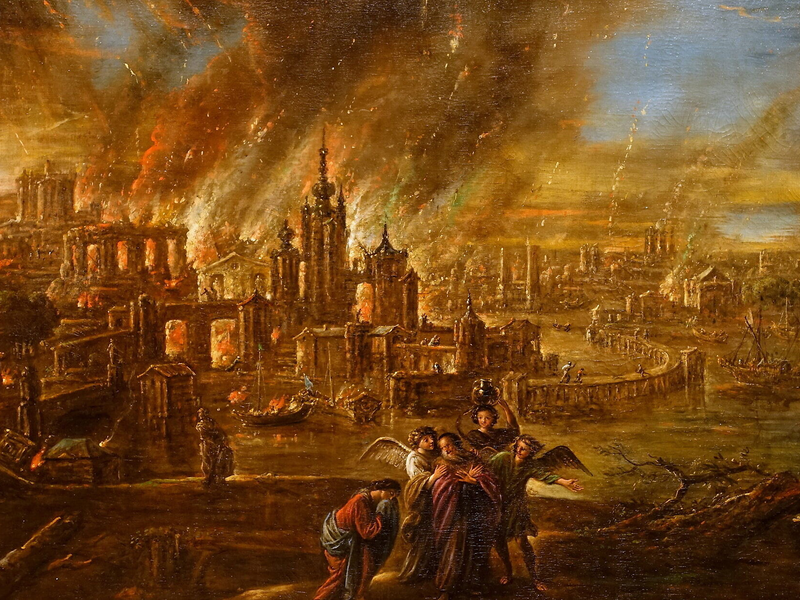
For nearly a half-century, Sodom has been a key symbol in the American culture wars. On the one side, we have an aggressive movement among homosexuals that has first decriminalized homosexual conduct, then to force cultural and legal recognition of homosexuals as a minority and to normalize homosexual behaviors, finally…

by Peter LeithartJanuary 28, 2016
image-20150409-15244-1r08rsu
Biblical Theology

The Meaning of the Mount of Olives

Speaking of the Church, Romans 11:16-17 says, "And if the root be holy, the branches are also. But if some of the branches were broken off, and you, being a wild olive were grafted in among them and became partaker with them of the root of the fatness of the…

by James B. JordanJanuary 26, 2016
img_6134
Isaiah

No Sabbath for God

At the end of Isaiah 61, Yahweh's Servant rejoices because the Lord clothes Him with salvation and righteousness. He decks Him like a bridegroom with a garland on His head. He wears jewels like a bride. He is a new bridegroom in a new garden of Eden, a garden of…

by Peter LeithartJanuary 21, 2016
hebrew-manuscript-2
Biblical Law

Approaching the Torah

Before anything else, a word about “Torah” may be in order. I have been persuaded that “law” is a bad translation of “Torah,” even though it is evident that what is called “Torah” does have commandments, statutes, and ordinances in abundance. Why not “law?” “Law” as a translation for “Torah”…

by Ralph Allan SmithJanuary 19, 2016
jane-austen-2
Biblical Horizons

Jane Austen, Pundit

Few novelists seem as innocent of the temptation to punditry as Jane Austen. Though living through a period that witnessed the birth of an independent United States, the French Revolution and the Terror, the Napoleonic wars and the rise of revolutionary romanticism, and the upheavals of the Industrial Revolution, she…

by Peter LeithartJanuary 14, 2016

Showing page 137 of 309

See all
See all
History

Hyperreal

Baudrillard sounds like a nut when he says that we are now living in a hyperreal world, a virtual world. But there is certainly something to it. We’re still physical creatures, of course, surrounded by physical objects, and that doesn’t change when we get strapped in for some virtual experience.…

November 2, 2006
History

Community of the fearful

Postmodernity unleashes fear, Bauman says: “Modernity was a continuous and uncompromising effort to fill or to cover up the void; the modern mentality held a stern belief that the job can be done - if not today then tomorrow. The sin of postmodernity is to abandon the effort and to…

November 2, 2006
History

Chronopolitics

Johannes Fabian argues in his Time and the Other that “geopolitics has its ideological foundations in chronopolitics.” Bauman summarizes the argument: “The modern perspective ‘denied coevality’ to any form of life different from its own; it construed the Other of itself as ‘living in another time.’ The allochronic distancing device…

November 2, 2006
History

Slavery in America

In his recent history of slavery in the New World, David Brion Davis records some surprising facts about American slavery. Prior to 1820, for instance, African slaves were more numerous than European settlers by a ratio of 5 to 1. About 5-6 percent of slaves in the Western hemisphere were…

November 1, 2006
Politics

Toleration and absolutism

In his history of the idea of toleration, the late A.J. Conyers summarizes the arguments of Robert P. Kraynak on the development of Locke’s thought on religious toleration. The puzzle is this: Locke’s early works are absolutist in a Hobbesian vein, invoking the supreme magistrate’s power to oversee religion for…

November 1, 2006
Literature

Herbert on Pop Music

Zbigniew Herbert writes in a poem entitled “Mr Cogito and Pop” of a visit to a concert. “Mr Cogito,” a recurring character in Herbert’s poems, reflects on the “aesthetics of noise” and offers some penetrating observations on the character of contemporary pop music: “to be a god means to hurl…

November 1, 2006

Showing page 1772 of 2212

Browse by Category

In Medias Res

Your weekly digest for all things Theopolis.

Donate

Theopolis is nearly 100% donor-supported. Consider joining us on our mission.