Theopolis Logo

Writing

Explore our collection of theological essays, biblical studies, and reflections on faith and culture.

See all
noahs-ark-genesis
Biblical Horizons

Who Rules the Land? The Meaning of the Noahic Covenant, Part 1

It is commonly held in Reformed thought that the Noahic Covenant is given to all men equally. The Noahic Covenant concerns "man," not simply "church," and establishes civil government as an institution among "mankind" — that is the theory. Sometimes the Noahic Covenant is regarded as a "covenant of common…

by James B. JordanNovember 23, 1990

tanner-mardis-xuxghzhibn4-unsplash-1-2
Daniel

The Babylonian Connection

The Fall of Jerusalem we have dated (provisionally) at 3426 Anno Mundi. In current B.C. dates this is 586 B.C. From this point forward in Biblical chronology we are required to make use of prophetic numbers rather than historical ones. Jeremiah prophesied that the captivity would last 70 years, but…

by James B. JordanNovember 16, 1990
screen-shot-2021-08-12-at-2-57-54-pm
Biblical Horizons

Taking the Situation Seriously

Evangelicals have in recent years become more interested in looking into their Bibles for wisdom to deal with modern problems. This is undoubtedly a welcome development, after many years of neglect. But there are dangers and costs as well. One of these is the tendency to fall into a modern…

by Peter LeithartOctober 19, 1990
carlo-alberto-burato-smdx3gleu_m-unsplash
Hermeneutics

The Unseen Things

Now faith is the substance of things hoped for, the evidence of things not seen (Hebrews 11:1). The famous definition of faith with which the eleventh chapter of Hebrews opens has received a number of different interpretations. The crux of the problem is the interpretation of the words translated in…

by Peter LeithartOctober 19, 1990
49980-nicolas_poussin_-_the_judgment_of_solomon_-_wga18330-800w-tn
Proverbs

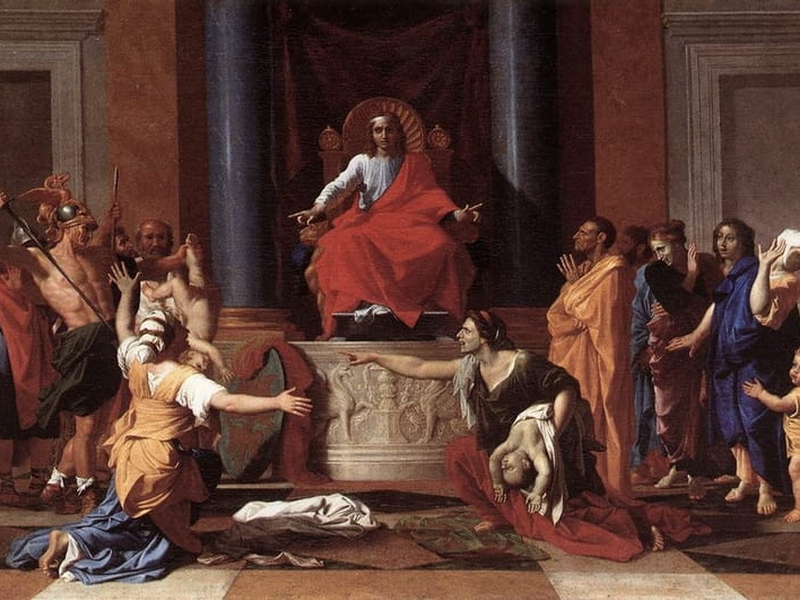
Advice From a Sojourner, Part 8

15. The leech has two daughters, "Give," "Give." There are three things that will not be satisfied, Four that will not say, "Enough": 16. Sheol, And the barren womb, Earth, that is never satisfied with water, And fire that never says, "Enough." We are assuming, at least for the purposes…

by James B. JordanOctober 16, 1990
tanner-mardis-xuxghzhibn4-unsplash-1-2
Biblical Chronology

Confusion Among the Kings

As we have seen in previous installments in this series, the Old Testament is quite concerned with chronology, and carefully records chronological data for our use. For this reason, we can assume when we come to the chronology of the kings of Judah and Israel that the writers of the…

by James B. JordanOctober 2, 1990

Showing page 301 of 309

See all
See all
Theology

Rehabilitating patriarchy

Russell Moore gave a vigorous presentation at ETS on why egalitarians are winning the evangelical gender debate. He summarized some of the recent sociological work on evangelical family life, which presents a mixed picture. On the one hand, Bradford Wilcox’s Soft Patriarchs, New Men shows that evangelical fathers are not…

November 18, 2005
Literature

Herod’s fears

In For the Time Being , W. H. Auden described Herod’s reaction to the news that “God has been born.” If this is true, and if the news gets out, Herod thinks, all is lost; confusion will reign. The passage is one of the most effective descriptions of the nature…

November 17, 2005
Literature

Herod’s fears

In For the Time Being , W. H. Auden described Herod’s reaction to the news that “God has been born.” If this is true, and if the news gets out, Herod thinks, all is lost; confusion will reign. The passage is one of the most effective descriptions of the nature…

November 17, 2005

Emerson as Sacramental Theologian

Lundin spends considerable time describing Emerson’s rejection of Christian orthodoxy in favor of an American version of Romanticism, and shows that Emerson’s departure from orthodoxy centered on his rejection of the Eucharist. Emerson resigned his post at the Second Church of Boston because he could no longer administer the Supper…

November 17, 2005
Literature

Lewis as critic

Toward the close of Lundin’s book, he offers a number of intriguing criticisms of CS Lewis as a literary critic. He claims that while Lewis recognized the corrosive effects of the Enlightenment and Romantic conception of the self in his theological writings, he adopted a form of romanticism in his…

November 17, 2005
Philosophy

Denken ist Danken

One of the important themes that emerges from Lundin’s book (mentioned in the previous post) is the centrality of gratitude in thought. Heidegger, he says, “was fond of the seventeenth-century Pietist phrase Denken ist Danken , ‘to think is to thank.’” Lundin expounds the point a few pages later: “Through…

November 17, 2005

Showing page 1924 of 2212

Browse by Category

In Medias Res

Your weekly digest for all things Theopolis.

Donate

Theopolis is nearly 100% donor-supported. Consider joining us on our mission.