Theopolis Logo

Writing

Explore our collection of theological essays, biblical studies, and reflections on faith and culture.

See all
800124htsdl
Authority

The Restrainer

When Samuel saw Saul, Yahweh answered him, "Behold, the man of whom I spoke to you! This one will restrain My people" (1 Samuel 9:17) Many English versions of 1 Samuel 9:17 read, "This one will rule over My people," but that is a mistranslation. The Hebrew verb is `atsar…

by James B. JordanDecember 4, 1992

screen-shot-2022-05-12-at-12-07-23-pm
Acts

Chronology of the Gospels

We have arrived at the tentative date of A.M. 3474 for the decree of Cyrus, and we have determined to operate as if the 70 weeks of Daniel 9 are literal years. We also decided that Messiah the Prince arrives at the beginning of the 70th week, after the 69…

by James B. JordanDecember 4, 1992
alex-shute-oz2yqcaszw-unsplash
Biblical Studies

The Dramatic Structure of Proverbs

The book of Proverbs appears as a largely random collection of aphorisms drawn from experience saturated in law. Despite its random arrangement, however, the book does have an over-arching structure that reinforces its main themes. One way to gather clues regarding the structure of a biblical book (or any book)…

by Peter LeithartNovember 17, 1992
sincerely-media-bhaswrjttzw-unsplash-2
Leviticus

Leviticus 27

I recently had the privilege and pleasure of reading the first draught of Gary North’s Economic Commentary on Leviticus , which will be out some time next year. Gary’s comments on Leviticus 27 were stimulating, and caused me to take another look at the passage. The results, which I sent…

by James B. JordanNovember 4, 1992
venice-la-distruzione-del-tempio-di-gerusalemme-francesco-hayez-gallerie-accademia-venice
Daniel

Bridging the Last Gap: Daniel’s Seventy Weeks Revisited

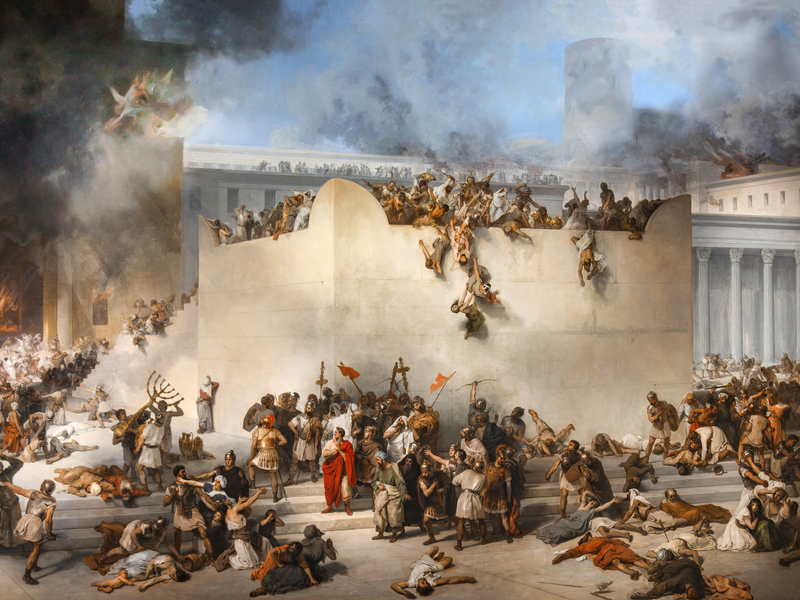
As we have seen in this series, each time there is a new covenant, there is a break in the year-by-year chronology. At the same time, each time the break is crossed by information provided in the text. Thus, the year-by-year chronology breaks down at the birth of Abraham, but…

by James B. JordanNovember 4, 1992
europeana-h-4wme4eooo-unsplash
Art

The Openness of Literature & the Mystery of Art

The Openness of Literature Let’s discuss literature for a moment. There are two ways a story or novel can close. The first is called poetic justice. When a story ends with poetic justice, the bad guys are all punished and the good guys are all rewarded. This kind of story…

by James B. JordanNovember 4, 1992

Showing page 287 of 309

See all
See all
Modernity

Multiple Modernities

“Classic theories of modernization, from the 1950s,” write the editors of Reflections on Multiple Modernities , “identified the core of modernity, of modern social structure, as the decomposition of older ‘closed' formations and . . . of the growing potential for social mobilization, and the concomitant development of new structural,…

May 3, 2016

Signs of the Times

In a 2009 University of Michigan dissertation, Richard Persky explores the cultural meaning of time in ancient Greece, focusing on the concept of kairos . According to Persky, “a kairos is a moment of opportunity, the right time to do some particular thing. The allegorical sculpture made by Lysippos and…

May 2, 2016

Jerusalem's Jasper Walls

Jerusalem descends from heaven a jeweled bride, with the luminosity of a precious stone, a “crystal-clear jasper” (v. 11; hos litho iaspidi krustallizonti ). She is also surrounded by a jasper wall (v. 18). How might the city be related to the wall? The structure of 21:18-22 gives us a…

May 2, 2016

Shakespeare and Chivalry

In the Weekly Standard , Paul Cantor explains that both Shakespeare and Cervantes aimed their writing at a common target: Chivalry. He describes chivalry as “a noble ideal and at its best it did much to refine an otherwise coarse and brutal world, but it rested on shaky foundations and…

May 2, 2016

Liturgy and Charity

Susan Holman ( The Hungry Are Dying ) draws on recent scholarship to argue that “food doles, communal religious feasts, public works, or subsidized public entertainment prior to the Christianization of Graeco-Roman culture did not function out of any concern to alleviate poverty per se.” These “public works” or leitourgia…

April 29, 2016

Bring Us To God

Peter tells us that Jesus was the “just” man who suffered for the sins of the “unjust,” and that the purpose of this suffering was to “bring us to God.” William Dalton ( Christ's Proclamation to the Spirits ) points out that the verb prosago has technical legal meaning in…

April 29, 2016

Showing page 294 of 2212

Browse by Category

In Medias Res

Your weekly digest for all things Theopolis.

Donate

Theopolis is nearly 100% donor-supported. Consider joining us on our mission.