Theopolis Logo

Writing

Explore our collection of theological essays, biblical studies, and reflections on faith and culture.

See all
denise-jans-dpemksg59la-unsplash
Art

Glorifications Versus Debasement

Because of sin, the arts sometimes do not serve to glorify but to debase. Sinful men make their environments ugly, and create ugly art to “enhance” their ugly words. But since all men are still God’s images, no men are able to live with such ugliness all the time. Thus,…

by James B. JordanMay 25, 1994

jeremy-yap-j39x2xx_8cq-unsplash
Art

Words and Glory

Arts and literature reviews in most evangelical Christian publications generally approach their subjects in terms of ideology. We are told whether or not the film or book is acceptable in terms of morals, sexual graphicness, and theological accuracy. While there is definitely a place for such reviews, I fear that…

by James B. JordanMay 25, 1994
screen-shot-2018-04-12-at-9-48-08-am
Biblical Horizons

Broadening Our View of the Trinity

We speak of God as Father, Son, and Holy Spirit. The early Church tended to speak of Him as Father, Word, and Spirit. In this short essay, I want to suggest some other ways to think of the Trinity, ways that I have found pastorally helpful in my own life…

by James B. JordanMay 5, 1994
Biblical Studies

Thousands of Generations

I, Yahweh your God, am a jealous God, visiting the iniquity of the fathers on the children, on the third and fourth of those who hate Me, but showing lovingkindness to thousands, to those who love Me and guard My commandments (Ex. 20:5-6). The Second Word forbids acts of ceremonial…

by James B. JordanMay 5, 1994
ben-white-w8qqn1pmqh0-unsplash
Biblical Chronology

The Chronology of the Pentateuch (Part 3)

8. The Table of Nations If we assume births every two years, and about 30 years between generations (cp. Gen. 11:12-24), we can come up with an approximate series of dates for the generations recorded in Genesis 10. We shall assume that all three of Noah’s sons had their firstborn…

by James B. JordanMay 5, 1994
49980-nicolas_poussin_-_the_judgment_of_solomon_-_wga18330-800w-tn
Biblical Studies

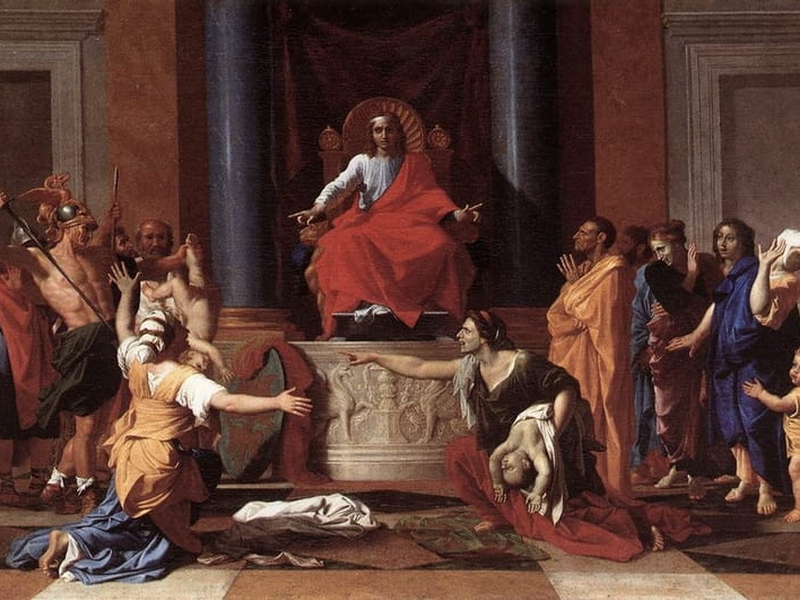
The Eighth Month

Zechariah’s first prophecy (Zech. 1:1-6) was delivered in the eighth month of the second year of Darius. The notation of this date serves a number of purposes. Most obviously, it relates Zechariah’s prophecies to those of Haggai. By the time Zechariah delivered his first prophecy, Haggai had already chided the…

by Peter LeithartApril 23, 1994

Showing page 279 of 309

See all
See all

The Weapons of Our Warfare

In The Empty Men , his study of the heroic theme in the Bible, Gregory Mobley catalogs some of the odd weapons used by biblical warriors: “In Judges and 1 Samuel, the relative inferiority of the weapons of the biblical heroes is emphasized. Shamgar ben Anat is lauded for killing…

December 11, 2014

Individualist Collectivism

I have a great deal of sympathy with Jose Miranda’s claim (in Marx and the Bible ) that Paul is writing about justice in Romans, and that the apostles is concerned “with the problem of society . . . of human civilization. His anguish is over the injustice which reigns…

December 11, 2014

Baptized into the New Age

John Dunnill ( Body and Sacrifice , 128-9) argues that for Paul baptism is more than a “sign” of the new age: “For him, resurrection is the actual transformation of the mortal body of Jesus, the reversal of the deathward trend established by Adam: not merely the resuscitation of a…

December 10, 2014

Sacrificial death?

In some ways, Daniel Ullucci’s The Christian Rejection of Animal Sacrifice helpfully complicates our picture of views on ancient sacrifice, both pre-Christian and Christian. He challenges the standard narrative that claims that Christians straightforwardly and pretty much immediately recognized Jesus’ death as a final sacrifice, and pretty much immediately abandoned…

December 10, 2014

The Universe is a Kitchen

In a recent article in the Journal of the American Academy of Religion , Natalie Gummer lays out the sacrificial cosmology embodied in early Buddhist texts. The premise is that the world is a kitchen, in which things take the forms of ingredients in a cosmic stew - saps, juices,…

December 10, 2014

Horizontal Hierarchy

In his monograph on Israel’s Tabernacle as Social Space , Mark George makes the observation that tabernacle space is “configured horizontally”: “There is not a single step, platform, or dais in tabernacle space. No steps differentiate court space from common space, holy space from court space, or most holy space…

December 10, 2014

Showing page 488 of 2212

Browse by Category

In Medias Res

Your weekly digest for all things Theopolis.

Donate

Theopolis is nearly 100% donor-supported. Consider joining us on our mission.