Theopolis Logo

Writing

Explore our collection of theological essays, biblical studies, and reflections on faith and culture.

See all
sixteen-miles-out-al48tflf4e8-unsplash
James

Future Justification to the Doers of the Law

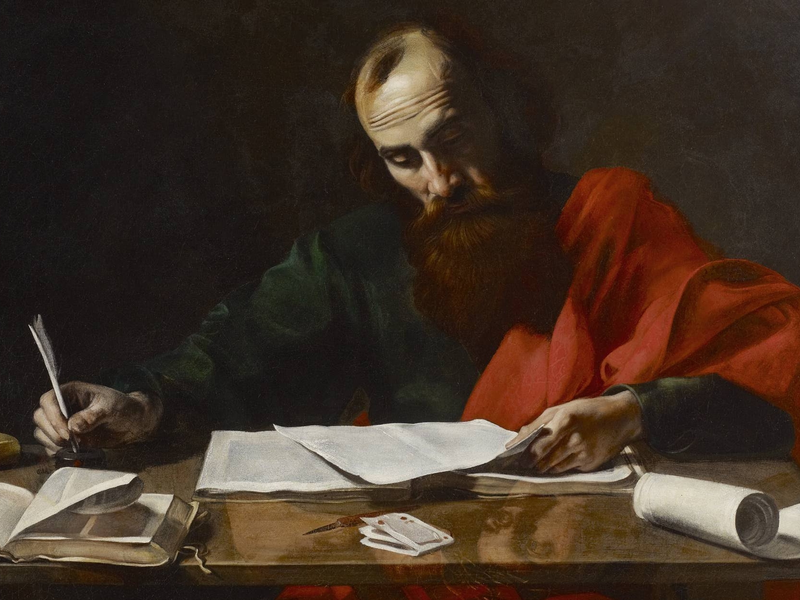
Keeping the Law Paul states just as emphatically as James that the doers of the law will be justified (Rom. 2:13; James 2:14ff). But who are these doers of the law? Is Paul speaking hypothetically of a class of sinless people who do not really exist? Or does he have…

by Mark HorneApril 21, 2003
13071-probablyvalentindeboulogne-saintpaulwritinghi-1
New Perspective on Paul

A Quickie Evangelical Introduction to the So-Called “New Perspective on Paul”

I have entitled this super-condensed piece to capture interest, but the fact is it sets forth what I have believed and taught long before I had ever heard of the so-called “new perspective.” For example, one can look at my paper on Ephesians 2.15 , written before I had ever…

by Mark HorneApril 5, 2003
aaron-burden-qjdzyt_k8xg-unsplash
Justification

The Tenses of Justification

N. T. Wright and other “New Perspective on Paul” (NPP) theologians have been criticized and condemned for speaking of justification in various “tenses.” In fact, Wright typically begins discussions of justification with future justification and works his way back to the present. But this is hardly a novelty. While the…

by Rich LuskMarch 24, 2003
sixteen-miles-out-d40gdcd_-he-unsplash
Romans

Faith & Faithfulness in Paul’s Letter to the Romans & the Obedience of the Nations

A doctrine of “faith alone” must be explicated and lived out in the light of the larger story of faithfulness, a story that reaches its climax in Jesus, the faithful Messiah. Indeed, the idea of “faith alone,” and even Paul’s use of the OT in service of that idea, makes…

by Mark HorneMarch 21, 2003
stephen-radford-86qxyjwq8lu-unsplash
How to Worship

The Role of Preaching in the Covenant Renewal Liturgy

In every city in the United States there are at least a couple of Christian radio stations which broadcast preaching around the clock, seven days a week. Many areas have a Christian television station or two which broadcast worship services several hours a day. Almost any bookstore will have a…

by Duane GarnerMarch 21, 2003
greg-rakozy-ompaz-dn-9i-unsplash-2
Justification

Trustworthy Precepts

The queston has been discussed: which is prior, faith or repentance? It is an unnecessary question and the insistence that one is prior to the other is futile. There is no priority. The faith that is unto salvation is a penitent faith and the repentance that is unto life is…

by Mark HorneMarch 7, 2003

Showing page 235 of 309

See all
See all
Literature

Michel on Tragedy

Laurence Michel, exploring the “Possibility of a Christian Tragedy,” suggests that the creation account of Genesis opens the possibility for a “tragic sense of life.” How? “To have a world imitative of the simple perfection of God one must have multiplicity and diversity of goods. Various evils and contraries will…

January 15, 2004
Theology

Evil and Good

CS Lewis says in Pilgrim’s Regress : “Evil is fissiparous, and could never in a thousand eternities find any way to arrest its own reproduction. If it could, it could be no longer evil: for Form and Limit belong to the good.” But what then of a Good and Infinite…

January 15, 2004
Literature

Niebuhr on Christianity and Tragedy

In a chapter in Beyond Tragedy , Reinhold Niebuhr considers the relationship between Christianity and tragedy. He denies that Christianity is tragic: “The cross is not tragic but the resolution of tragedy.” In the course of his discussion he makes several intriguing points about the tragic outlook: 1) He highlights…

January 15, 2004
Literature

Weil on Tragedy

Simone Weil offered one of the most thorough-going Christian defenses of tragedy, though that defense comes at considerable cost to her orthodoxy. As Katherine Brueck points out in her study of Weil’s theory ( The Redemption of Tragedy ), Weil recognized that what was at stake in a discussion of…

January 15, 2004

More Thoughts from Segal

Some more thoughts from Segal’s book: 1) He points out the optimism that gripped Athens in the Periclean period, an optimism about the ability of human LOGOS and NOMOS to stave off the savage potential of man’s PHUSIS. But that was short-lived: The Peloponnesian wars broke out, marked by several…

January 15, 2004

civilization in Sophocles

In his study of Sophocles, Tragedy and Civilization , Charles Segal points to several Greek terms that might be translated as “civilization” and that capture various aspects of civilized life: NOMOS = the established institutions, customs, and norms of a people POLITEIA = the form of government, especially the constitutional…

January 15, 2004

Showing page 2136 of 2212

Browse by Category

In Medias Res

Your weekly digest for all things Theopolis.

Donate

Theopolis is nearly 100% donor-supported. Consider joining us on our mission.