Theopolis Logo

Writing

Explore our collection of theological essays, biblical studies, and reflections on faith and culture.

See all
johann-siemens-epy0gbjzzzu-unsplash
Apologetics

A Sabbath Conversation: How Old is the Earth?

As Adam and Eve walked to the center of the Garden of Eden to meet with the LORD on their first Sabbath they conversed about the origin and age of the earth. Adam: You know, honey, we spent a lot of time yesterday making preparations for our house, and we…

by Jeff MeyersOctober 3, 1997

img_1043
Biblical Horizons

Psalms for Exile: The Narrative Progression in the Fifth Book of the Psalter

Some of our forefathers believed in reading/singing the psalms in order. Today, when the psalms are even used at all, they tend to be used randomly, though sometimes tied to a church calendar or to the pastor’s sermon. The Bible does not bind us to any particular practice, but there…

by James B. JordanSeptember 4, 1997
jordan-wozniak-xp_agmeea6s-unsplash-2
Biblical Chronology

The Anthropomorphic Days of C. John Collins, Part 2

Dr. Collins begins his essay with a brief statement of the Day Age view and then a brief statement of the Six Day view, focussing on the challenge to that view posed by modern "science." He ends this discussion by writing: "Two crucial points are at stake here: first, the…

by James B. JordanSeptember 4, 1997
john-salzarulo-wtjrpjzabcq-unsplash
Biblical Horizons

Paperweights and the Puzzles of Secularism

In his The Construction of Social Reality , Berkeley philosopher John Searle puzzles over the ontology of the products of human construction. Certain things – granite, platypi, weeping willows – occur naturally; while other realities – stone walls, zoos and parks, Chase Manhattan Bank – exist only as products of…

by Peter LeithartAugust 27, 1997
ales-krivec-4mibe6zg5r0-unsplash
Biblical Chronology

The Anthropomorphic Days of C. John Collins, Part 1

In the journal Presbyterion 20 (1994):109-130, published by Covenant Theological Seminary, Dr. C. John Collins sets forth a revision of the Day Age approach in his essay, "How Old Is the Earth? Anthropomorphic Days in Genesis 1:1–2:3." Dr. Collins’s essay has been widely accepted in evangelical Presbyterian circles as an…

by James B. JordanAugust 4, 1997
screenshot-2023-09-04-at-10-37-01-am
Biblical Horizons

The Sin of Ham and the Curse of Canaan, Part 3 (An Exposition of Genesis 9:20-27)

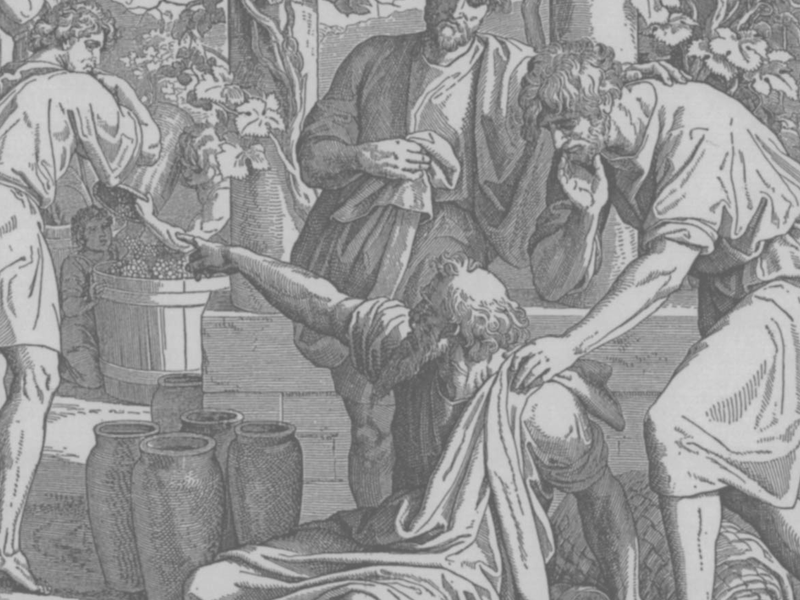
The Righteousness of Shem and Japheth As noted above, the action of Shem and Japheth was purely symbolic. They did not need to cover Noah with a garment, for he was already covered by the tent. Their action was a symbolic affirmation of Noah’s authority, a symbolic rejection of Ham’s…

by James B. JordanAugust 4, 1997

Showing page 254 of 309

See all
See all
Philosophy

Postmodern Tragedy

Postmodern tragedy is also rooted in Freud: For Freud, the id desires but is blocked and opposed by the superego. The ego negotiates, and finds ways for the id to express itself without violating the standards of the superego. This is reasonable, submission to the reality principle. But it is…

October 30, 2003
American Religion

Just War

Christopher Lynch ends a review of several books on just war ( Weekly Standard , Nov 3), with the comment that “popular punditry’s now-routine use of the theory and the flood of recent books on the topic suggest that a change in the nation’s thinking has taken place.” Just in…

October 30, 2003
Philosophy

Worldview

Evangelicals these days are positively giddy about worldview. For many, developing a Christian worldview is the answer to all or most of the ills that plague the contemporary church. When I see a bandwagon, however, I tend to wonder why they are heading in that direction, and this contrarian bias…

October 30, 2003

Unitarianism

The internal contradictions of unitarianism: If God is finite, then there is a boundary, and he is hardly worthy of the name God. If he is infinite, then there is no boundary, but there is also no outside. But if there is no “outside,” where does this unitarian God “put”…

October 30, 2003
Philosophy

Plato and Fear

To what extent does Platonism arise out of fear of contaminants, of miasma, of impurity? On Derrida’s reading, Plato dreams of an uncontaminated origin and presence that can never be arrived at or achieved, and he sees every supplement as an unhappy contamination of the purity of the origin. That…

October 30, 2003

JSOT Articles

Several interesting articles in the current issue of JSOT : 1) Yairah Amit of Tel Aviv University writes on “Progression as a Rhetorical Device in Biblical Literature.” The concept is fairly simple: He’s pointing to places where, in narrative or speech, the biblical writers list a series of events or…

October 29, 2003

Showing page 2175 of 2212

Browse by Category

In Medias Res

Your weekly digest for all things Theopolis.

Donate

Theopolis is nearly 100% donor-supported. Consider joining us on our mission.