Theopolis Logo

Writing

Explore our collection of theological essays, biblical studies, and reflections on faith and culture.

See all
sculptor
Art

The Artist's Litany

If we say that we have no sin, we deceive ourselves, and the truth is not in us. (1 John 1:8) O God the Father, creator of heaven and earth, Alpha and Omega, beginning and end, who inspired Creation with the breath of your nostrils, who placed Adam in the…

by Christian LeithartFebruary 2, 2016
sodom_and_gomorrah_afire_by_jacob_jacobsz-_de_wet_d-_j-_probably_koln_c-_1680_oil_on_canvas_-_hessisches_landesmuseum_darmstadt_-_darmstadt_germany_-_dsc01149-e1632540497247
American Culture

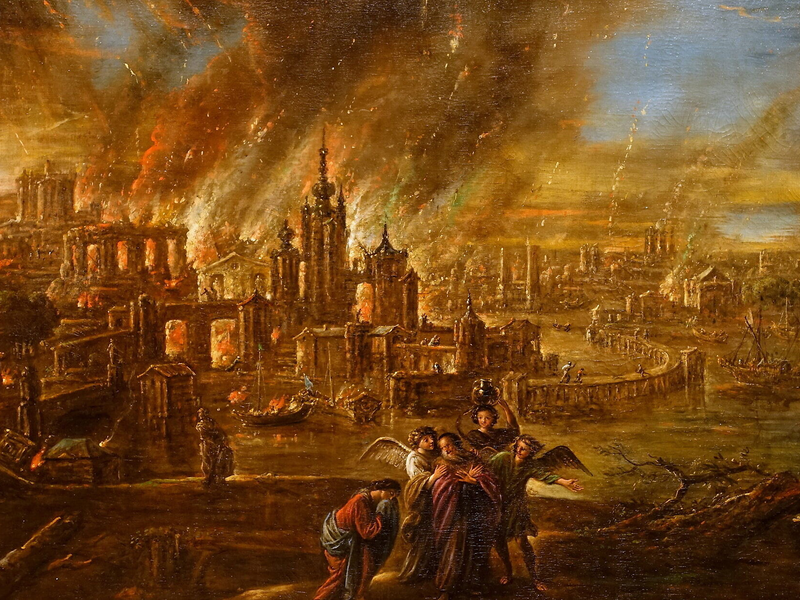
American Sodom

For nearly a half-century, Sodom has been a key symbol in the American culture wars. On the one side, we have an aggressive movement among homosexuals that has first decriminalized homosexual conduct, then to force cultural and legal recognition of homosexuals as a minority and to normalize homosexual behaviors, finally…

by Peter LeithartJanuary 28, 2016
image-20150409-15244-1r08rsu
Biblical Theology

The Meaning of the Mount of Olives

Speaking of the Church, Romans 11:16-17 says, "And if the root be holy, the branches are also. But if some of the branches were broken off, and you, being a wild olive were grafted in among them and became partaker with them of the root of the fatness of the…

by James B. JordanJanuary 26, 2016
img_6134
Isaiah

No Sabbath for God

At the end of Isaiah 61, Yahweh's Servant rejoices because the Lord clothes Him with salvation and righteousness. He decks Him like a bridegroom with a garland on His head. He wears jewels like a bride. He is a new bridegroom in a new garden of Eden, a garden of…

by Peter LeithartJanuary 21, 2016
hebrew-manuscript-2
Biblical Law

Approaching the Torah

Before anything else, a word about “Torah” may be in order. I have been persuaded that “law” is a bad translation of “Torah,” even though it is evident that what is called “Torah” does have commandments, statutes, and ordinances in abundance. Why not “law?” “Law” as a translation for “Torah”…

by Ralph Allan SmithJanuary 19, 2016
jane-austen-2
Biblical Horizons

Jane Austen, Pundit

Few novelists seem as innocent of the temptation to punditry as Jane Austen. Though living through a period that witnessed the birth of an independent United States, the French Revolution and the Terror, the Napoleonic wars and the rise of revolutionary romanticism, and the upheavals of the Industrial Revolution, she…

by Peter LeithartJanuary 14, 2016

Showing page 137 of 309

See all
See all
History

Enlightenment

Two very different evaluations of the Enlightenment appear in recent books. First from Robert Darnton, historian of the French Enlightenment, who, according to the reviewer in the October 6 TNR , devotes the first and most substantative essay in his recent book George Washington’s False Teeth to defending the Enlightenment.…

October 20, 2003
Biblical Studies

Promised Land and Heaven

There’s a breakdown in the traditional typology that links “promised land” with “heaven.” Though the promised land is eschatologically a new heavens and new earth, the typology is more exactly fulfilled in the church’s fulfillment of the great commission on earth. After all, we don’t embark on a “conquest” of…

October 18, 2003
Biblical Studies

Moses the Matchmaker

Moses is the matchmaker who brings the bride to a trysting place with her lover, Yahweh. He is the “friend of the bridegroom” who, like John the Baptist, prepares the bride for her husband. As such, Moses and John are models for all Christian ministry, which is also all about…

October 18, 2003
Biblical Studies

Horned Man

Something to check: Is Moses the first “horned man” in the Bible? He comes down from the mountain, having seen the glory of God, with “horns” on his head, rays of glory radiating out. This may be the source of the horned man image used elsewhere, in the Psalms for…

October 18, 2003

“From Faith” (Rom. 1:17)

Douglas A. Campbell argues forcefully for interpreting the phrase ek pisteos (from faith) in Romans 1:17 as a reference to the faithfulness of Christ in his obedience to death. This, in turn, suggests strongly that Paul’s later use of pistis Christou (faith of Christ) as Christ’s own faithfulness rather than…

October 18, 2003

“From Faith” (Rom. 1:17)

Douglas A. Campbell argues forcefully for interpreting the phrase ek pisteos (from faith) in Romans 1:17 as a reference to the faithfulness of Christ in his obedience to death. This, in turn, suggests strongly that Paul’s later use of pistis Christou (faith of Christ) as Christ’s own faithfulness rather than…

October 18, 2003

Showing page 2181 of 2212

Browse by Category

In Medias Res

Your weekly digest for all things Theopolis.

Donate

Theopolis is nearly 100% donor-supported. Consider joining us on our mission.