
Theopolis News
Constantine the Pious
Trinity House President Peter Leithart will deliver a lecture on "Constantine the Pious" at Oregon State University, Wednesday, October 30, at 7:00 PM.
by Peter LeithartOctober 29, 2013
Explore our collection of theological essays, biblical studies, and reflections on faith and culture.
Trinity House President Peter Leithart will deliver a lecture on "Constantine the Pious" at Oregon State University, Wednesday, October 30, at 7:00 PM.

In his rich study, We Have Never Been Modern (Harvard 1993), Bruno Latour describes modernity in terms of a dual process of “purification” and “hybridization.” Purification involves the clean construction of a nature (and science) separated off from society and the self, while hybridization involves mixtures of nature and culture.…

In James K.A. Smith’s excellent book, Introducing Radical Orthodoxy: Mapping a Post-secular Theology , he explains recent developments in theology and philosophy among mostly post-liberal (some Catholic) theologians. As with everything Dr. Smith writes, his prose is accessible, and written with clarity and precision as he describes the contribution made…

This is the last of a three-part series. 1:14-19 – The Lights in the Firmament The fourth day is the first day where God sets out His mediators and rulers. In the celestial bodies, God sets out His mediators and rulers in the same single class of created beings. We…
Trinity House President Peter Leithart will be in Chicago this weekend lecturing on Revelation. Sign up here .
Only two more weeks to register for the Trinity House Advent class on the book of Genesis. Register before the late fees kick in!
Showing page 185 of 309
Showing page 43 of 43

In the Greek text of Ephesians 2:8, the statement “and this not of ourselves, it is the gift of God” is chiastically structured. A wooden translation is: “and this not out of ourselves, of God the gift,” with the EX HUMON (“out of ourselves”) chiastically matching the genitive THEOU (“of…
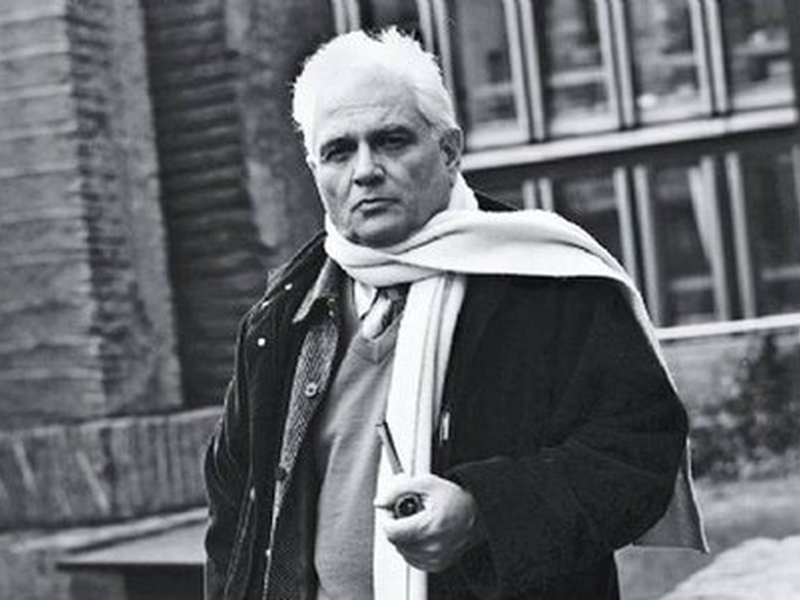
Here’s a summary of part of Milbank’s critique of Derrida (from Theology and Social Theory , pp. 307-311). Derrida attacks Western metaphysics by focusing on the attempt to separate a “meaning” out from the “play of signs.” In most Western systems, this meaning is associated with an original meaning that…

A note against empiricism: Derrida quotes Scheler (in his essay on Levinas, “Violence and Metaphysics”) to this effect: “I see not only the eye of an other, I see also that he looks at me.” That is, what is seen is not only a thing, a dead object, but also…

Levinas claims that an absolute other must necessarily be invisible. If the other is visible, I can at least “capture” and “grasp” and “encompass” him in my gaze, which is the first moment in a sequence that could lead to capturing, grasping, and encompassing and dominating him in other ways.…

Yeats said that the classical world was fundamentally tragic, with the Oedipus myth as the founding myth — the man kills his father and marries his mother. Yeats would have been better off pointing to the myth of Zeus, for that truly is the founding myth of the Olympian order,…

In his history of the ancient concept of progress, E. R. Dodds says that one fundamental limitation on the idea of progress was imposed by the theory of Forms, both in Platonic and in the Aristotelian version. For Plato all progress consists in approximation to a pre-existing model; the model…
Showing page 2196 of 2212
Your weekly digest for all things Theopolis.
