Theopolis Logo

Writing

Explore our collection of theological essays, biblical studies, and reflections on faith and culture.

See all
aaron-burden-1ebsmyrau-s-unsplash
Biblical Horizons

The Sin of Ham and the Curse of Canaan, Part 1

The history of the sin of Ham and the curse of Canaan comes in the middle of the Generations of Noah, a section of Genesis that begins at Genesis 6:9 and extends to the closing notice, Genesis 11:9. To understand the story better, it is necessary to get in mind…

by James B. JordanJune 3, 1997

david-weber-f_nj26i9wyo-unsplash-1
Eucharist

You and Your Son and Daughter: Christ’s Communion with Young Children

This paper was written to persuade people who were members of the Presbyterian Church in America. It should be accessible to anyone who believes in baptizing infants–especially to those who consider themselves a part of the Reformation Tradition. References to “our Confession” or “our standards” invoke the Westmeinster Confession of…

by Mark HorneJune 3, 1997
screenshot-2023-07-27-at-10-25-35-am
Baptism

The Westminster Standards & Sacramental Efficacy

Version 1.2 I write this brief essay in order to address a problem I have encountered. I keep reading explanations of doctrine of the sacraments fundamentally empty of the content which was once held by virtually all Reformed confessions and formulations. Furthermore, I read explanations and commentaries on the Westminster…

by Mark HorneJune 3, 1997
aaron-burden-h8s0pf2rcqs-unsplash
Biblical Chronology

John Sailhamer Weighs In, Part 2

We continue our analysis of John Sailhamer’s book *Genesis Unbound: A Provocative New Look at the Creation Account* (Multnomah Books, 1996), which argues that Genesis 1:2ff. is not about the creation of the whole world, but about the preparation of the Land of Eden, which is also the Promised Land.…

by James B. JordanMay 31, 1997
screenshot-2023-08-30-at-11-50-23-am
Matthew

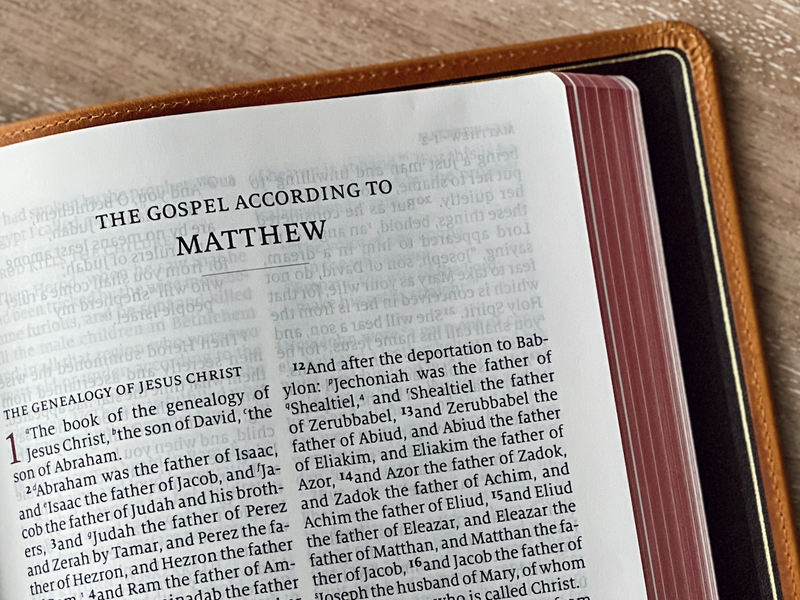
Toward a Chiastic Understanding of the Gospel According to Matthew, Part 2

III. Death of God’s Firstborn in the real Egypt: This huge chiasm has as its center the betrayal of Peter, as the leader of the disciples himself rejects Jesus. Peter holds an oficial position as high priest among the disciples of the incarnate Lord. His rejection of Jesus is the…

by James B. JordanMay 31, 1997
aaron-burden-qjdzyt_k8xg-unsplash
Eucharist

A Response to Rev. Bacon’s Argument that Manna was not a Sacrament

I wrote a response to Rev. Richard Bacon’s tract, What Mean Ye by This Service , a copy of which I borrowed from the library at Covenant Theological Seminary. However, I recently discovered that a new appendix was added to the version available on the Blue Banner’s web page. This…

by Mark HorneMay 29, 1997

Showing page 257 of 309

See all

Showing page 5 of 43

See all
History

Witch Craze

Jeffrey Burton Russell, who identifies himself as a “lapsed atheist,” has spent most of his career writing about Satan and hell. His most recent book is a history of the modern “mislaying” of heaven. Early in the book, he points out that “The ‘decline of heaven’ was linked to the…

August 18, 2006

Plato’s forms

In his “Hortatory Address,” Justin claims that Plato’s theory of forms came from a misreading of the tabernacle texts of Exodus: “And Plato, too, when he says that form is the third original principle next to God and matter, has manifestly received this suggestion from no other source than from…

August 16, 2006

Plato’s forms

In his “Hortatory Address,” Justin claims that Plato’s theory of forms came from a misreading of the tabernacle texts of Exodus: “And Plato, too, when he says that form is the third original principle next to God and matter, has manifestly received this suggestion from no other source than from…

August 16, 2006

Types and Shadows

As Hugo Rahner made clear in his classic study of the patristic uses of Greek myth, the church fathers saw Christ anticipated not only in the OT but in ancient literature and philosophy generally. Some examples: In Plato’s Republic (2, 361d-e), Glaucon describes the perfectly just man as one who…

August 16, 2006

Ouch!

In his “Hortatory Address to the Greeks,” Justin Martyr argued that the disagreements among Greek philosophers undermined their reliability, while the unity of the apostolic witness, and the witness of their successors, was evidence that Christianity came from God. “Since therefore it is impossible to learn anything true concerning religion…

August 16, 2006
History

Hegel and Hermes again

In the aforementioned book, Magee enumerates the following parallels between Hegel and Hermeticism: 1. Hegel holds that God’s being involves “creation,” the subject matter of his Philosophy of Nature. Nature is a moment of God’s being. 2. Hegel holds that God is in some sense “completed” or actualized through the…

August 16, 2006

Showing page 1808 of 2212

Browse by Category

In Medias Res

Your weekly digest for all things Theopolis.

Donate

Theopolis is nearly 100% donor-supported. Consider joining us on our mission.