Theopolis Logo

Writing

Explore our collection of theological essays, biblical studies, and reflections on faith and culture.

See all
aaron-burden-h8s0pf2rcqs-unsplash
Galatians

The Restoration of the Galatians

While controversies over the writings of Paul continue in various corners of the intellectual globe, the word of God given through Paul and his scribe and all of the church’s interpreters and translators over the last two millennia is still readily available to the lofty and the lowly. Paul, as…

by Grace LangnessMarch 25, 2013

kiwihug-l4gw27xzn1i-unsplash
Deuteronomy

Law and History: How to Read the Law of Moses (Part 2)

The second in a series of studies in Deuteronomy. Deuteronomy 22:30: A man shall not take his father’s wife, and shall not uncover his father’s wing (Hebrew: kanaf ). There are a number of unusual features in this law that mark it out from the previous context, indicating that it…

by Ralph Allan SmithMarch 20, 2013
200403-moss-pilate-tease_pncfq5
History

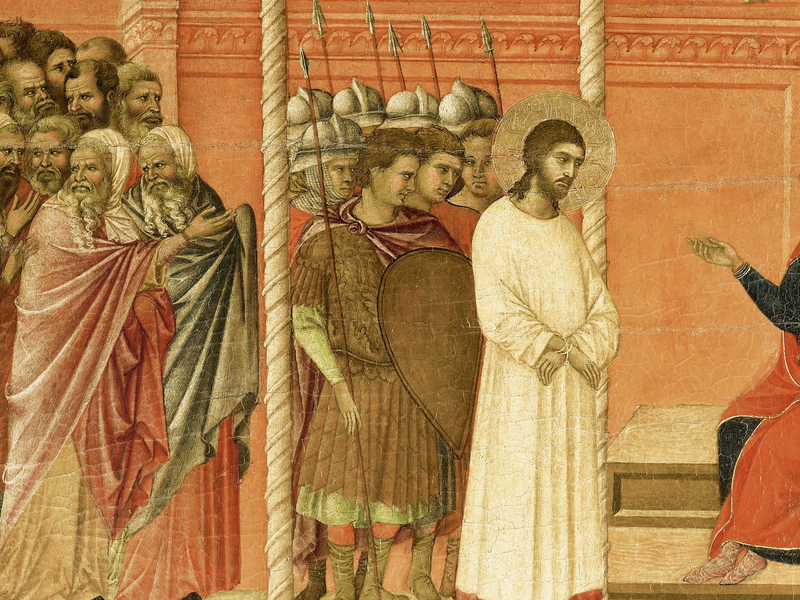
Victimhood and the Gospel

The texts of Christianity have been slowly at work, under the power of the Holy Spirit for 2000 years now. If we could be magically transported back into the world of two millennia ago, modern Americans would be shocked at the cruelty of that world. There was no concern for…

by Richard BledsoeMarch 18, 2013
aaron-burden-1ebsmyrau-s-unsplash
Luke

The Dysfunctional Family of the Gadarene Madman

The Story of the Gadarene Madman is told in all three synoptic Gospels (Matthew 8:28-34, Mark 5:1-20, Luke 8:26-37). Jesus ventures into a Gentile area when He passes over the Sea of Galilee. Upon disembarking from his boat, he is immediately met by a demon-possessed madman. Upon meeting Jesus, he…

by Richard BledsoeMarch 13, 2013
aaron-burden-1ebsmyrau-s-unsplash
Deuteronomy

Law and History: How to Read the Law of Moses

Part 1 of a multi-part series of studies on Deuteronomy 22:30-23:8. Eric Auerbach, in his classic work on Western literature, devotes his first chapter to contrasting Homer with the Bible. Of Homer, he writes of the “need of Homeric style to leave nothing which it mentions half in darkness and…

by Ralph Allan SmithMarch 12, 2013
markus-winkler-aid-xyrtlec-unsplash
Theopolis News

James Jordan in Korea, Japan

Trinity House Fellow James B. Jordan will be a speaker at an International Conference on Biblical Symbolism that will be held in Seoul on Monday, May 27 in 2013. He will address "The Importance of Biblical Symbolism and Symbolic Interpretation of the Bible." The conference will have three other speakers…

by Peter LeithartMarch 9, 2013

Showing page 197 of 309

See all

Showing page 5 of 43

See all

Are Trinitarian Persons Persons?

B oethius defined persona as an “individual substance of a rational nature ( natuae rationalis individua substantia ). This definition is often cited as evidence that medieval Trinitarian theology, deeply influenced by Boethius, did not teach that the Trinitarian “Persons” are persons in the modern sense of the term -…

January 19, 2017

Justice and Righteousness

N estled within several chapters of 1 Chronicles that describe David's wars, 1 Chronicles 18:14–17 explains the purpose of those wars: To establish Yahweh's order of justice in Israel, an order of justice that David himself administers and mediates. Having conquered Philistia, Moab, Ammon, and Edom, David reigns over “all…

January 18, 2017

God's Sacramental Self-Gift

What does God give in creation and redemption? He gives us our own existence, and that the gift He gives is Himself. Both are true. Luther captures this latter point in his 1528 “Confession”: “These are the three Persons and the one God, Who has given Himself to us wholly…

January 17, 2017

Anthropomorphism and Nature

I n his Essays in Anthropology , Robert Spaemann observes that “the beginning of modern science was marked by polemics against the concept of nature. The concept of nature is now taken to be anthropomorphic, while the essentially teleological idea of things in the cosmos having ‘movement in themselves' is…

January 17, 2017

American Covenant

P hilip Gorski's American Covenant examines the American tradition of civil religion or civic republicanism from the Puritans through President Obama. Gorski contrasts this tradition with the two most belligerent contenders in contemporary American politics, religious nationalism and radical secularism. Civil religion differs from radical secularism in its anthropology (communitarian…

January 16, 2017

Conrad’s Mesmerizing Obscurity

K ate Symondson begins her TLS review of recent editions of Joseph Conrad’s letters and his novel Victory with a reminder of FR Leavis's complaint about Conrad's “insistence on inexpressible and incomprehensible mystery.” Symondson writes, “Instead of the Victorian preference for pellucid—almost pedantic—hardened detail, mist shrouds and encircles Conrad's fiction.…

January 13, 2017

Showing page 216 of 2212

Browse by Category

In Medias Res

Your weekly digest for all things Theopolis.

Donate

Theopolis is nearly 100% donor-supported. Consider joining us on our mission.