Theopolis Logo

Writing

Explore our collection of theological essays, biblical studies, and reflections on faith and culture.

See all
denise-jans-dpemksg59la-unsplash
Art

Glorifications Versus Debasement

Because of sin, the arts sometimes do not serve to glorify but to debase. Sinful men make their environments ugly, and create ugly art to “enhance” their ugly words. But since all men are still God’s images, no men are able to live with such ugliness all the time. Thus,…

by James B. JordanMay 25, 1994

jeremy-yap-j39x2xx_8cq-unsplash
Art

Words and Glory

Arts and literature reviews in most evangelical Christian publications generally approach their subjects in terms of ideology. We are told whether or not the film or book is acceptable in terms of morals, sexual graphicness, and theological accuracy. While there is definitely a place for such reviews, I fear that…

by James B. JordanMay 25, 1994

screen-shot-2018-04-12-at-9-48-08-am
Biblical Horizons

Broadening Our View of the Trinity

We speak of God as Father, Son, and Holy Spirit. The early Church tended to speak of Him as Father, Word, and Spirit. In this short essay, I want to suggest some other ways to think of the Trinity, ways that I have found pastorally helpful in my own life…

by James B. JordanMay 5, 1994
Biblical Studies

Thousands of Generations

I, Yahweh your God, am a jealous God, visiting the iniquity of the fathers on the children, on the third and fourth of those who hate Me, but showing lovingkindness to thousands, to those who love Me and guard My commandments (Ex. 20:5-6). The Second Word forbids acts of ceremonial…

by James B. JordanMay 5, 1994
ben-white-w8qqn1pmqh0-unsplash
Biblical Chronology

The Chronology of the Pentateuch (Part 3)

8. The Table of Nations If we assume births every two years, and about 30 years between generations (cp. Gen. 11:12-24), we can come up with an approximate series of dates for the generations recorded in Genesis 10. We shall assume that all three of Noah’s sons had their firstborn…

by James B. JordanMay 5, 1994
49980-nicolas_poussin_-_the_judgment_of_solomon_-_wga18330-800w-tn
Biblical Studies

The Eighth Month

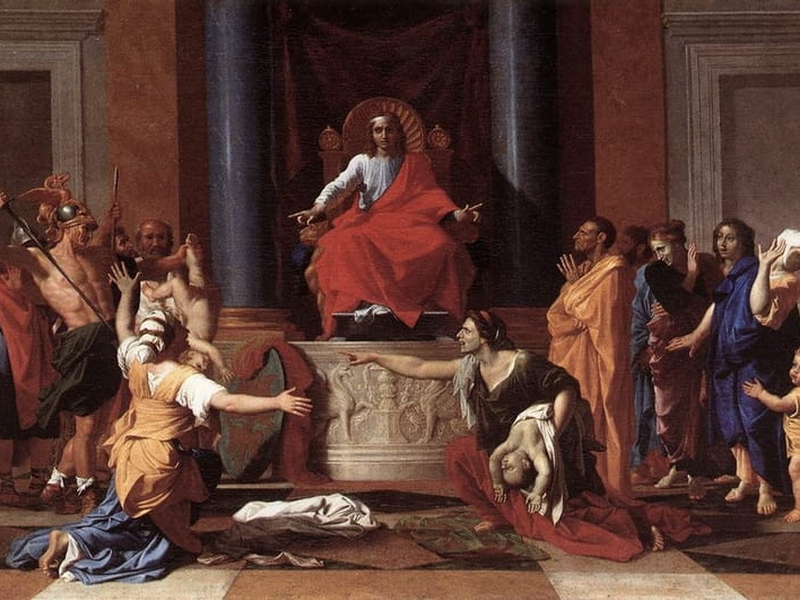
Zechariah’s first prophecy (Zech. 1:1-6) was delivered in the eighth month of the second year of Darius. The notation of this date serves a number of purposes. Most obviously, it relates Zechariah’s prophecies to those of Haggai. By the time Zechariah delivered his first prophecy, Haggai had already chided the…

by Peter LeithartApril 23, 1994

Showing page 279 of 309

See all

Showing page 5 of 43

See all

Why Protestants Can't Write, II

If the writer must be open to the manifestation of God in “what-is,” she must begin with the senses. Following Aquinas, Flannery O'Connor writes, “The beginning of human knowledge is through the senses, and the fiction writer begins where human perception begins. He appeals through the senses, and you cannot…

January 29, 2016

Apocalyptic Herods

C. E. Douglas's 1915 study of Revelation, The Mystery of the Kingdom , is an eccentric work in a number of ways, but for just that reason highly stimulating, provocative of insight. He rejects, for instance, both the “standard” dating of the book in the reign of Domitian (based on…

January 29, 2016

Den of Thieves

Jesus condemned the temple as a “den of thieves.” He was quoting Jeremiah, who said that the Jews of his time were using the temple as a “safe house” where they could store and enjoy their ill-gotten gains. The temple was not where their thieving took place, but their hideout.…

January 29, 2016

Holy One of Israel

Yahweh is the “Holy One of Israel” ( qedosh yisrael ). It is a name used almost exclusively in Isaiah. It appears once in Kings (2 Kings 19:22), three times in the Psalms (71:22; 78:41; 89:18), a couple of times in Jeremiah. Isaiah uses the name twenty-five times (significant? 2…

January 28, 2016

Kings and the Land

Israelite kings were not to be like kings of the nations (Deuteronomy 17). Kings from the nations multiplied wealth and lived in luxury; they built military machines to conquer their neighbors; they kept harems full of princesses, wives and concubines that represented political alliances. Israel's kings were to be different…

January 28, 2016

Why Protestants Can't Write, I

Blame it on Marburg. The 1529 Colloquy at Marburg attempted to reconcile Lutherans and Zwinglians on the doctrine of the real presence, and was nearly able to achieve its aim. To Luther's surprise, the Zwinglian party agreed with fourteen of his fifteen propositions, and even conceded most of what was…

January 28, 2016

Showing page 327 of 2212

Browse by Category

In Medias Res

Your weekly digest for all things Theopolis.

Donate

Theopolis is nearly 100% donor-supported. Consider joining us on our mission.