Theopolis Logo

Writing

Explore our collection of theological essays, biblical studies, and reflections on faith and culture.

See all
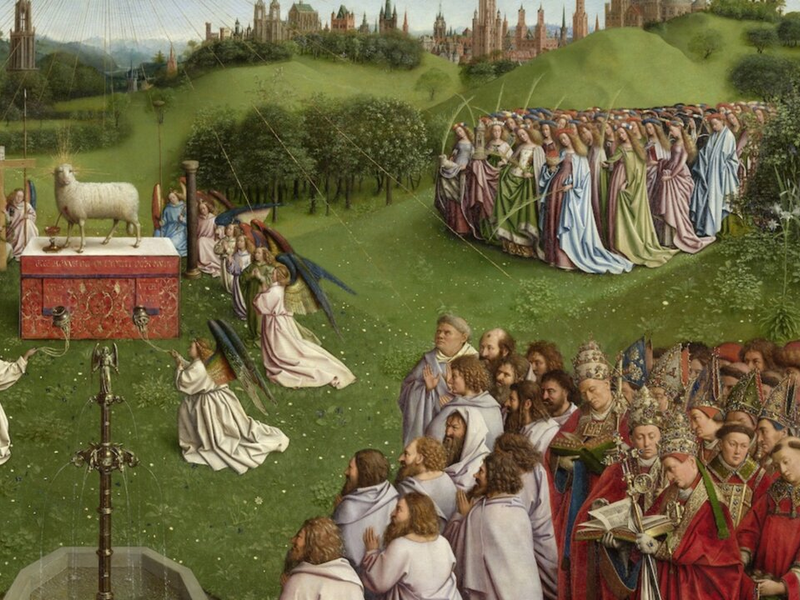
20_van-eyck_bavo-altar_adoration-of-the-lamb-copy-67f4f94b
Culture

An Introduction to the Sacred Music of Josquin

This essay is adapted from my articles in Theopolis’s In Medias Res as a series of Holy Week meditations. Like many celebrities such as Kanye or Beyoncé or Adele, Josquin des Prez (d. 1521) was often known only by his first name, in his own time as now. “Josquin” is…

by John AhernJuly 29, 2025
screenshot-2025-07-22-at-11-57-58-am
Numbers

Sight and Memory: Examining the Monuments of Numbers

Sight is a major theme in the scriptures. The church has long identified sight’s relationship to the future fulfillment of the eschaton. As Paul says, “For now we see only a reflection as in a mirror; then we shall see face to face” (1 Cor 13.12). Sight is associated with…

by Matthew DarbyJuly 22, 2025
tengyart-aaz5-as3io-unsplash
Biblical Theology

Yahweh’s Flame: the Gospel through Symbolism

What is the chief end of man? —yes, to glorify God and enjoy him forever. But how ought man–and all creation–so glorify him? I propose a Theopolitan addition to the catechism, question and answer number 1.5, begun in the last question and answered as follows: Earth’s inhabitants were created to…

by Ben LoveladyJuly 16, 2025
screenshot-2025-07-08-at-8-31-22-am
Culture

Morality and the Practice of Poetry

Naphtali is a hind let loose: he giveth goodly words. Genesis 49:21 Frederick Buechner once said, “We move into the extraordinary by way of the ordinary.” In poetry, this happens by way of a compressed code of analogs; often, two or more very ordinary things begin to reveal something that…

by Garrett SoucyJuly 8, 2025
screenshot-2025-07-03-at-9-26-50-am
Ephesians

The Trinitarian Structure of Obedience

The evangelical milieu of America has often lost a vision of the fruit of repentance. We tend to simplify repentance by asking for forgiveness. After all, Jesus tells Peter to forgive 70 times 7. This verse must be paired with Paul’s scoffing at the question: why not sin more so…

by Matthew CoreyJuly 3, 2025
33255drsdl
Luke

The Hemorrhaging Woman, the Eucharist, and the Sermon

I. The hemorrhaging woman. En route to Jairus’ house, Jesus is touched by a woman with a hemorrhage of blood (Matt 9:18–26; Mk 5:21–34; Lk 8:40–48). The story is one that many of us know very well. She has been yoked to her illness for twelve years, all of her…

by Mark BriansJuly 1, 2025

Showing page 7 of 309

See all

Showing page 5 of 43

See all

History of Disgust

Norbert Elias’s The Civilizing Process traces modern standards of disgust and cleanliness to the development of court society during the Renaissance. Drawing on Elias, William Miller ( Anatomy of Disgust ) suggests sensitivity to disgust and being civilized are directly proportional. Martha Nussbaum ( Hiding from Humanity , 115-6) disagrees…

December 15, 2014

Islamic Revolutionaries

In his brilliant Earthly Powers (3), Michael Burleigh cites a passage from Tocqueville’s book on the French Revolution. Taking a note from Schiller about “how early modern religious wars spilled across political boundaries, which reminded Tocqueville of the ideological struggle between Jacobins and counter-revolutionaries in late-eighteenth-century Europe,” Tocqueville drew a…

December 12, 2014

Sacrificial Politics

Semyon Frank was a Russian emigre to London. Michael Burleigh ( Sacred Causes , 39) sums up his life: “Born in 1877 into a Russian-Jewish family, he had quickly outgrown a juvenile Marxism, converting to Orthodox Christianity in 1912, on the ground that the Jewish God was as remote from…

December 12, 2014
Modernity

Un-Secular Age

Our secular age can be sustained only if the secular has been carefully distinguished from the sacred, and only if the boundary between the two is vigorously, not to say violently, guarded. But boundary-drawing between the sacred and profane is the work of a priest. It is the sacred act…

December 12, 2014

Pure Aesthetics

Hugh Grady opens his Shakespeare and Impure Aesthetics (6-10) with a brief and illuminating discussion of Kant’s aesthetics of purity. By “pure” here is meant the freedom of aesthetic experience from cognitive reason and teleological judgments, from practical or moral interests. This disinterested experience of art is an encounter with…

December 12, 2014

After the Temple

Jonathan Klawans is a great one for cutting through nonsense. In his Purity, Sacrifice, and the Temple , he points to the oddity that “documents composed three, four, or even five centuries after the destruction are labeled as delayed responses to the destruction. . . the suggestion that it took…

December 11, 2014

Showing page 487 of 2212

Browse by Category

In Medias Res

Your weekly digest for all things Theopolis.

Donate

Theopolis is nearly 100% donor-supported. Consider joining us on our mission.