Theopolis Logo

Writing

Explore our collection of theological essays, biblical studies, and reflections on faith and culture.

See all
johann-siemens-epy0gbjzzzu-unsplash
Apologetics

A Sabbath Conversation: How Old is the Earth?

As Adam and Eve walked to the center of the Garden of Eden to meet with the LORD on their first Sabbath they conversed about the origin and age of the earth. Adam: You know, honey, we spent a lot of time yesterday making preparations for our house, and we…

by Jeff MeyersOctober 3, 1997

img_1043
Biblical Horizons

Psalms for Exile: The Narrative Progression in the Fifth Book of the Psalter

Some of our forefathers believed in reading/singing the psalms in order. Today, when the psalms are even used at all, they tend to be used randomly, though sometimes tied to a church calendar or to the pastor’s sermon. The Bible does not bind us to any particular practice, but there…

by James B. JordanSeptember 4, 1997
jordan-wozniak-xp_agmeea6s-unsplash-2
Biblical Chronology

The Anthropomorphic Days of C. John Collins, Part 2

Dr. Collins begins his essay with a brief statement of the Day Age view and then a brief statement of the Six Day view, focussing on the challenge to that view posed by modern "science." He ends this discussion by writing: "Two crucial points are at stake here: first, the…

by James B. JordanSeptember 4, 1997
john-salzarulo-wtjrpjzabcq-unsplash
Biblical Horizons

Paperweights and the Puzzles of Secularism

In his The Construction of Social Reality , Berkeley philosopher John Searle puzzles over the ontology of the products of human construction. Certain things – granite, platypi, weeping willows – occur naturally; while other realities – stone walls, zoos and parks, Chase Manhattan Bank – exist only as products of…

by Peter LeithartAugust 27, 1997
ales-krivec-4mibe6zg5r0-unsplash
Biblical Chronology

The Anthropomorphic Days of C. John Collins, Part 1

In the journal Presbyterion 20 (1994):109-130, published by Covenant Theological Seminary, Dr. C. John Collins sets forth a revision of the Day Age approach in his essay, "How Old Is the Earth? Anthropomorphic Days in Genesis 1:1–2:3." Dr. Collins’s essay has been widely accepted in evangelical Presbyterian circles as an…

by James B. JordanAugust 4, 1997
screenshot-2023-09-04-at-10-37-01-am
Biblical Horizons

The Sin of Ham and the Curse of Canaan, Part 3 (An Exposition of Genesis 9:20-27)

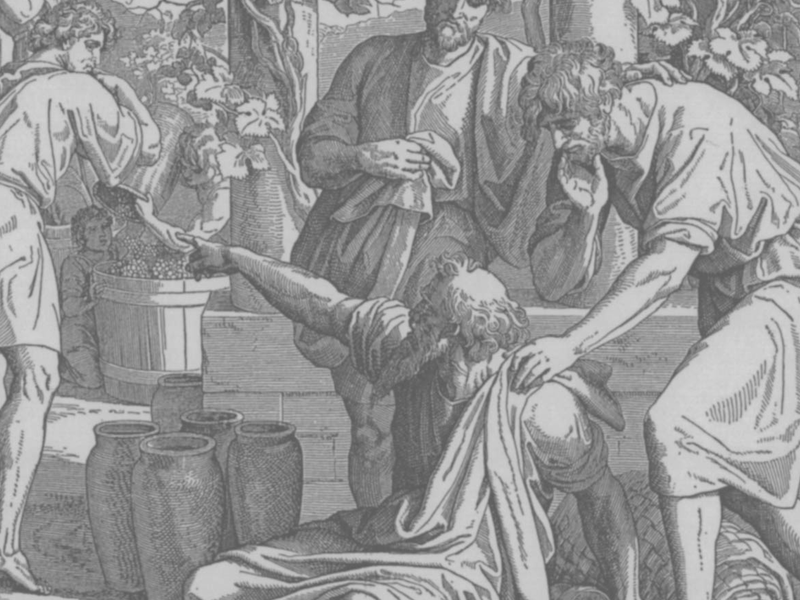
The Righteousness of Shem and Japheth As noted above, the action of Shem and Japheth was purely symbolic. They did not need to cover Noah with a garment, for he was already covered by the tent. Their action was a symbolic affirmation of Noah’s authority, a symbolic rejection of Ham’s…

by James B. JordanAugust 4, 1997

Showing page 254 of 309

See all

Showing page 5 of 43

See all

Roth’s Reversal

Philip Roth famously announced last year that he was quitting. Writing in the TLS , Adan Thirlwell suggests that what he’s actually doing is continuing his career in an inverted fashion. Thirlwell cites a 1984 interview with Hermione Lee, where Roth described his working method: “Making fake biography, false history,…

March 25, 2014

Dostoevsky’s Moral Fiction

In an essay on Dostoevsky and evil in Between Religion and Rationality , Joseph Frank observes that Dostoevsky frequently leads readers into moral horrors, but his “unflinching explorations of evil” don’t leave readers paralyzed. How does that work? Frank traces Dostoevsky’s depiction of evil to his prison experience, recounted in…

March 25, 2014

Irony and Proclamation

In one of his late essays in Speech Genres , Bakhtin traces the secularization of literature to the solvent effects of irony: “Irony has penetrated all languages of modern times (especially French); it has penetrated into all words and forms . . . Irony is everywhere - from the minimal…

March 25, 2014

Augustinian Semiotics

In a 1988 article in the Journal of Literature and Theology (2:1), Milbank sketches the contours of a “theology without substance.” Along the way, he offers a critique of Augustine’s signum-res distinction and the implied metaphysics. On the one hand, Augustine pours some of the foundations for a Christian linguistics…

March 25, 2014

Death Before the Fall

Ronald Osborn’s Death Before the Fall is two books in one, as the subtitle suggests: “Biblical Literalism and the Problem of Animal Suffering.” Part of the book is a critique of “literalism,” especially as expressed in young-earth creationism, the other part is an exegetical defense of the notion that animal…

March 24, 2014

Tossed on a Bed

Jesus threatens to throw the self-appointed prophetess Jezebel onto a bed (Revelation 3:22). The threat carries multiple resonances. The original Jezebel died by being thrown from a window to the ground in front of conquering Jehu. Jesus is the new Jehu throwing Jezebel to her deathbed. It’s fitting that she’s…

March 24, 2014

Showing page 652 of 2212

Browse by Category

In Medias Res

Your weekly digest for all things Theopolis.

Donate

Theopolis is nearly 100% donor-supported. Consider joining us on our mission.