Theopolis Logo

Writing

Explore our collection of theological essays, biblical studies, and reflections on faith and culture.

See all
screen-shot-2023-05-02-at-1-14-25-pm
Poetry

Seed-bearing Fruit

Ten-thousand ‘yeses’ and a single ‘no.’ From bough it dangles, beauty to the eyes, For belly, food, a fruit to make one wise. Too soon, they eat; they know; the leaves they sew, But, oh! the Love who asks, “Where did you go?” Confessions flow from under leaf’s disguise; A…

by Marc HaysAugust 16, 2023
screenshot-2023-08-15-at-8-22-28-am
Augustine

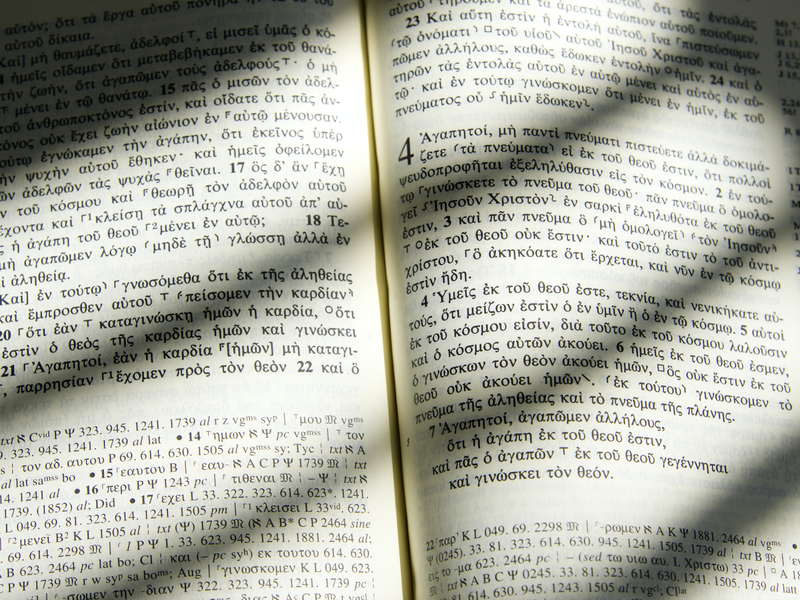
Eternal Life Chiasm in John's Gospel

In his masterful work, De Doctrina Christiana , Augustine of Hippo writes: I would have learned men to know that the authors of our Scriptures use all those forms of expression which grammarians call by the Greek name tropes, and use them more freely and in greater variety than people…

by Doug PonderAugust 15, 2023
screenshot-2023-08-08-at-11-13-28-am
Ruth

Lot, Ruth, and the Work of New Creation

“In accordance with the creation pattern, God sovereignly took hold of Adam and put him to sleep. Then God divided Adam by removing flesh and bone from his side, and restructured humanity into male and female. When Adam awoke, God distributed the woman to him. Adam gazed upon her and…

by Josh JensenAugust 8, 2023
rev-1-barbie-tp-0002-high-res-jpeg-647e152f50df6-2
Culture

The Barbie Movie

Greta Gerwig’s new film, Barbie, has been criticized, probably rightly, for having too many ideas and layers to properly bring in any for a landing. Gerwig herself thought the script was so “ wild and anarchic ” that she was surprised WB agreed to make it. Many see it as…

by Robin HarrisAugust 1, 2023
mariam-soliman-ht5xmeulydg-unsplash-2
Matthew

Why Does John the Baptizer Look Like a Camel?

“Now John wore a garment of camel’s hair and a leather belt around his waist, and his food was locusts and wild honey” (Matt. 3:4). Why is John the Baptizer clothed with camel’s hair? Why does he want to look like a camel? Or at least: what does he expect…

by Jeff MeyersJuly 26, 2023
darwin
Literature

Stinking, Rotten Ministers of the Gospel

In the second greatest story ever told, The Brothers Karamazov , Fyodor Dostoyevsky tells the story of a family plagued by the lasting legacy of sin’s destructive power and the all-surpassing truth that God is Light and in Him is no darkness. The young protagonist, Alyosha, is a monk committed…

by Garrett SoucyJuly 18, 2023

Showing page 29 of 309

See all

Showing page 5 of 43

See all
Economics

Historicizing Homo Economicus

Among the German writers that Liebersohn ( The Return of the Gift ) discusses, Karl Bucher stands out as a crucial figure. Like other German economists, Bucher objected to what he saw as abstract British economic theories, which attempted to universalize the historically specific British experience. Beyond other theorists, and…

June 29, 2012
American Religion

Instant America

In his fascinating intellectual history of nineteenth and twentieth-century theories about gifts ( The Return of the Gift ), Harry Liebersohn discusses the theories of nineteen-century German economists who attempted to historicize economics. Friedrich List’s advocacy of rapid German modernization was partly shaped by his experience of the United States.…

June 29, 2012
Literature

Literature Guide

Louis Markos packs an awful lot into the 130 pages of his new Literature: A Student’s Guide (Reclaiming the Christian Intellectual Tradition) . The book is an introduction to poetry, with a chapter on metrics and rhyme and another on poetic tropes and imagery. Halfway through, it turns into a…

June 27, 2012
History

State and Modernity

In his Guilt and Gratitude: A Study of the Origins of Contemporary Conscience (Contributions in Philosophy) (pp. 37-8) , Joseph Amato follows Karl Polanyi in noting how the introduction of markets, contract, cash, corporations “radically transformed traditional man’s fundamental conception of giving and taking.” Adjusting to this new order left…

June 27, 2012
History

Keeping things together

In the second book of De Specialibus Legibus Philo writes about the feast of trumpets: “Immediately after comes the festival of the sacred moon; in which it is the custom to play the trumpet in the temple at the same moment that the sacrifices are offered. From which practice this…

June 26, 2012

Self-gift

John Paul II ( Man and Woman He Created Them: A Theology Of The Body , p. 168-9 ) notes that parents and children have a natural fleshly unity with one another. In marriage, by contrast, the one-flesh relationship is chosen: This “reciprocal choice . . . establishes the conjugal…

June 26, 2012

Showing page 894 of 2212

Browse by Category

In Medias Res

Your weekly digest for all things Theopolis.

Donate

Theopolis is nearly 100% donor-supported. Consider joining us on our mission.