Theopolis Logo

Writing

Explore our collection of theological essays, biblical studies, and reflections on faith and culture.

See all
tanner-mardis-xuxghzhibn4-unsplash-1-2
Biblical Studies

Tweets-turned-Notes on the Bible’s Chronology

Summary In what follows, I will consider the “year-stamps” employed in Scripture, i.e., statements of the form, “Such-and-such an event took place in the Xth year of Y.” In the process, I will suggest some ways in which the Biblical narrative might relate to events in the extra-Biblical world, though…

by James BejonJuly 16, 2019
durer-prodigal-son-2
Luke

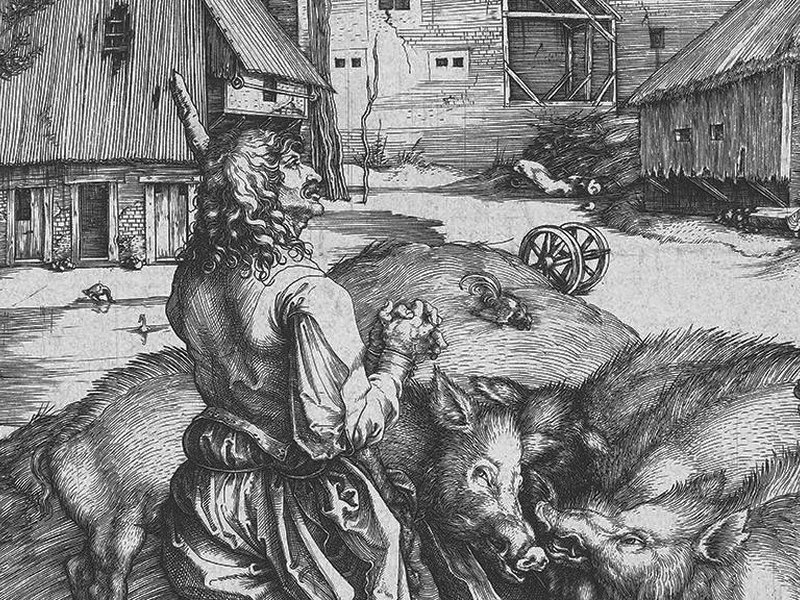
Perspectives on the Prodigal, (Part 2)

In the first essay on the parable of the Prodigal Son, I suggested that the problems commentators and others encounter in interpreting Jesus three-part parable are not accidental. These are not just problems in our ignorance of cultural background. They are intentional features of the stories —stories designed to poke…

by Ralph Allan SmithJuly 11, 2019
durer-prodigal-son-2
Luke

Perspectives on the Prodigal, (Part 1)

The story of the Prodigal Son is perhaps the most well-known story in the Bible. As others have observed, it may also be one of the most misunderstood. In two short essays, I will point out features of this story that are commonly neglected, aspects of Jesus’ parable that might…

by Ralph Allan SmithJuly 9, 2019
de-rijke-man-en-de-arme-lazarus-by-jacopo-da-ponte-16th-century
Luke

Lazarus and the Rich Man

The parable of Lazarus and the nameless rich man is not an independent story. It is part of a long context that begins in Luke 15:1, where Jesus is eating with tax collectors and sinners and the scribes and Pharisees grumble. In response to their hardheartedness, Jesus tells a three-part…

by Ralph Allan SmithJuly 4, 2019
aaron-burden-uynrnfdkjwg-unsplash
Luke

Everybody has Dropsy - Luke 14:1-24

The Bible is written so that even when a reader cannot pick up on what might be deeper or more detailed aspects of a text, there is virtually always a message to be heard. In the ancient world, where the “reader” of Scripture would likely be a church official facing…

by Ralph Allan SmithJuly 2, 2019
communion
Biblical Theology

Fruit Trees and Grain Plants

The distinction between garden (or vineyard) and field begins in Genesis 2. This relates to the ordering of the formless world. Plants of the field are contrasted with the garden planted by God in Genesis 2:5&8. Later on, under the Old Covenant the Israelites will be required to keep their…

by James B. JordanJune 27, 2019

Showing page 77 of 309

See all

Showing page 6 of 43

See all
Theology

Christ and Radical Orthodoxy

The papers in the seminar on the recent Duke publication Theology and the Political: The New Debate were dense, difficult, and hard to follow. And then Graham Ward got up and said, essentially, that the whole point of Radical Orthodoxy was to start with Christ; all the philosophical apparatus arises…

November 21, 2006

Feminine city

Chrisi Maier gave an interesting paper on the feminine conception of space in Lamentations. Jeremiah speaks of Jerusalem in turn as widow, as violated virgin, and as mother bereft of children. There is an intriguing asymmetry between these three images. The first two have an obvious literal referent: The city…

November 21, 2006

Structure of Hebrews

Gabriella Gelardini of the University of Basel gave an excellent presentation on the structure of Hebrews, defending this basic chiasm: A. Elevation and Abasement of the Son, 1:1-2:18 (terminology: son, angels, abase) B. Faithlessness of fathers and sons, 3:1-6:20 C. New Covenant and the cult, 7:1-10:18 B’. Faith of sons…

November 19, 2006
Philosophy

Skeptical theism

One of Wright’s respondents argued for what he called a “skeptical theism” with regard to the problem of evil. The main points are: 1) We don’t have the cognitive equipment to figure out whether God intends to achieve goods that are morally sufficient to justify His permission of evil. When…

November 19, 2006

Prelapsarian carnivores

In a discussion of NT Wright’s new book on evil, the question of pre-fall carnivores came up. Both Wright and his respondent basically agreed that animals killed and ate other animals before the fall, and that this was not incompatible with Yahweh’s judgment that this was “very good.” But both…

November 19, 2006

Isaac and Saul

I don’t recall now if I noticed the connections between Isaac and Saul in 1 Samuel. Isaac abuses his divinely favored son Jacob; Saul abuses his son-in-law David. Isaac preferred Esau, the eldest, to the second son; Saul prefers Jonathan to David. One of the key discontinuities is Jonathan’s behavior.…

November 19, 2006

Showing page 1760 of 2212

Browse by Category

In Medias Res

Your weekly digest for all things Theopolis.

Donate

Theopolis is nearly 100% donor-supported. Consider joining us on our mission.