Theopolis Logo

Writing

Explore our collection of theological essays, biblical studies, and reflections on faith and culture.

See all
screenshot-2023-07-27-at-10-25-35-am
Federal Vision

Zacharias Ursinus & the Imputation of Christ’s Righteousnes

While I think Zacharias Ursinus’ thinking would be profitable to consider, I am not recording his reflections in order for readers to come to agreement with his position as a whole. Rather, my interest is twofold. First, I think the way the Heidelberg Catechisms is used as a “proof” of…

by Mark HorneJune 5, 2006

karsten-wurth-imegmbunara-unsplash
Covenant

Does the New Covenant have its own distinctive sanctions as well as blessings? We affirm

On this question Hebrews 10 is quite clear and really needs no additional argument. For if we go on sinning deliberately after receiving the knowledge of the truth, there no longer remains a sacrifice for sins, but a fearful expectation of judgment, and a fury of fire that will consume…

by Mark HorneMay 21, 2006
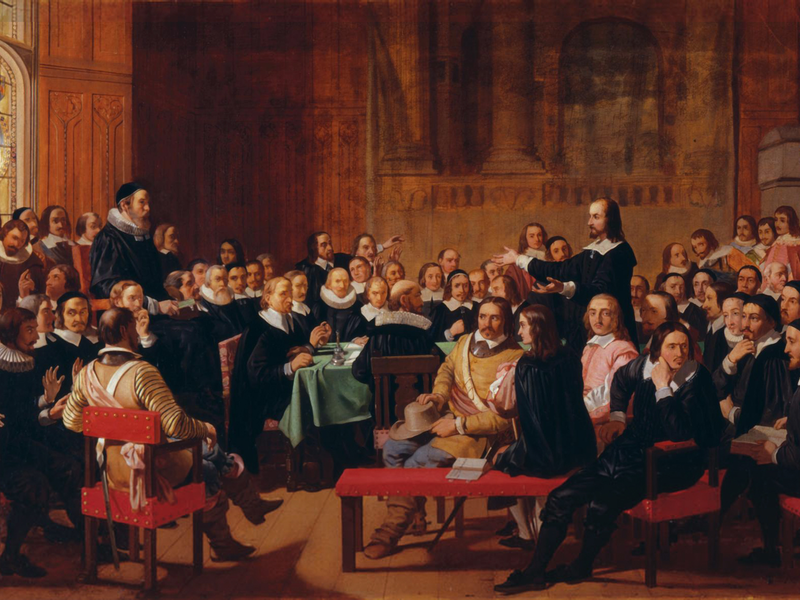
assertion_of_liberty_of_conscience_by_the_independents_of_the_westminster_assembly_of_divines_1644
Biblical Horizons

FV, NPP, PCA, AAPC, ETC.

Not all readers of this essay letter may be aware of it, but a tempest has been brewing in the Presbyterian Church in America (PCA), a tempest created by the liberal party in that denomination. It came about this way. In January 2002, a Pastor’s Conference on covenant theology was…

by James B. JordanAugust 5, 2005
screenshot-2023-09-18-at-12-32-26-pm
Biblical Horizons

The Closing of the Calvinistic Mind

Once upon a time there was such a thing as Calvinistic thought. It existed when I was younger, but seems to have largely disappeared in recent years. But let me elaborate. When I became a Calvinist, back in 1970, I bought a bunch of books. Over the next few years,…

by James B. JordanAugust 5, 2005
kelly-sikkema-ggs0_g6wi-i-unsplash
Ephesians

The Centrality of Preaching

CHRIST THE PREACHER How Ephesians Shows Us Why Preaching is Essential to Salvation & Sanctification Listen to me, O coastlands, and give attention, you peoples from afar. The Lord called me from the womb, from the body of my mother he named my name. He made my mouth like a…

by Mark HorneJune 5, 2005
screenshot-2024-04-04-at-4-49-39-pm
Baptism

Baptismal Theology Within Reformed Evangelicalism

Tracking the informal shifts in Protestant opinion regarding Baptism can be a difficult business. For example, in 1849 Anglican clergyman William Goode published his defense of Evangelicalism against the Anglo-Catholics under the title, The Doctrine of the Church of England as to the Effects of Baptism in the Case of…

by Mark HorneMay 29, 2005

Showing page 221 of 309

See all

Showing page 6 of 43

See all
Literature

The Politics of Playing

Plays might be promoted as a kind of opiate of the masses: Mass entertainment that keeps them from more violent entertainments like rioting and pillaging. This could be problematic, if the entertainments were too heady for most people to follow. Thomas Heywood (1612) suggested that playwrights should “ayme . .…

September 28, 2006
Literature

Shakespeare regulated

How regulated was Shakespeare’s own theater? And for what reasons? Patterson highlights various reasons for closing or permitting theaters: audience composition, including the fear that a large collection of workers might be distruptive; public health; economic concerns; religious and moral concerns, especially Sabbatarian; and “a shifting and elusive imperative to…

September 28, 2006
Literature

American Shakespeare

Shakespeare’s fortunes in the US were, understandably, different from in England. Initially, Shakespeare was America’s most popular playwright, appealing to a wide sector of the American populace. Patterson notes that “by the end of the nineteenth century ‘Shakespeare’ had become a cultural icon, the property only of the ‘legitimate theater,’…

September 28, 2006
Literature

Popular Shakespeare

Annabel Patterson notes ( Shakespeare and the Popular Voice ) that contemporary critics, whatever their own political outlook, assume that Shakespeare was an advocate of Elizabethan hierarchy. This view, however, is a product of the 19th century. Dryden, Johnson, and others criticize Shakespeare for violating the conventions of his genre,…

September 28, 2006
Literature

Courtly Shakespeare, IV

By the 18th century, acting styles also invested Shakespeare with “courtly” virtues of control, dignity, stateliness. Dobson writes, “Shakespearian acting . . . in the decades following Betterton’s death in 1710, seems to have settled into a grandiloquent vein of static declamation, best exemplified by the stout James Quin (1693-1766)…

September 28, 2006
Literature

Courtly Shakespeare, III

Dobson again: “after Charles II’s death in 1685 England would never again have another monarch with such an informed interest in the drama (or, mercifully, such a lascivious one), and deprived of royal patronage and protection the playhouses came under renewed attack from the moralists (led by the redoubtable clergyman…

September 28, 2006

Showing page 1785 of 2212

Browse by Category

In Medias Res

Your weekly digest for all things Theopolis.

Donate

Theopolis is nearly 100% donor-supported. Consider joining us on our mission.