Theopolis Logo

Writing

Explore our collection of theological essays, biblical studies, and reflections on faith and culture.

See all
sixteen-miles-out-al48tflf4e8-unsplash
James

Future Justification to the Doers of the Law

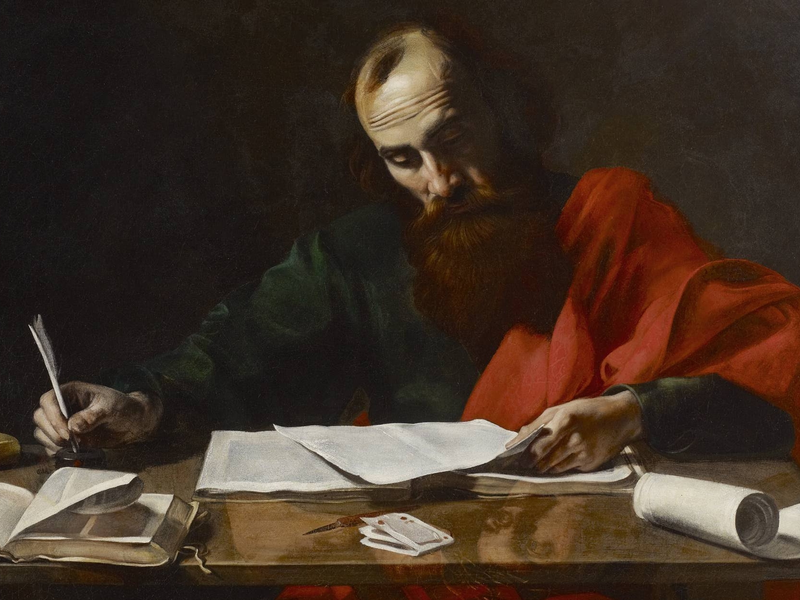
Keeping the Law Paul states just as emphatically as James that the doers of the law will be justified (Rom. 2:13; James 2:14ff). But who are these doers of the law? Is Paul speaking hypothetically of a class of sinless people who do not really exist? Or does he have…

by Mark HorneApril 21, 2003
13071-probablyvalentindeboulogne-saintpaulwritinghi-1
New Perspective on Paul

A Quickie Evangelical Introduction to the So-Called “New Perspective on Paul”

I have entitled this super-condensed piece to capture interest, but the fact is it sets forth what I have believed and taught long before I had ever heard of the so-called “new perspective.” For example, one can look at my paper on Ephesians 2.15 , written before I had ever…

by Mark HorneApril 5, 2003
aaron-burden-qjdzyt_k8xg-unsplash
Justification

The Tenses of Justification

N. T. Wright and other “New Perspective on Paul” (NPP) theologians have been criticized and condemned for speaking of justification in various “tenses.” In fact, Wright typically begins discussions of justification with future justification and works his way back to the present. But this is hardly a novelty. While the…

by Rich LuskMarch 24, 2003
sixteen-miles-out-d40gdcd_-he-unsplash
Romans

Faith & Faithfulness in Paul’s Letter to the Romans & the Obedience of the Nations

A doctrine of “faith alone” must be explicated and lived out in the light of the larger story of faithfulness, a story that reaches its climax in Jesus, the faithful Messiah. Indeed, the idea of “faith alone,” and even Paul’s use of the OT in service of that idea, makes…

by Mark HorneMarch 21, 2003
stephen-radford-86qxyjwq8lu-unsplash
How to Worship

The Role of Preaching in the Covenant Renewal Liturgy

In every city in the United States there are at least a couple of Christian radio stations which broadcast preaching around the clock, seven days a week. Many areas have a Christian television station or two which broadcast worship services several hours a day. Almost any bookstore will have a…

by Duane GarnerMarch 21, 2003
greg-rakozy-ompaz-dn-9i-unsplash-2
Justification

Trustworthy Precepts

The queston has been discussed: which is prior, faith or repentance? It is an unnecessary question and the insistence that one is prior to the other is futile. There is no priority. The faith that is unto salvation is a penitent faith and the repentance that is unto life is…

by Mark HorneMarch 7, 2003

Showing page 235 of 309

See all

Showing page 6 of 43

See all
History

Modernity and antiquity

Kumar suggests that “some of the principal hall-marks of modernity” are already evident in the Christian notions of time and history. Both Christianity and modernity separate time from nature, and humanize time; time is seen by both as “linear and irreversible”; both see history as an Aristotelian drama with beginning,…

February 24, 2006
History

First Modernity

The Latin modernus was coined in the late fifth century, as an antonym to antiquus , and variations of modernus became particularly common after the 10th century. Thus, Krishan Kumar writes, “Modernity is . . . an invention of the Christian Middle Ages,” and was used to emphasize the radical…

February 24, 2006
Philosophy

Computer Communications and the Self

Poster lists four effects that computer communications (email, chat groups, etc) have on the self: “1 they introduce new possibilities for playing with identities; 2 they degender communications by removing gender cues; 3 they destabilize existing hierarchies in relationships and re-hierarchize communications according to criterio that were previously irrelevant; and…

February 24, 2006
Philosophy

Computers, subjects and objects

Descartes famously contrasted the mind (res cogitans) with the external world (res extensa), but Mark Poster suggests that computer writing fudges that distinction: “the computer dematerializes the written trace. As inputs are made to the computer through the keyboard, pixels of phosphor are illuminated on the screen, pixels that are…

February 24, 2006
Media

Community and New Communications

Mark Poster points to a tension between the modern institutions of production and the postmodern technologies of communication, particularly as they impact the formation of the self: “If modernity or the mode of production signifies patterned practices that elicit identities as autonomous and (instrumentally) rational, postmodernity or the mode of…

February 24, 2006
Media

Telephone

Prior to World War I, Telefon Hirmondo, the telephone system of Budapest, was used as a broadcast system, with a published schedule of programs that were restricted to certain classes of people in Hungary. Only later did it develop into a communications system in which everyone could pass information to…

February 24, 2006

Showing page 1878 of 2212

Browse by Category

In Medias Res

Your weekly digest for all things Theopolis.

Donate

Theopolis is nearly 100% donor-supported. Consider joining us on our mission.