Theopolis Logo

Writing

Explore our collection of theological essays, biblical studies, and reflections on faith and culture.

See all
little-girl
Children

Honor God With Your Body

I am making a new rule in our house! We are actually kind of skimpy on the house rules. I try very hard to keep things simple: love God, love others, be joyful. It’s not complicated to avoid discipline here. But I have found myself repeating this new rule over…

by Lindsey TollefsonApril 9, 2015
giotto-noli-me-3
John

The Gardener and the Beloved, (Part 3)

Click HERE for Part 2 The voice of Jesus transforms and changes Mary when she hears him speak her name. This is her last “turning.” So also the woman in the Song of Songs longs to hear the voice of her beloved. Let me see your face, let me hear…

by Jeff MeyersApril 6, 2015
giotto-noli-me-2
John

The Gardener and the Beloved, (Part 2)

Click HERE for Part 1. The details of this story call the attentive reader back to the drama of Solomon’s Song of Songs. And the Song of Song’s alludes to, ties us into the story of Adam and Eve in the Garden and the promise of a coming Messiah that…

by Jeff MeyersApril 4, 2015
easter-term-2015-2
Theopolis News

Easter Term, 2015

“The course was a paradigm shift for me,” said Jonathan Sedlak, a Milwaukee electrical contractor who attended Theopolis’s course on Revelation. “I am left with a book that is far more practical than it has ever seemed before.” Jonathan Anderson of Louisville, Kentucky found the course “refreshing.” “I finished with…

by TheopolisApril 2, 2015
psalm-singing
Genesis

Worship as Response: Liturgical Logic, (Part 1)

“It is only by participation in a rational, practice-based community that one becomes rational.” – Alasdair MacIntyre It may be perfectly clear to a chef why adding unsifted powdered sugar to a hot frosting is a bad idea. But for an amateur cook, this may be the kind of rule…

by Jonathan BarlowApril 2, 2015
giotto-noli-me
John

The Gardener and the Beloved, (Part 1)

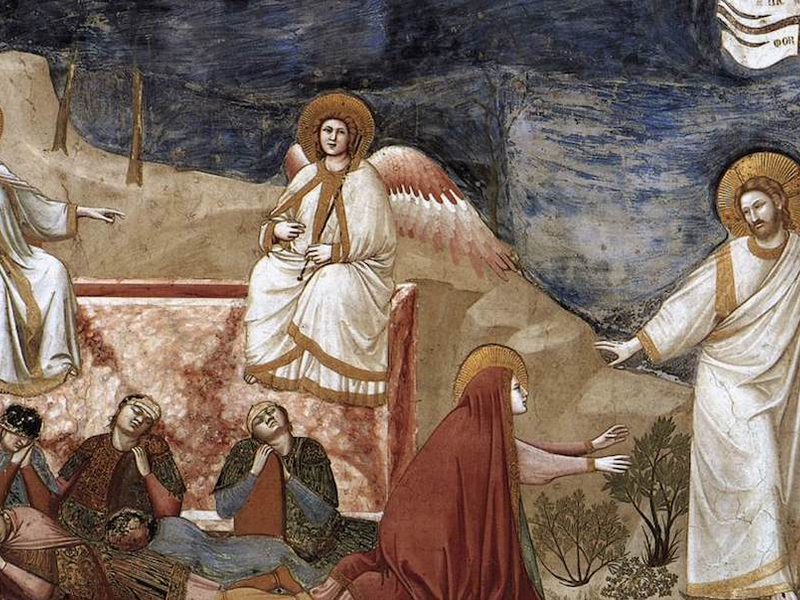
On a fresco in a chapel in Padua, Italy, there is a famous painting depicting the dramatic post-resurrection scene in John 20 with Mary and Jesus outside of the garden tomb. Giotto di Bondone painted it in the early 14th century. Jesus is striding from the tomb with a victor’s…

by Jeff MeyersApril 1, 2015

Showing page 156 of 309

See all

Showing page 6 of 43

See all

Kolb on Luther and Chemnitz, Revisited

A perceptive Lutheran reader asked whether I was endorsing an antinomian position in my favorable summary of Kolb’s article on Luther and Chemnitz. He pointed out that Kolb’s position relies on an illegitimate separation of God and His Law, and argued that instead the Law should be seen as an…

February 14, 2005

Eucharistic Meditation, First of Lent

?And the ravens brought him bread and meat in the morning, and bread and meat in the evening, and he would drink from the brook.?E In this morning sermon, we saw how the writer of Kings highlights the authority of Elijah and His power. He speaks, and the heavens become…

February 13, 2005

Exhortation, First of Lent

So what? So what if Jeroboam made golden calves and worshiped them at Dan and Bethel? So what if the house of Jeroboam was destroyed by Baasha, and the house of Baasha destroyed by Zimri, and Zimri destroyed by Omri, and the house of Omri destroyed by Jehu? What does…

February 13, 2005

Philosophy and Self-Justification

Alain de Botton notes in his book Status Anxiety that many societies see a direct relationship between reputation and self-image. If others hold me in contempt, then I must either defend myself against their contempt or accept their contemptuous assessment. Philosophy introduces a mediator, reason, which assesses and judges reputation…

February 11, 2005

The Village

I finally watched The Village . Much of it was perfectly silly. The initial explanation of the dead animals littering the village is that a coyote is on the loose, and this theory is put to rest only when it’s decided that coyotes are not big enough to leave big…

February 11, 2005

Chemnitz and Luther

Robert Kolb offers this helpful analysis of the differences between Luther and Chemnitz on justification: “Luther understood justification as the execution of the wages of sin . . . upon sinners and their simultaneous resurrectionto new life in Jesus Christ . . . . Chemnitz did not pursue this aspect…

February 10, 2005

Showing page 2007 of 2212

Browse by Category

In Medias Res

Your weekly digest for all things Theopolis.

Donate

Theopolis is nearly 100% donor-supported. Consider joining us on our mission.