Theopolis Logo

Writing

Explore our collection of theological essays, biblical studies, and reflections on faith and culture.

See all
800124htsdl
Authority

The Restrainer

When Samuel saw Saul, Yahweh answered him, "Behold, the man of whom I spoke to you! This one will restrain My people" (1 Samuel 9:17) Many English versions of 1 Samuel 9:17 read, "This one will rule over My people," but that is a mistranslation. The Hebrew verb is `atsar…

by James B. JordanDecember 4, 1992

screen-shot-2022-05-12-at-12-07-23-pm
Acts

Chronology of the Gospels

We have arrived at the tentative date of A.M. 3474 for the decree of Cyrus, and we have determined to operate as if the 70 weeks of Daniel 9 are literal years. We also decided that Messiah the Prince arrives at the beginning of the 70th week, after the 69…

by James B. JordanDecember 4, 1992
alex-shute-oz2yqcaszw-unsplash
Biblical Studies

The Dramatic Structure of Proverbs

The book of Proverbs appears as a largely random collection of aphorisms drawn from experience saturated in law. Despite its random arrangement, however, the book does have an over-arching structure that reinforces its main themes. One way to gather clues regarding the structure of a biblical book (or any book)…

by Peter LeithartNovember 17, 1992
sincerely-media-bhaswrjttzw-unsplash-2
Leviticus

Leviticus 27

I recently had the privilege and pleasure of reading the first draught of Gary North’s Economic Commentary on Leviticus , which will be out some time next year. Gary’s comments on Leviticus 27 were stimulating, and caused me to take another look at the passage. The results, which I sent…

by James B. JordanNovember 4, 1992
venice-la-distruzione-del-tempio-di-gerusalemme-francesco-hayez-gallerie-accademia-venice
Daniel

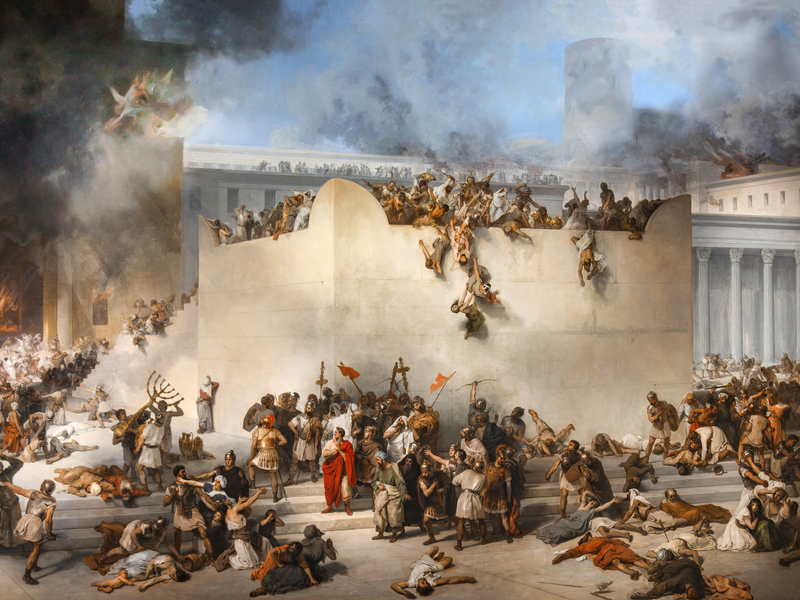
Bridging the Last Gap: Daniel’s Seventy Weeks Revisited

As we have seen in this series, each time there is a new covenant, there is a break in the year-by-year chronology. At the same time, each time the break is crossed by information provided in the text. Thus, the year-by-year chronology breaks down at the birth of Abraham, but…

by James B. JordanNovember 4, 1992
europeana-h-4wme4eooo-unsplash
Art

The Openness of Literature & the Mystery of Art

The Openness of Literature Let’s discuss literature for a moment. There are two ways a story or novel can close. The first is called poetic justice. When a story ends with poetic justice, the bad guys are all punished and the good guys are all rewarded. This kind of story…

by James B. JordanNovember 4, 1992

Showing page 287 of 309

See all

Showing page 6 of 43

See all

Augustinian Optimism and Modern Science

P eter Harrison points out in his The Fall of Man and the Foundations of Science (10–11) that the Reformation coincided with the rediscovery of ancient skepticism. While the Reformers were undermining traditional Catholic sources of authority from one side, Montaigne and others were corroding certainty from the other. Descartes…

December 12, 2016

Apocalypse Preserved

Karl Shuve's contribution to Apocalypses in Context traces the Christian use of Jewish apocalyptic, especially of the Book of the Watchers from 1 Enoch, which even makes it into the universal canon of the New Testament (Jude). The Watcher story appears in Justin, who “blames ‘every evil' on the Watcher…

December 9, 2016

Constructing Modernity

Thomas Fabisiak wonders, What does the New Jerusalem have to do with modernity? ( Apocalypses in Context ). Ask most modern philosophers, and the answer will be, Not much. Fabisiak speaks of the “'rhetorical construction' of modernity” that takes the form of a dismissal or expulsion of apocalyptic and all…

December 9, 2016

Chess and Soviet Man

In a 2011 New Yorker profile of Norwegian chess champion Magnus Carlsen, D.T. Max digresses to explain the logic behind the Soviet interest in chess: “Lenin, an enthusiastic player, made the game a priority for the new nation. In 1920, Alexander Ilyin-Zhenevsky, a commissar of Soviet chess, wrote that chess,…

December 9, 2016

Erotics of Reading

In the middle stanzas of “Erotikos Logos,” watching someone else reading, Scott Cairns ( Slow Pilgrim , 278) writes, “So much, of course, depends upon your own willingness to find something worthy here, even as you bring - as you must - something worthy to the effort. So much of…

December 9, 2016

From Polemic to Propaganda

Andrew Pettegree ( Reformation and the Culture of Persuasion ) observes a shift in rhetorical tone in Protestant-Catholic debates between the early and mid sixteenth century: “While much of the polemical writing of Luther’s day was rumbustious in tone, making liberal use of ridicule and ad hominem attacks, it still…

December 9, 2016

Showing page 224 of 2212

Browse by Category

In Medias Res

Your weekly digest for all things Theopolis.

Donate

Theopolis is nearly 100% donor-supported. Consider joining us on our mission.