Theopolis Logo

Writing

Explore our collection of theological essays, biblical studies, and reflections on faith and culture.

See all
kristina-flour-bcjdbykwquw-unsplash
Culture

On Foul Language

The Stranger: Do you have to use so many cuss words? The Dude: What the f*ck you talking about? - The Big Lebowski There was a man I knew, an elder at his church, who, whenever he was called upon to announce a pregnancy, preferred the euphemism “with child” because…

by Remy WilkinsJanuary 12, 2016

organ-pipes
How to Worship

Pipes Worth Playing

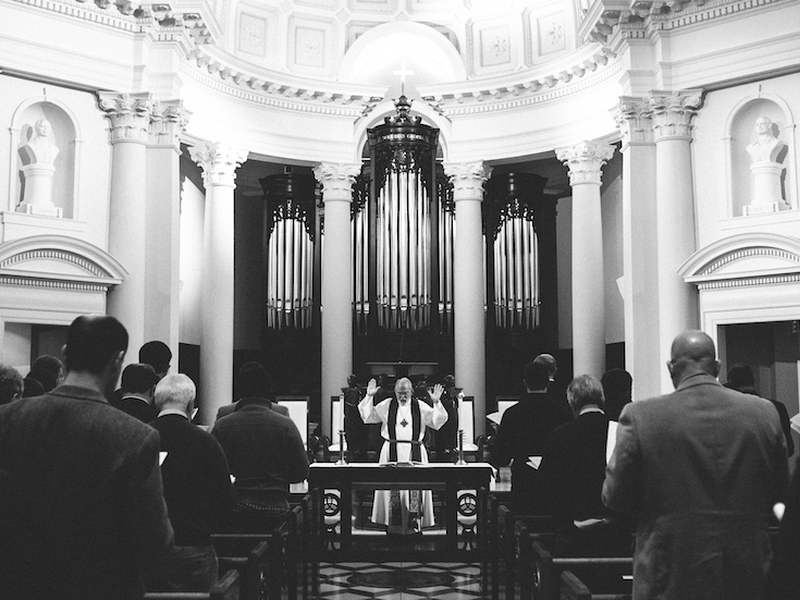
I know what you’re thinking. Organ: funeral, ball game, grand dusty cathedral. Why should modern Christians of such a technological age revisit a thousand year-old instrument? Don’t worry, I will not be trying to punch another hole in my Weird Music Preferences and Opinions card here. The truth is, our…

by Jarrod RicheyJanuary 7, 2016
tree-2
James

Do Things Have Natures?

Do things have natures? As I am posing the question, it is not simply a question of whether there are particular kinds of things in the world that have characteristic features, patterns of behavior, trajectories of growth and development. If that is what the word means, then the answer is…

by Peter LeithartJanuary 5, 2016
jim-leading-worship
Theopolis News

2016 Nevin Lectures with Father John Behr

We are excited to announce our 2016 Nevin Lectures featuring Father John Behr. Fr. John is the Dean of St. Vladimir's Seminary and Professor of Patristics, as well as the author of multiple works. He will be delivering three lectures over the course of two days dealing with "What Protestants…

by Brian MoatsJanuary 4, 2016
times-square
Creation

Time, Curse or Gift?

New Year's Day makes one reflective, at least about the past year, perhaps about life, perhaps, more broadly, about time itself. Many view time as a curse. Some see it as a curse because of missed chances. As one day or year moves on to the next, all we can…

by Peter LeithartDecember 31, 2015
nativity-2
Advent

The Manger

It seems a truism to say that we live in the world: that the world is outside of us. In reality the world is very much inside of us too. In fact the world passes through us as much as we pass through it. We breathe in its air, using…

by Arthur KayDecember 29, 2015

Showing page 138 of 309

See all

Showing page 6 of 43

See all

Economics and Work

Modernity, especially as theorized in modern economics, treats work as "instrumental to the acquisition of goods" (Stephen Marglin, The Dismal Science , 44). Modernity "closes off thinking of hard work as something other than drudgery" (43). As a counterpoint, Marglin calls attention to work in Amish communities: "In physical terms,…

March 23, 2018

Greater Father?

"The Father is greater than I," says Jesus (John 14:28). Eunomius uses this to prove the ontological interiority of the Son. Basil of Caesarea rejects that reading, of course. But his way of rejecting it is worth attending to. He doesn't claim that Jesus is talking about His inferiority as…

March 23, 2018

Secularization Theory As Contestant

Ian Hunter argues that "secularization" as "transition from divine reverencing to rational autonomy" didn't happen during the centuries after Reformation. Confessional Christianity didn't disappear but was more deeply entrenched during that time. "Secular" referred not to the imposition or incursion of rational atheism but to the formation of purely political…

March 22, 2018

Simplicity’s Not So Simple

Is God simple? Christian theologians from the Cappadocians to Aquinas and beyond said Yes. But we need to probe this consensus: Did they mean the same thing by saying Yes? Andrew Radde-Gallwitz says No ( Basil of Caesarea, Gregory of Nyssa, and the Transformation of Divine Simplicity ). What is…

March 22, 2018

Confessionalization v. Secularization

In a debunking paper on "secularization" and the "secular," Ian Hunter argues that "nobody in early modernity spoke of secularization in terms of a transition from divine reverencing to rational autonomy, but also that there is no evidence of such a transition taking place there and, further, that there is…

March 21, 2018

Disdain for Lesser Talent

Richard Spady's eye-opening piece in First Things examines the consequences that follow when economics becomes an ideology, that is, when economics "will­fully projects its own first principles on its subject matter and actively seeks, perhaps unconsciously, material changes to bring social realities into conformity with these first principles." He offers…

March 20, 2018

Showing page 84 of 2212

Browse by Category

In Medias Res

Your weekly digest for all things Theopolis.

Donate

Theopolis is nearly 100% donor-supported. Consider joining us on our mission.